
Lion Capital of Ashoka
The Lion Capital of Ashoka is the capital of a column erected by the Mauryan emperor Ashoka at Sarnath, India, after his conversion to Buddhism. Carved from a single block of highly polished sandstone, it features four life-sized lions seated back to back on a drum-shaped abacus. The abacus is decorated with relief wheels and four animals—a lion, elephant, bull, and galloping horse—moving from right to left, above a bell-shaped lotus base. Excavated by the Archaeological Survey of India in 1904–1905, it is now displayed in the Sarnath Museum, near the original site. The sculpture is significant for its Buddhist and secular symbolism and later inspired India’s national emblem and the wheel in the national flag.
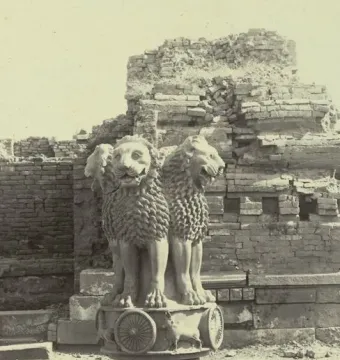
1905 © Madho Prasad, c.1905 . · Public domain
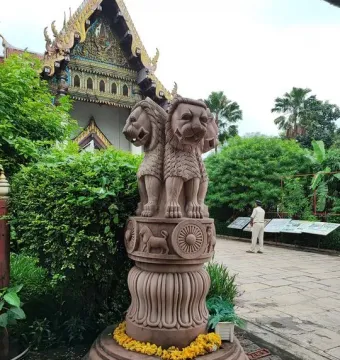
October 2023 © Sumitsurai · CC BY-SA 4.0
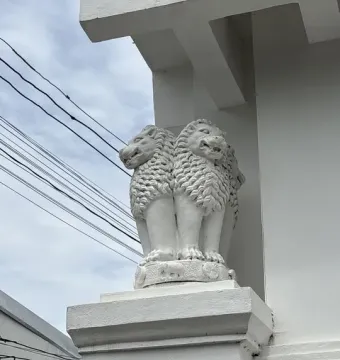
July 2026 © Chainwit. · CC BY 4.0
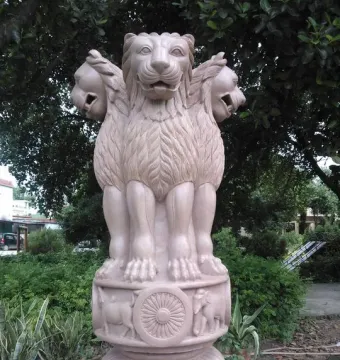
August 2012 © Bhupesh arya · CC BY-SA 4.0
September 2022 © Kevin Standage · CC BY 2.5
Identification | |
| Title | Lion Capital of Ashoka |
| Type | Mauryan pillar capital |
| Alternative names | Lion Capital of Asoka; Ashoka Pillar capital; Capitello do Leão de Açoca ou Asoca |
| Original-language name | Ashokastambham |
Historical context | |
| Date | c. 250 BCE |
| Period | Mauryan period; 3rd century BCE |
| Original setting | Sarnath, an important Buddhist site and religious center |
| Historical significance | Among the first major groups of Indian stone sculpture after the end of the Indus Valley Civilisation |
| Artistic significance | One of the first existing visual portrayals of lions in South Asia |
| Cultural context | Made in an empire and period in which ideas and technologies were in flux |
Creator | |
| Commissioned by | Emperor Ashoka |
Discovery and provenance | |
| Current relation to original site | Displayed in a museum near the excavation site; the pillar remains at the original site |
| Current location | Sarnath Museum, Uttar Pradesh, India |
| Historical references | Mentioned by Faxian in the early 5th century and Xuanzang in 629–645 CE |
| Excavation date | Winter 1904–1905 |
| Excavated by | Archaeological Survey of India; directed by F. O. Oertel |
| Discovery context | Found buried with the stump and fragments of the Ashokan pillar |
| Associated monument | Ashoka's pillar |
| Original location | Top of Ashoka's pillar at Sarnath |
| Discovery location | Sarnath, west of the Main Shrine, near the Jagat Singh stupa |
Physical characteristics | |
| Height | 2.15 metres including the base |
| Form | Capital with four life-sized lions on a drum-shaped abacus above a bell-shaped lotus base |
| Lions | Four back-to-back lions, life-sized |
| Abacus | Circular, drum-shaped slab |
| Lower member | Bell-shaped lotus |
| Condition after excavation | Better preserved than the pillar, but cracked across the neck above the lotus and with damage to two lions' heads and jaws |
Materials | |
| Eye treatment | The lions originally had precious stones set in their eye sockets, held by iron pins |
| Material | Single block of sandstone |
| Attachment method | Secured to the pillar by a metal dowel |
| Surface finish | Highly polished |
Technique | |
| Construction | The capital was carved as a separate piece from the pillar |
| Polish technique | The sandstone may have been polished by heat and a fine abrasive or wood |
Appearance | |
| Lions arrangement | Set back to back, joined at the shoulders |
| Abacus decoration | A frieze in relief of an elephant, horse, bull, and lion, separated by four 24-spoked wheels |
| Surmounting wheel | A larger wheel originally surmounted the capital but survives only in fragments |
| Other details | The lions have open mouths and were oriented toward the cardinal directions |
Iconography and meaning | |
| Wheel symbolism | Interpreted as the Buddhist dharmachakra, a symbol of ethical rulership, or a chariot wheel with 24 spokes |
| Alternative interpretation | The four lions may relate to the Four Noble Truths of Buddhism |
| Lotus symbolism | Interpreted as a stylized lotus, an Indo-Persepolitan bell, or a purna-ghata motif |
| Four animals symbolism | Often linked to events in Prince Siddhartha's life, or interpreted as the cardinal directions, the four rivers from Lake Anavatapta, or the four dangers of samsara |
| Lions symbolism | Interpreted as symbols of the Buddha, royal prowess, sovereignty, or the Buddha's message proclaimed to the cardinal directions |
| Symbolism | Associated with Buddhism, the Buddha, and secular royal authority; meanings of the lions, animals, wheels, and lotus are debated |
Location and ownership | |
| Associated site | Sarnath |
| Replica | A replica of the Sarnath pillar and capital stands at Wat Umong near Chiang Mai, Thailand |
History and restoration | |
| Excavation condition | The capital was found broken and damaged; the heads of two lions had come off before burial and were reattached during excavation |
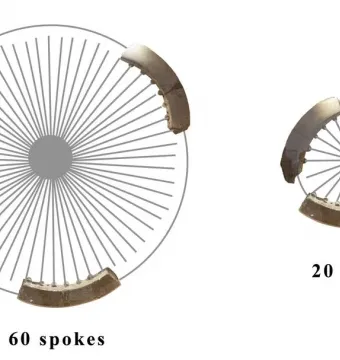
| Wheel fragments | Four small fragments of the wheel were found; thirteen spokes survive on the fragments |
| Museum display | Displayed at the Archaeological Museum Sarnath since 1910 |
| Museum significance | The first site museum of the Archaeological Survey of India |
Significance | |
| National emblem | A graphic representation was adopted as the Emblem of India in 1950 |
| National flag | The Ashoka Chakra based on the wheel was used in the center of the Indian national flag |
| National motto | When used by state authorities, the emblem is accompanied by the motto Satyameva Jayate ('Truth alone triumphs') in Devanagari under the Indian State Emblem Act of 2005 |
| Comparative context | Compared with Persepolitan and Achaemenid capitals, other Ashoka pillar capitals, and similar four-lion capitals at Sanchi |