
Bust of Nefertiti
Bust of Nefertiti is one of the best-known works of Amarna art and ancient Egyptian sculpture. Discovered on 6 December 1912 at Tell el-Amarna during Ludwig Borchardt’s excavations, it was found in the house of the sculptor Thutmose among other statues from Akhetaten. The bust was taken to Germany in 1913 and later donated to the Museum of the Ancient Near East in Berlin by James Simon. Made of limestone and covered with a painted gypsum-anhydrite layer, it shows the queen in idealized, highly symmetrical form. The left eye is missing, and the bust remains on display in the Neues Museum on Berlin’s Museum Island.
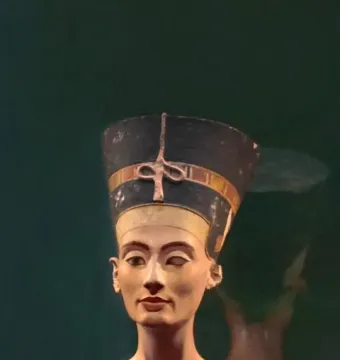
August 2017 © Jean-Pierre Dalbéra · CC BY 2.0
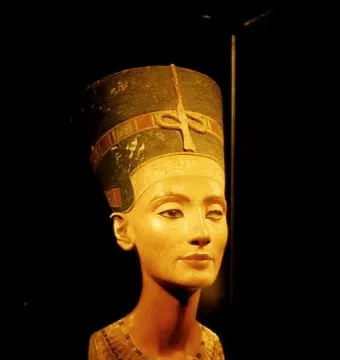
2002 © Витольд Муратов · Public domain
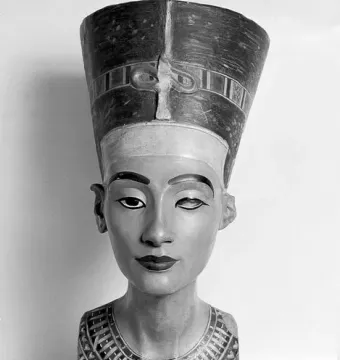
· CC BY 4.0
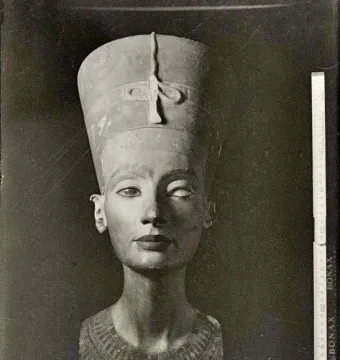
December 2012 © Photo-of-the-bust-of-Nefertiti-taken-1912-document-of-the-official-division-of-finds-©-Deutsche-Orient-Gesellschaft-DOG-Homa-Nasab-for-MuseumViews.jpg · CC BY-SA 4.0
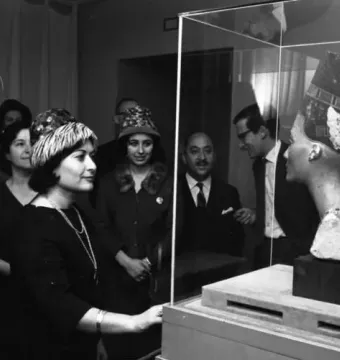
© Ludwig Wegmann · CC BY-SA 3.0 de
Identification | |
| Title | Bust of Nefertiti |
| Type | Painted stucco-coated limestone bust |
| Depicted subject | Nefertiti, Great Royal Wife of Pharaoh Akhenaten |
| Alternative names | Nefertiti bust; Head of Nefertiti; The Nefertiti Bust; the colorful queen ("Die bunte Königin"); simply "the Nefertiti" |
Historical context | |
| Dynasty | 18th Dynasty (New Kingdom) |
| Date of creation | c. 1345 BCE |
| Associated ruler | Akhenaten |
Creator | |
| Attributed artist | Thutmose (Totmes) |
Discovery and provenance | |
| Division of finds | Allocated to the German side in the 20 January 1913 division of finds |
| Ownership basis claimed by Germany | An official protocol signed by the German excavators and the French-led Egyptian Antiquities Service |
| Repatriation dispute | Egypt has demanded its return since 1924; Germany asserts ownership |
| First public display | 1924, in the Berlin Tell el-Amarna exhibition on Museum Island |
| Donation | 11 July 1920 James Simon donated it to the Free State of Prussia, transferring it from the long-term loan to the Egyptian Department of the Royal Prussian Art Collections |
| Early Berlin custody | Kept in James Simon's residence, then deposited in the Altes Museum in Berlin |
| Export and transfer | Export permit granted in 1913; brought to Berlin in 1913 |
| Find number | 748 |
| Original position at discovery | Apparently stood on a wooden wall shelf before falling when the shelf disintegrated |
| Condition at discovery | Largely intact |
| Excavation sponsor | German Oriental Society; financed by James Simon |
| Excavation leader | Ludwig Borchardt |
| Discovery context | Found during German Oriental Society excavations in Thutmose's workshop, together with numerous other sculptures |
| Discovery location | Tell el-Amarna, House P 47.2, room 19, workshop of Thutmose |
| Discovery date | 6 December 1912 |
Physical characteristics | |
| Dimensions | Not stated |
| Composition | Limestone base with gypsum-anhydrite / stucco coating |
| Surface treatment | Painted in six colors |
| Missing eye | Left eye socket is empty; the reason is disputed |
Appearance | |
| Stylistic characterization | Idealized, highly symmetrical portrait of the queen |
| Interpretation of appearance | Widely regarded as an ideal embodiment of female beauty; described as having a softness of treatment that gives it a sense of vitality |
Iconography and meaning | |
| Subject identification note | Identification with Nefertiti is considered correct because of the royal headdress, despite the lack of inscriptions |
Location and ownership | |
| Current owner | Prussian Cultural Heritage Foundation (Stiftung Preußischer Kulturbesitz) |
| Current inventory number | 21300 |
| Current location | Egyptian Museum Berlin, Neues Museum, Museum Island, Berlin |
| Current display location | Main hall / north dome hall of the restored Neues Museum |
| Current display date | Since 16 October 2009 |
| Previous display locations | James Simon's villa in Berlin-Tiergarten; West Berlin Dahlem branch of the State Museums; Egyptian Museum in Charlottenburg; Altes Museum; temporary display in the Old Museum and at the Kulturforum Berlin; later returned to the Neues Museum |
| War storage locations | Prussian State Bank vault in Berlin; Berlin anti-aircraft bunker (Flakturm); Merkers-Kieselbach salt mine; Reichsbank in Frankfurt am Main; US Central Collecting Point in Wiesbaden |
History and restoration | |
| Restoration / conservation note | German authorities stated the bust is too fragile for transport |
| Temporary 2005 display | Shown from 13 August 2005 in the Old Museum on Museum Island after the exhibition "Hieroglyphs around Nefertiti" at the Kulturforum Berlin |
| CT examination | First CT scan in 1992 at the Charlottenburg clinic of the Free University of Berlin |
| Move to Charlottenburg | Transferred to the new West Berlin Egyptian Museum in the Eastern Stüler Building on 10 October 1967 |
| Return to Berlin | Returned to West Berlin on 22 June 1956 |
| Postwar exhibition in Wiesbaden | Displayed from 12 May 1946 in the Landesmuseum Wiesbaden |
| World War II damage context | Neues Museum was destroyed in 1943 during RAF bombing of Berlin |
Significance | |
| Art-historical significance | One of the best-known works of Amarna art and ancient Egyptian art; considered a masterpiece of Amarna-period sculpture and portrait sculpture |
| Cultural significance | A cultural symbol of Berlin and ancient Egypt; Nefertiti has become one of the most famous women of the ancient world and an icon of feminine beauty |
| Historical significance | One of the most copied works of ancient Egypt and one of its best-known art treasures |
| Reception and fame | Its public display in Berlin caused sensation and admiration; Time magazine included it among the most valuable looted artifacts |
Other | |
| Authenticity doubts | Its excellent preservation, the ambiguous role of Borchardt, and the unexplained missing eye led to doubts about its authenticity; modern scientific knowledge rejects forgery theories |
| Forgery hypotheses | In the late 20th and early 21st centuries several researchers proposed that the bust was forged in 1912 |
| Acquisition context | At the time of excavation Egypt was a British protectorate; Egypt has also argued the removal was colonial looting and illegal |
| Borchardt controversy | Borchardt was suspected of concealing the bust's value; contemporary and later critics said he may have described it as a plaster model and hidden it from Egyptian inspectors |
| Quoted reaction by Borchardt | "Suddenly we had in our hands the most real and alive Egyptian masterpiece. You cannot describe it in words, you must see it." |
| Associated personage | Nefertiti is described as Akhenaten's beloved wife and mother of six daughters; some hypotheses identify her later as co-regent Neferneferuaten or as Ankhkheperure Smenkhkare |