
Lemnian Athena
Lemnian Athena, or Athena Lemnia, was a Classical Greek statue of the goddess Athena that stood on the Acropolis of Athens. Ancient writers such as Pausanias, Lucian, and Aelius Aristides mention the statue, and Pausanias attributed it to Pheidias and said it was dedicated by the people of Lemnos. Since the 1890s, the name has also been applied to a statue type showing Athena without a helmet and wearing an aegis across her breast. That type survives in Roman copies and imitations, including the Dresden and Bologna pieces used by Adolf Furtwängler to reconstruct the figure. His identification with Pheidias’s original remains influential but is still debated.
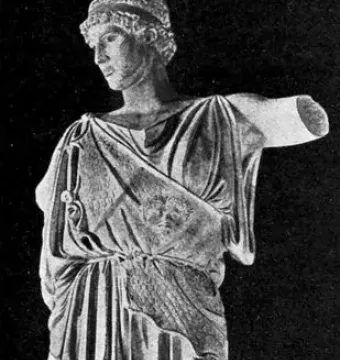
1909 © Paul Schumann (1855–1927) · Public domain
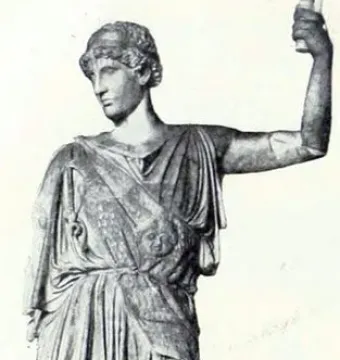
1911 © Georges Servières · Public domain
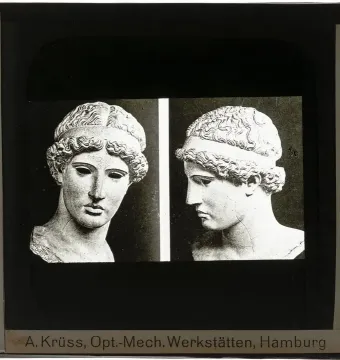
© Phidias (Greek sculptor, ca. 490-430 BCE) (artist) · Public domain
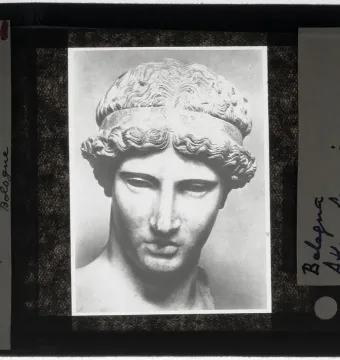
© Phidias (Greek sculptor, ca. 490-430 BCE) (artist) · Public domain
1896 © Rijksmuseum · CC0
Identification | |
| Title | Lemnian Athena |
| Subject | Athena |
| Alternative names | Athena Lemnia; Athena of Lemnos; Lemnia |
| Type | votive statue |
| Original-language title | Афина Лемния |
Historical context | |
| Date | c. 450–440 BC |
| Commissioned by | Athenians who had settled on the island of Lemnos |
| Dedication | an ex-voto / tribute to Athena |
| Ancient literary attestations | Mentioned by Pausanias, Lucian, Aelius Aristides, Pliny the Elder, and Himerius |
| Ancient reputation | Highly admired in antiquity |
| Ancient praise by Pausanias | Pausanias called it the most worth seeing / most remarkable and most beautiful of Phidias's works, and said the name Lemnia came from its donors |
| Ancient praise by Lucian | Lucian treated it as Phidias's outstanding work and said it was the goddess of Lemnos |
| Ancient praise by Aelius Aristides | Aristides praised it as an expression of unsurpassed technical mastery and incomparable aesthetic pleasure, ranking it after Zeus Olympios, Athena Parthenos, and Athena Promachos |
| Ancient reference to Pliny | Possibly alluded to by Pliny the Elder |
Creator | |
| Artist | Phidias |
| Attribution note | According to Pausanias, the statue was made by Phidias; some scholars have tentatively suggested Alkamenes instead, and the evidence for identifying the surviving type with Phidias's Lemnian Athena is not universally accepted |
Discovery and provenance | |
| Reconstruction history | Adolf Furtwängler reconstructed the type in 1891 from Roman marbles, especially the Dresden torso and the Bologna head; his reconstruction is now generally regarded as largely accurate in outline, though the identification with Phidias's original remains disputed |
| Alternative scholarly proposals | Some scholars linked the surviving fragments instead to the Athena Medici type, the Riace bronzes, or the Phidian victory monument at Delphi |
| Current status | Lost; the original is not preserved |
| Surviving evidence | Roman copies and related fragments in Dresden, Bologna, Kassel, Baia, Oxford, Toronto, and the Vatican Museums |
| Known from | Roman marble copies and free imitations, including heads and incomplete statues |
| Original location | the Acropolis of Athens, probably near the Propylaea, likely on an open pedestal at the northeast corner of the eastern facade |
Physical characteristics | |
| Original material | Probably bronze, though not securely known |
| Figure type | Classical Greek statue of Athena |
Appearance | |
| Iconography | Athena wearing a peplos and aegis, with a helmet in her right hand and a spear in her left; the aegis falls diagonally across her breast and may symbolize peace |
| Reconstructed pose | Absorbed and thoughtful, looking toward the object in her right hand |
| Stylistic features | Soft facial contours, harmonious nose, soft cheeks, symmetrical locks of hair with a taenia or broad band, and a Classical-period hairstyle |
| Possible right-hand attribute | Helmet, though some scholars have proposed an owl instead |
| Aegis details | Diagonally belted aegis with a Gorgoneion; in the reconstruction it has a scales pattern bordered by winding snakes |
| Surviving body details | Only the upper arms survive on the Dresden bodies; the left upper arm angles roughly horizontally away from the shoulder and the right upper arm probably hung down |
Location and ownership | |
| Modern reconstructions | Two complete reconstructions are preserved in the Albertinum Sculpture Collection / State Art Collections in Dresden |
| Reconstruction components | Dresden torsos acquired from the Chigi collection in Rome in 1728; one reconstruction used a Dresden marble head and the other a plaster cast of a Roman marble head in Bologna |
History and restoration | |
| Reconstruction method | Furtwängler combined heads and torsos and added the arms and attributes to produce an almost complete conjectural prototype |
| Scholarly debate | Furtwängler's reconstructions and identifications were criticized and questioned, though they remain widely accepted and frequently published |
Other | |
| Related ancient works | Lucian also mentioned the statue together with the Amazon leaning on a spear, and a passage compared its head to an ideal female face alongside works by Praxiteles, Alcamenes, and the Amazon |