
Moor of Borghese
The Moor of Borghese is a 188 cm-high polychrome stone statue in the Louvre collection. It was created in Rome in the early 17th century for Cardinal-nephew Scipione Borghese by the Lorraine sculptor Nicolas Cordier, and is named after its patron. The sculpture belonged to a series of polychrome works commissioned by Borghese that combined surviving ancient fragments with alabaster, marble, and sometimes bronze additions. In this statue, the head and upper torso are believed to come from an ancient original, while the rest was added by Cordier. It entered the Louvre after Camillo Borghese sold part of the Borghese collection to Napoleon in 1807.
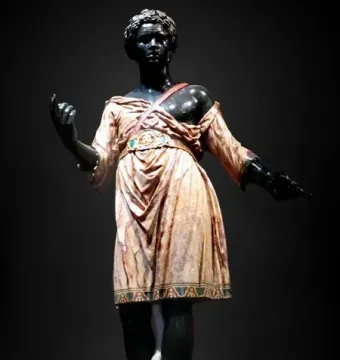
August 2018 © Sukkoria · CC BY-SA 4.0
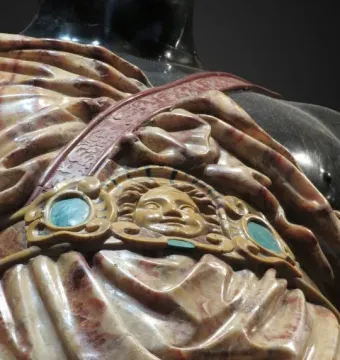
August 2018 © Sukkoria · CC BY-SA 4.0
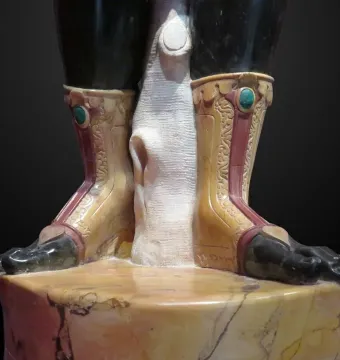
August 2018 © Sukkoria · CC BY-SA 4.0
Identification | |
| Title | Le Maure Borghèse; Le Maure Borghèse - MR 303; Le Maure Borghèse (MR 303) |
| Type | Statue; Polychrome stone statue |
| Inventory number | MR 303 |
| Alternative name | The Moor |
Iconography and meaning | |
| Depicted subject | A Moor |
Physical characteristics | |
| Height | 188 cm |
Historical context | |
| Series | Part of a series of polychrome sculptures commissioned by Cardinal Borghese |
| Date | Early 17th century, circa 1611–1612 |
| Place of creation | Rome |
| Commissioned by | Cardinal-nephew Scipione Borghese; Cardinal-nephew Scipione (Shipione) Borghese |
Creator | |
| Sculptor | Nicolas Cordier |
| Sculptor's origin | Lorraine |
Materials | |
| Materials and technique | Polychrome sculpture with ancient fragments supplemented by alabaster, marble, and sometimes bronze inserts |
Technique | |
| Construction | An assemblage / 'constructor' work completed from surviving ancient fragments with later additions |
Appearance | |
| Ancient components | The head and upper part of the torso are believed to belong to the ancient original |
History and restoration | |
| Later additions | Everything else is attributed to Cordier's additions; the rest of the sculpture was added by Cordier |
Discovery and provenance | |
| Provenance | In the Louvre since 1807 |
| Ownership history | In 1807, Prince Camillo Borghese sold a significant part of his collection to Napoleon / Pauline Bonaparte, which later became part of the Louvre's Borghese Collection |
Location and ownership | |
| Current location | Louvre; The Louvre |
| Collection | Louvre Museum |
| Display status | On view in the permanent collection; On view in the permanent exhibition |
Related works | |
| Related works | Two statues of Diana in the same series, both nicknamed Singarella ('Gypsy girl'), one in the Borghese Gallery in Rome and the other in the Louvre; and some other works |