
Orfeo y Eurídice
Orfeo y Eurídice is a sculptural group of two independent but complementary statues by Antonio Canova, carved in Vicenza soft stone in 1775–1776. Standing 2.04 m high, it represents the artist’s principal early work. Inspired by the myth of Orpheus in Ovid’s Metamorphoses and Virgil’s Georgics, the figures show the tragic instant when Orpheus turns back as Eurydice begins to vanish into the darkness of Hades. An inscription along the bases includes verses from the two Latin poets. The work was made in Venice, where Canova carried out his first studies, and was intended for the entrance to the garden of the Falier family’s country house. It is now preserved in the Dance Hall of the Museo Correr in Venice.
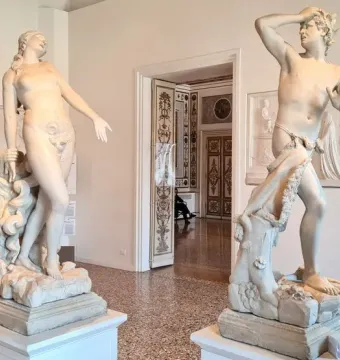
May 2022 © Derbrauni · CC BY 4.0
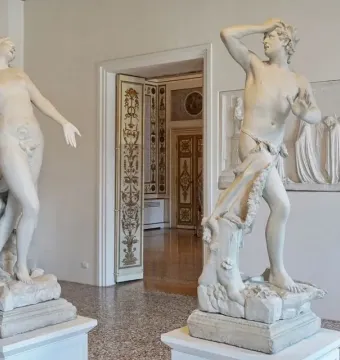
August 2019 © Armin Kleiner · CC BY-SA 4.0
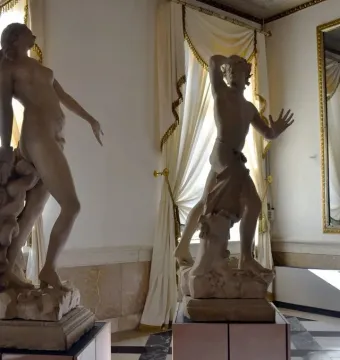
March 2015 © Vassil · CC0
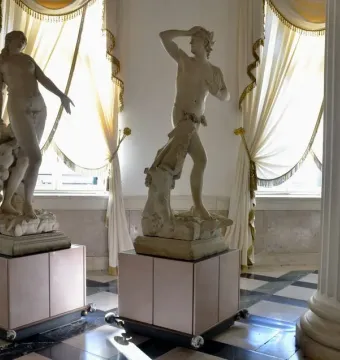
March 2015 © Vassil · CC0
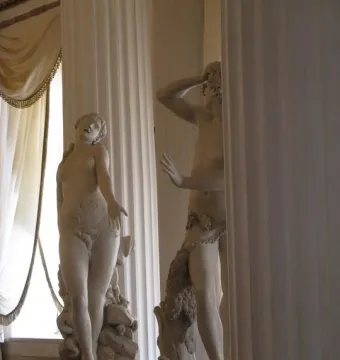
September 2015 © Yair Haklai · CC BY-SA 4.0
Identification | |
| Title | Orpheus and Eurydice |
| Alternative title | Orfeo ed Euridice |
| Type | Sculptural group |
| Number of figures | Two |
Creator | |
| Artist | Antonio Canova |
| Artist nationality/style | Italian Neoclassical sculptor |
| Birth | Possagno, 1757 |
Historical context | |
| Date of creation | 1775–1776 |
| Place of creation | Venice |
| Artist's studies | Canova completed his studies in Venice and Asolo |
| Intended location | To decorate the entrance to the garden of the Venetian Falier family country house |
| Exhibition | Exhibited at the Festa della Sensa in 1776 |
| Early reception | It brought Canova initial notoriety |
| Significance | Canova's principal early work |
Discovery and provenance | |
| Copy | A copy of the Orpheus statue dated 1777 is in the Hermitage Museum |
Physical characteristics | |
| Height | 2.04 m |
Materials | |
| Material | Vicenza stone |
| Material | Soft Vicenza stone |
Appearance | |
| Relationship between figures | The two figures are independent but complementary |
| Inscription | Inscriptions on the bases quote verses from Ovid and Virgil; on Orpheus, "Omnis effusus labor" is written under his right foot, and on Eurydice, verse 494, "Quis et me miseram et te perdidit Orpheu," is written on her pedestal |
Iconography and meaning | |
| Subject | The myth of Orpheus and Eurydice |
| Literary sources | Ovid's Metamorphoses and Virgil's Georgics |
| Depicted moment | Orpheus, returning from Hades, turns around to see whether Eurydice is following him, and sees her for the last time as she begins to vanish and is forced to return to Hades |
| Orpheus expression | He makes a desperate gesture as he sees Eurydice for the last time |
| Eurydice expression | She shows consternation and reproach as she begins to fade into the darkness |
| Mythological context | Eurydice is forced to return to Hades |
Location and ownership | |
| Current location | Ballroom of the Museo Correr, Venice, Italy |
| Inventory reference | Orpheus: Correr Museum, inventory Cl. XXV n. 1072; Eurydice: Museo Correr |