
Fountain of the Tritons
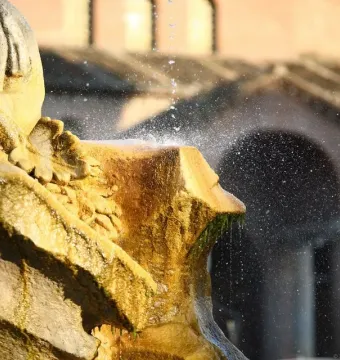
The Fountain of the Tritons is a fountain in Rome, located in Piazza Bocca della Verità in front of the basilica of Santa Maria in Cosmedin. Its construction began on 11 August 1717, during the rearrangement of the square. Designed by architect Carlo Bizzaccheri, it features a travertine structure on a circular step, a main basin shaped like an eight-pointed star, and a central group of rocks with two Tritons sculpted by Francesco Moratti. The Tritons kneel with entwined tails and raised arms, supporting a large oyster shell that forms the upper basin, with the pope’s coat of arms between them. The fountain has undergone restorations, including work in 1994–1995 and 2010.
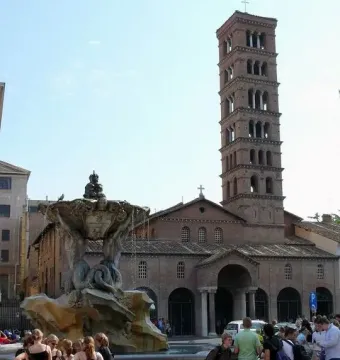
October 2006 © Attila Terbócs · CC BY 2.5
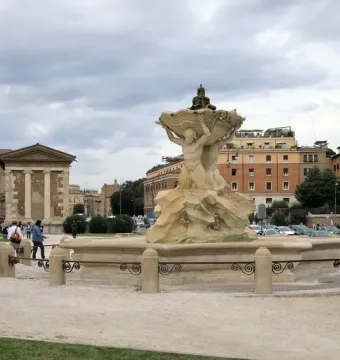
October 2025 © Falk2 · CC BY-SA 4.0
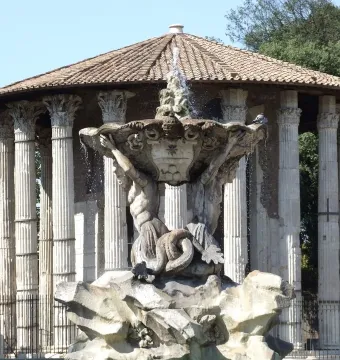
© gnuckx · CC BY 3.0
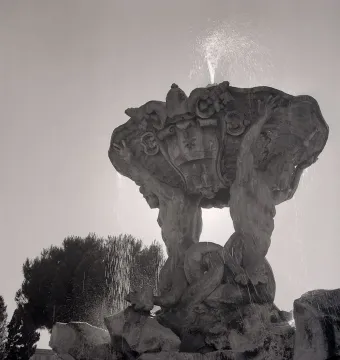
© Paolo Monti · CC BY-SA 4.0
May 2008 © Dino Quinzani · CC BY-SA 2.0
Identification | |
| Name | Fountain of the Tritons |
| Type | Fountain |
| Italian name | Fontana dei Tritoni |
Historical context | |
| Stylistic influences | Its structure and tritons recall Sicilian examples and Bernini |
| Reason for attribution | The delicate proportions of the nymphs decorating it, unlike the fuller Italian ones |
| Attribution | Considered a Spanish work |
| Date of construction | 1715 |
Creator | |
| Patron | Pope Clement XI |
| Sculptor of the tritons | Francesco Moratti |
| Designer | Architect Carlo Francesco Bizzaccheri |
Discovery and provenance | |
| Related nearby addition | The Fountain of the Shells was also installed in this enclosure as part of the same initiative, from the Palace of the Infante Don Luis in Boadilla del Monte |
| Context of relocation project | Part of Narciso Pascual y Colomer's urban planning projects around the Royal Palace of Madrid, including Plaza de Oriente and Campo del Moro |
| Relocation alteration | Installed after being provided with a new basin |
| Transfer requested in | 1844 |
| Transfer initiated by | Architect Narciso Pascual y Colomer |
| Moved to | Campo del Moro gardens, Royal Palace of Madrid, Madrid, Spain |
| Commissioned by | King Philip IV |
| Constructed for | the Island Garden in Aranjuez |
| Original location | Garden of the Queen, in the Buen Retiro Palace complex |
| Installed in new location | 1846 |
| Purpose | To decorate a small square near the watercourse of the garden complex and the Tagus River |
| Described by | Bertaut, who admired its water displays in 1669; also mentioned by Antonio Ponz and Juan Álvarez de Colmenar |
| Original site context | Area south of the Tiber Island, among ancient Roman and medieval monuments |
| First documented mention | 1656 |
| Commissioned by | Pope Clement XI |
| Purpose | A monument in memory of Pope Clement XI |
| Construction start date | 11 August 1717 |
| Completion date | 1715 |
| Original location | Piazza della Bocca della Verità, Rome, Italy, in front of the Basilica of Santa Maria in Cosmedin |
| Nearby monuments | Arch of Argentari, Arch of Janus, Temple of Hercules Victor, Temple of Portunus, and the Basilica of Santa Maria in Cosmedin |
| Water supply context | Built on a secondary branch of the Acqua Felice that reached the area |
| Historical context | Built after the Acqua Virgo and Acqua Felice aqueducts, whose branches allowed new fountains to be erected in the city |
| Site characteristics | Poorly inhabited, water-impermeable, and prone to flooding by the Tiber |
| Original reception | Contemporaries criticized the choice of location as unsuitable |
| Location uncertainty | The reason the pope wanted the fountain erected in this little-used, flood-prone area is not clear |
Physical characteristics | |
| Pose and attributes of tritons | They raise their arms and support a large oyster shell on their shoulders |
| Original water features | Four mascarons poured water into the main basin |
| Water feature | Water jets from the central trimonzio at the center of the shell |
| Upper basin | A large oyster shell functioning as the upper basin |
| Base | Placed on a circular step bordered by 16 small columns joined by an iron railing |
| Sculptural figures | Two tritons kneeling on the rocks with their tails intertwined |
| Central composition | A group of rocks with tufts of vegetation |
| Main basin shape | An octagon with concave sides, or an eight-pointed star |
| Material | Travertine |
Iconography and meaning | |
| Heraldic symbolism | The eight-pointed star symbolizes the heraldic emblem of the Albani family |
| Heraldic element | The papal coat of arms is placed between the two tritons |
History and restoration | |
| Alteration | The mascarons were removed in the 19th century, probably because of the scarcity of water supplying the fountain |
| Water status | The fountain remained dry for a long time |
| Recent water supply restoration | In recent years, the water supply has been restored, though it is still rather scarce |
| Restorations | 1994–1995 and 2010 |
Significance | |
| Historical significance | Considered the oldest surviving monumental fountain in the capital of Spain |
Other | |
| Literary reference | Mentioned in Misericordia (1897) by Benito Pérez Galdós, where Almudena's hat is compared to the upper part of the fountain and said to be close to becoming green with verdigris |