
Bicha of Balazote
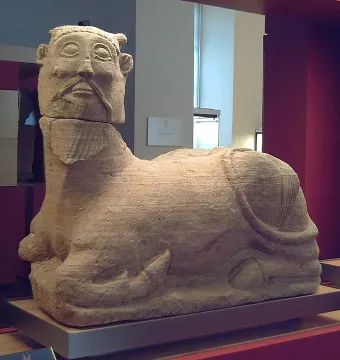
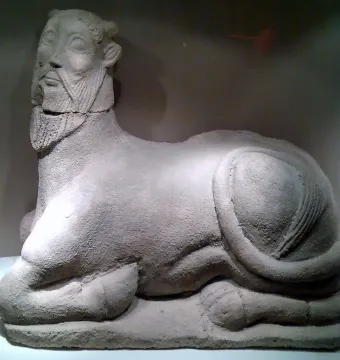
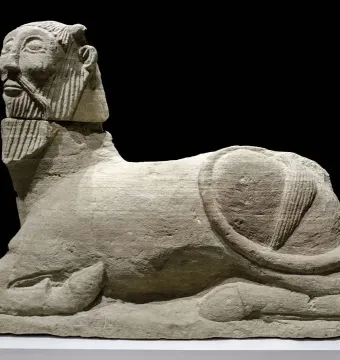
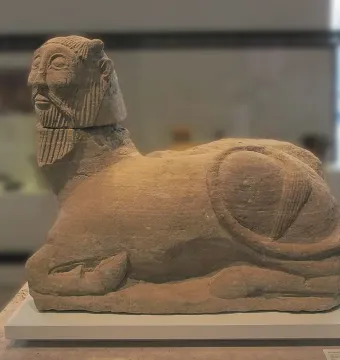
The Bicha of Balazote is an Iberian sculpture dated to the 6th century BCE and now in the National Archaeological Museum of Spain in Madrid, where it has been since 1910. Found at Majuelos near Balazote in Albacete province, it was carved from two limestone blocks and measures 93 cm long and 73 cm high. The figure combines a bull’s body with the head of a horned, bearded man and bull’s ears. Its pose is at rest, with bent forelegs and tucked hind legs. Scholars have suggested it may have belonged to a tomb or temple and possibly represented a fertility deity or the river god Achelous.
· CC BY-SA 2.0
September 2009 © Certo Xornal · CC BY 2.0
January 2015 © Ángel M. Felicísimo · CC BY-SA 4.0
August 2014 © jacinta lluch valero · CC BY-SA 2.0
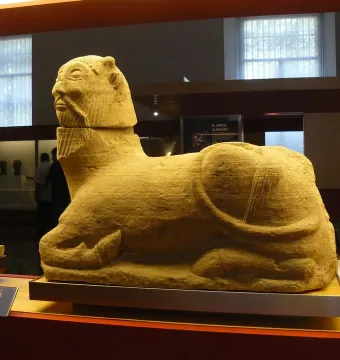
July 2010 © Rowanwindwhistler · CC BY-SA 3.0
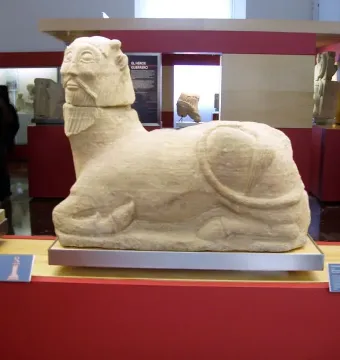
December 2008 © Emilio J. Rodríguez Posada · CC BY-SA 2.0
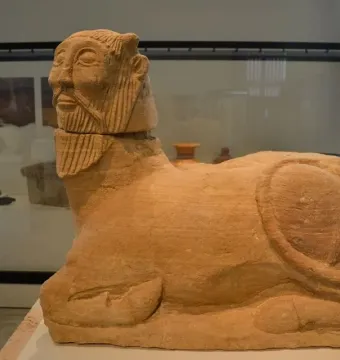
· CC BY-SA 4.0
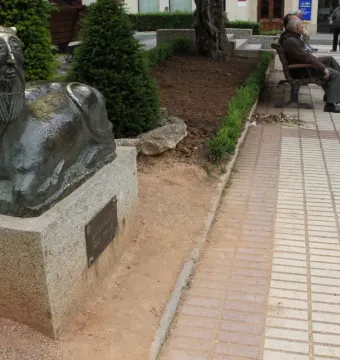
© DnTrotaMundos ☮ · CC BY 3.0
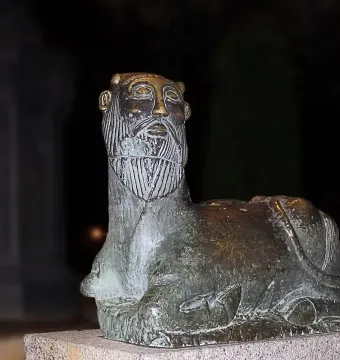
November 2012 © jacilluch · CC BY-SA 2.0
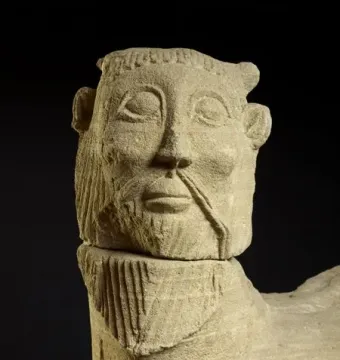
0525 © Relanzón, Santiago (photo) · CC BY-SA 4.0
Identification | |
| Title | Biche of Balazote |
| Type | Iberian sculpture; sculpture; zoomorphic and anthropomorphic hybrid sculpture; synthesis of animal and human forms; full-body sculpture |
| Alternative names | Bicha of Balazote; Bicha de Balazote; Esfinge de Balazote; La Bicha de Balazote; La Bicha di Balazote; biche; bicha; Beast of Balazote |
Historical context | |
| Date | 6th century BC; second half of the 6th century BC; second half of an unspecified century; before the arrival of the Barcids in 238 BC |
| Cultural style | Iberian art; large Iberian monuments found only in the southeastern Iberian Peninsula |
| Related sculptural group | Large group of zoomorphic sculptures from the 5th–4th centuries BC, including lions, bears, wolves, bulls, sphinxes, and creatures with human heads; among the oldest sculptures in this group (550–450 BC) |
Discovery and provenance | |
| Recipient institution | Provincial Commission of Historical and Artistic Monuments of Albacete |
| First identification | A French archaeological team first identified it as a kind of deer/doe (cerva) |
| Name origin | The name "biche" came from a French identification of the figure as a doe/deer; it was later borrowed into Spanish and adapted as "bicha"; the name may also be related to its strange and unique character and a popular vernacular word |
| Delivery date in register | 28 June 1879 |
| Recorded archival name | "bicha" |
| Probable original context | A tomb and burial mound in the Balazote plain; an Iberian tumulus; a tumulus necropolis; burial under a mound; a tomb or temple; a tomb or a temple; funerary in character and part of the decoration of a temple |
| Donor | Isidro López, a resident of Balazote |
| Associated finds | Nearby Roman villa mosaics; important mosaics from a Roman villa; a Roman villa with mosaics; The Sphinx of Haches; the Twin Sphinxes of El Salobral; the Sphinx of Haches |
| Discovery context | Found in the vicinity of Balazote; few data about its discovery; archaeological discovery; found in a context where other zoomorphic sculptural figures also appeared |
| Find spot | Site of Majuelos; Majuelos site; Majuelos area; the Majuelos stop; the Majuelos district; not far from the city center; a short distance from the town center; a short distance from the urban center |
| Discovery location | Balazote, Albacete province, Castile-La Mancha, Spain; Balazote, province of Albacete, Spain; Balazote, Province of Albacete, Spain; the Balazote area, in the province of Albacete, Spain; Spain |
| First studied by | a group of French archaeologists |
Location and ownership | |
| Replica locations | Bronze replica in Altozano Square, Albacete; plaster replica in the permanent exhibition of the Museum of Albacete; a copy in Albacete |
| Since in current location | 1910 |
| Current location | National Archaeological Museum of Spain, Madrid; National Archaeological Museum, Madrid |
Materials | |
| Material | Limestone; two limestone blocks |
| Replica materials | Bronze; plaster |
Physical characteristics | |
| Dimensions | 93 cm long; 73 cm high; 73 cm maximum height; 92 cm long; 37 cm wide; length unknown; height unknown |
| Construction | Carved from two limestone blocks; not carved entirely in the round; one corner appears to be ashlar; seems to have been a corner block; the right side is unfinished/not carved; intended to attach to a place or structure; designed to adhere to some place or support |
Appearance | |
| Head | Horned or small-horned bearded human head with bull's ears; facing the viewer and slightly raised |
| Influences | Greek Archaic sculpture; Hittite roots; strong eastern influence; direct prototypes in Syrian and Hittite art; similarities in technique in Achaemenid Persian and Babylonian sculpture |
| Style | Hair and beard rendered by straight grooves or incised grooves; hieratic style; archaic Greek characteristics; geometrized form; similar to archaic Greek hieratic sculpture |
| Tail | Curved over/on the left thigh and ending in a tuft or pointed tuft of hair |
| Pose | Body in repose; forelegs/front legs bent or tucked under the chest; hind legs tucked/folded under or toward the belly |
| Depicted form | Chimeric synthesis of man and a bull; reclining bull with a human bearded face; resting bull with a human bearded head; human-headed bull; a chimera or being half-animal, half-human; bovine |
Iconography and meaning | |
| Interpretation | May represent a fertility god; may have served as a defense symbol or represented fertility; symbol of life wished for the deceased; adapted by Iberian iconography as a protective genius of the tomb or as a hybrid being of the afterlife, guide and counselor of the souls of the dead |
| Proposed identification | The Greek river god Achelous; Achelous, Greek god of rivers and fertility |
| Basis for identification | Its image resembles Achelous on Sicilian coins; relation to Sicilian coins depicting Achelous |
| Comparative interpretation | Comparable to Greek man-headed or androcephalic bull statues used to represent river gods and the fertility of rivers that fertilize the fields |
| Scholarly assessment | "This sculpture is a daughter of the Greeks, and if you will, granddaughter of the Phoenicians and great-granddaughter of Mesopotamia," (1931) |
| Proposed by | A. García and Bellido; A. García y Bellido; García y Bellido; A. Garcia Bellido |
Significance | |
| Significance | One of the emblematic sculptural examples of Iberian art |
Other | |
| Related works cited | "Le taureau chaldéen à tête humaine et ses dérivés"; Essai sur l'art et l'industri de l'Espasgne primitif, vol. I (1903), plate 4; "Pre-Roman Antiquities of Spain", American Journal of Archaeology 11.2 (April–June 1907: 187) |
| Additional note | Recent excavations in the Balazote plain revealed a tomb and burial mound, and nearby Roman villa mosaics were also discovered |