
I Am Beautiful
I Am Beautiful, also called The Rape, is a sculpture by Auguste Rodin inspired by an excerpt from Charles Baudelaire’s The Flowers of Evil, La Beauté. It appears in The Gates of Hell at the top of the right jamb, formed from The Squatting Woman holding The Falling Man. Rodin used an assemblage technique, altering the meaning of The Squatting Woman by turning and bending it like a closed balloon. The work presents a morbid erotic vision in which sexual fulfillment is unattainable. It was included in the 1886 exhibition organized at the Georges Petit Gallery, where it was considered remarkably audacious for its time.
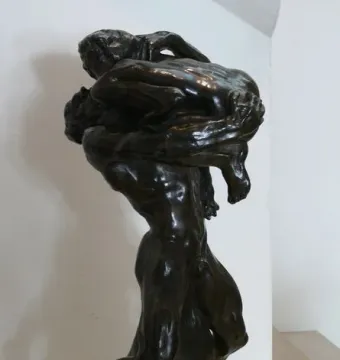
© Auguste Rodin · Public domain
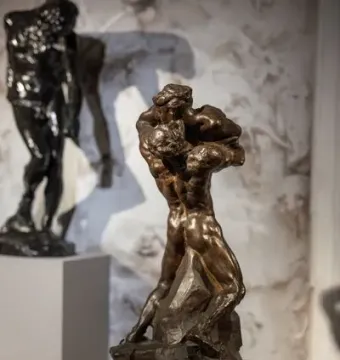
May 2024 © PMRMaeyaert · CC BY-SA 4.0
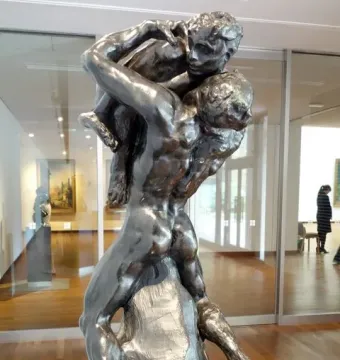
September 2013 © Daderot · Public domain
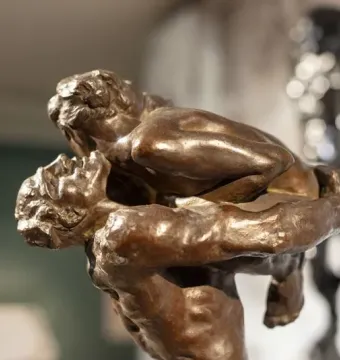
May 2024 © PMRMaeyaert · CC BY-SA 4.0
Identification | |
| Title | I Am Beautiful |
| Alternative titles | El Rapto; L’Enlèvement; L’Amour charnel; La Chatte; The Abduction; Soy Bella |
| Type | Sculpture |
| Original title | Je suis belle |
Creator | |
| Artist | Auguste Rodin |
| Artist nationality | French |
| Technique | Assembled from fragments / assemblage |
| Source works | La mujer en cuclillas (Femme accroupie / Crouching Woman) and L'Homme qui tombe (The Falling Man / El hombre que cae) |
| Derived from | The original assembly was altered by rotating the crouching woman and bending her like a closed balloon |
Historical context | |
| Date of creation | circa 1882 |
| Literary inspiration | Charles Baudelaire’s poem “La Beauté” in Les Fleurs du mal (published 1857) |
| Exhibition | First publicly exhibited in 1886 at the Galerie Georges Petit in Paris |
Physical characteristics | |
| Man's pose | He lifts the woman in a manner reminiscent of Atlas |
| Overall form | Round-like shape |
| Depicted figures | A woman and a man |
| Woman's pose | Her back is turned to the audience |
| Depicted subject | A couple embracing |
Iconography and meaning | |
| Theme | Sexual satisfaction is unattainable |
| Interpretation | Rodin intended a morbid, erotic vision |
| Interpretation of the figures | One figure withdraws into itself while the other shows rapture, extension, and arching |
| Symbolic interpretation | The union of the two figures symbolizes joy of life and passions |
| Symbolic comparison | The man lifts her like Atlas or Octavius Musaluppi |
Location and ownership | |
| Museum locations | Rodin Museum, Paris; Museum of Fine Arts and Archaeology of Châlons-en-Champagne; National Museum of Western Art, Tokyo; Dallas Museum of Art; a museum in the United States |
| Provenance of Dallas example | Its exact origin is not specified; it is linked to the philanthropist mentioned in the source fragment |
| Provenance of Philadelphia example | A bronze from the Rudier foundry was acquired by bequest in 1929 |
| Provenance of U.S. example | A bronze version was donated by the Iris and B. Gerald Cantor Foundation, associated with Bernard Cantor |
| Ownership/provenance of Japanese example | Purchased in 1919 by Japanese art collector Matsukata Kōjirō, conserved on deposit in France, transferred from the French government to the Japanese government in 1959, then entrusted to the National Museum of Western Art, Tokyo |
| Part of | The Gates of Hell |
| Related work in The Gates of Hell | L'Homme qui tombe appears at the top of the right pilaster |
| Placement in The Gates of Hell | At the top of the right jamb |
Materials | |
| Foundry | Rudier foundry |
| Materials of the rediscovered cast | Plaster |
| Material | Bronze |
Discovery and provenance | |
| Rediscovery of plaster cast | A plaster cast was found in 2017 after the death of an elderly person in Pyrénées-Atlantiques |
| Previous location of rediscovered cast | Kept for her entire life in an apartment in Pau, then in the institution where she died |
| Heritage status of rediscovered cast | French national treasure |
| Estimated value of rediscovered cast | Around an unspecified amount in 2020 |
| Acquisition campaign | Subject of a patronage appeal for acquisition by the French state |
History and restoration | |
| Condition of rediscovered cast | It does not bear the verses of Charles Baudelaire on its base; visible recent plaster repairs are present between the figures' breasts, between the woman's right arm and the man's left flank, and on several parts of the man's arms |
| Alterations to figures on rediscovered cast | The man's arms were modified in several places to fit the woman's body, and the woman's buttocks were entirely remodeled in plaster |
| Assessment by Rodin Museum notice | The cast is considered the original assembly and the first stage in the creation of this subject |
| Reason for national treasure classification | It is considered the original assembly and first stage of creation |
Significance | |
| Reception at exhibition | The 1886 exhibition caused commotion and was considered remarkably bold for the time |
| Interpretive note | The sculpture's meanings are described as blurred or uncertain, and its multiple titles are taken as evidence of that uncertainty |