
Shelley Memorial
Shelley Memorial is a memorial dedicated to the English poet Percy Bysshe Shelley (1792–1822). It is located at University College, part of the University of Oxford in England. Shelley briefly attended the college before being expelled after writing the pamphlet The Necessity of Atheism. Despite that history, he remains one of the college’s most famous former students, and the institution continues to honor his connection. In 2005, University College further strengthened that link by purchasing some letters written by Shelley at auction.
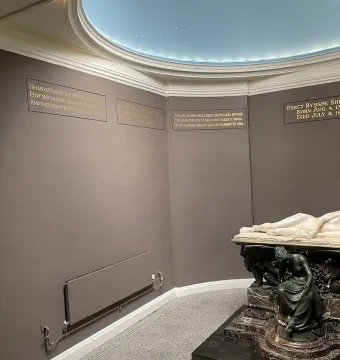
June 2023 © Set in Stone Project · CC BY-SA 4.0
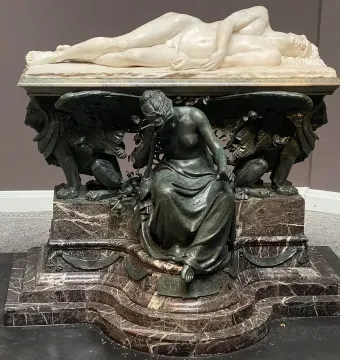
June 2023 © Set in Stone Project · CC BY-SA 4.0
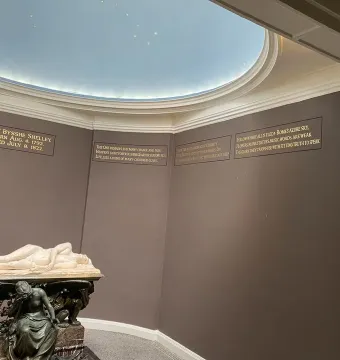
June 2023 © Set in Stone Project · CC BY-SA 4.0
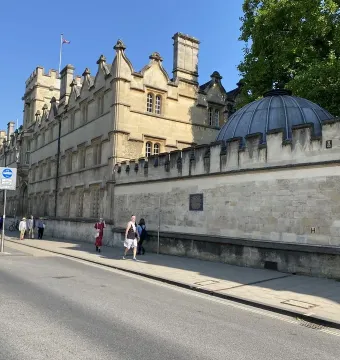
June 2023 © Set in Stone Project · CC BY-SA 4.0
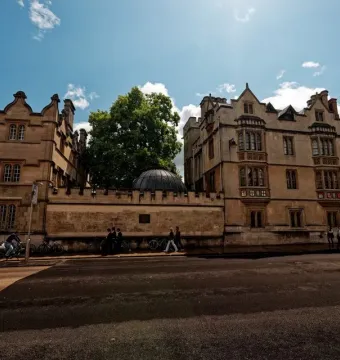
June 2011 © Txllxt TxllxT · CC BY-SA 4.0
Identification | |
| Title | Shelley Memorial |
| Dedicated to | Percy Bysshe Shelley (1792–1822), English poet |
| Type | memorial sculpture |
Creator | |
| Sculptor | Edward Onslow Ford |
Historical context | |
| Art movement | New Sculpture |
| Connection to location | Shelley briefly attended University College and was expelled in 1811 for writing the pamphlet The Necessity of Atheism |
| Institutional status of Shelley | Despite his expulsion, Shelley is regarded as one of the college's most famous former students |
Location and ownership | |
| Current location | University College, Oxford, England |
| Associated institution | University College, Oxford |
| Site history | Located on the site where Robert Boyle and Robert Hooke carried out experiments in Oxford; the site was previously Cross Hall until the early 19th century |
| Plaque | An exterior plaque records the site's history and historical connection |
Discovery and provenance | |
| Reason original plan failed | Trelawny's heirs considered Ford's statue too large and did not agree to place it in the cemetery |
| Unveiling attendees | Lady Shelley, Edward Onslow Ford, Basil Champneys, and Benjamin Jowett, among others |
| Unveiled | 14 June 1893 |
| Donated to current location by | Lady Shelley |
| Edward John Trelawny's connection | A friend of Shelley who bought a plot near him in the Roman cemetery in 1822 |
| Original intended location | The Protestant Cemetery in Rome |
| Commissioned by | Lady Jane Shelley, Shelley's daughter-in-law |
| Reason for commission | To honor Shelley's memory and fulfill Edward John Trelawny's wish for a monument beside his own grave |
Physical characteristics | |
| Support | Set on a decorative pedestal or plinth |
| Purpose of barrier | To protect the memorial from vandals and students |
| Protective barrier | Ornamental railings |
| Housing | A small late Victorian domed room designed by Basil Champneys |
| Figure depicted | Percy Bysshe Shelley as a reclining nude corpse, washed ashore on the beach at Viareggio, Italy |
| Material | White marble |
Iconography and meaning | |
| Other people in the depicted event | Edward Ellerker Williams and the sailor Charles Vivian were aboard the Ariel with Shelley |
| Depicted event | Shelley is shown after being brought ashore following the wreck of the schooner Ariel |
History and restoration | |
| Original decoration | A gilt-bronze laurel wreath was originally on Shelley's brow |
| Alteration | The laurel wreath was removed during the 1930s because of student pranks |
| Vandalism and pranks | The memorial has been the target of numerous acts of vandalism and pranks; one example is that E. J. Bowen, a chemistry don, had to clean graffiti or paint from the statue |
| Flood incident | The room housing the memorial was once flooded and filled with goldfish |
| Critical reception | The monument has been criticized over the years, sometimes for the excessive femininity of the subject and sometimes for its harshness or crudity |
Significance | |
| Cultural appearances | Featured in the 1997 film The Saint and in the Lewis episode And the Moonbeams Kiss the Sea, where the memorial's pose is echoed by the body of a murdered student |