
Lion of Babylon
Lion of Babylon is an over 2,600-year-old stone sculpture found in the ancient city of Babylon, Iraq. First documented in 1817 by Claudius Rich, it may have been seen earlier by Joseph de Beauchamp in 1790. The statue is made of black basalt, measures two meters in length, stands on a one-meter-high platform, and weighs around 7,000 kg. It shows a Mesopotamian lion above a supine human figure. Some interpretations suggest the two figures are engaged in sexual intercourse, and the carved depression on the lion’s back may indicate where a saddle once supported a figure of Ishtar.

June 2019 © NoraElansary · CC BY-SA 4.0
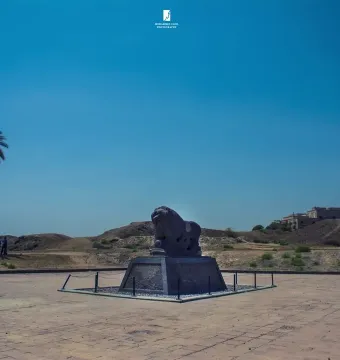
September 2017 © Mohamm3dfadil · CC BY-SA 4.0
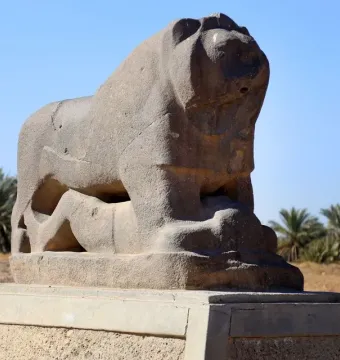
February 2022 © Safa.daneshvar · CC BY-SA 4.0
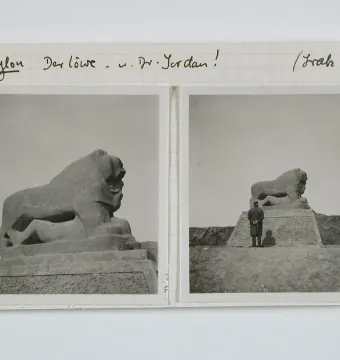
© Annemarie Schwarzenbach · Public domain
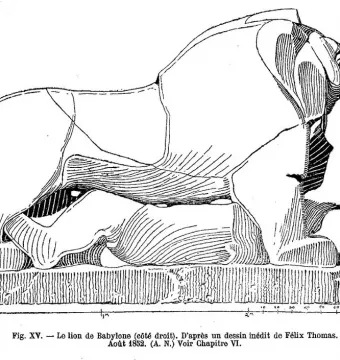
August 1852 © Felix Thomas drawing of the Lion of Baylon made in 1852 · Public domain
Identification | |
| Title | Lion of Babylon |
| Type | stone sculpture; statue |
Historical context | |
| Age | over 2,600 years old |
| Cultural context | Mesopotamian art |
Creator | |
| Attributed creator | Nebuchadnezzar II, king of Babylon (reigned 605–562 BC) |
Discovery and provenance | |
| Possible later history | may have been part of booty captured by the Babylonians during Nebuchadnezzar II's campaigns |
| Possible original commission | possibly commissioned by Nebuchadnezzar II |
| Alternative origin interpretation | Hittite origin; possibly made during a Hittite occupation of the city |
| Attribution history | Initially thought by the German mission to have been sculpted under Nebuchadnezzar II; later attributed on stylistic and material grounds to Northern Syria in the Neo-Hittite and Aramaean sphere |
| Possible earlier sighting | possibly seen as early as 1790 by Joseph de Beauchamp |
| First documented by | Claudius Rich |
| Discovered by | German archaeological mission |
| Discovery date | 1876 |
| Discovery location | Babylon, Iraq |
Physical characteristics | |
| Length | 2.6 meters |
| Height | 1 meter |
| Platform height | 1 meter |
| Weight | about 7,000 kg |
Materials | |
| Material | black basalt |
Appearance | |
| Depicted subject | a lion trampling a human figure |
| Back feature | a carved depression on the lion's back |
| Original feature | a saddle was originally placed in the carved depression |
| Deity placement | the back of the lion includes a representation of where Ishtar should stand |
Iconography and meaning | |
| Interpretation | the lion and human are strongly suggested to be engaged in sexual intercourse |
| Associated deity | Ishtar |
| Ishtar's role | goddess of fertility, love, and war |
| Intended effect | to intimidate and frighten enemies |
Location and ownership | |
| Current location | Babylon, Iraq |
History and restoration | |
| Condition history | damaged over the years due to lack of protection, tourist climbing, marks left by visitors, and erosion |
| Protection concern | archaeologists feared erosion would occur without adequate protection |
| Restoration date | 2013 |
| Restoration organizations | World Monuments Fund and the Iraqi State Board of Antiquities and Heritage |
| Restoration work | cleaned and partially restored; the statue base was replaced; a protective barrier was added |
Significance | |
| Cultural significance | one of the most important symbols of Babylon and Mesopotamian art |
| National significance | a national symbol of Iraq |
| Use by institutions | used by several Iraqi institutions, including the Iraqi Football Association |