
Horse Tamers
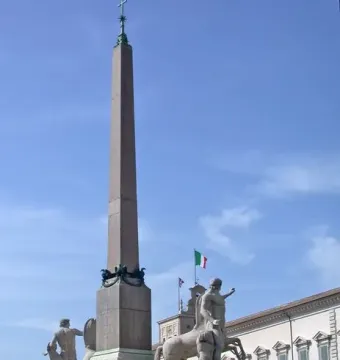
Horse Tamers is a famous pair of colossal statues, usually identified as Castor and Pollux, that have stood near the site of the ancient Baths of Constantine on Rome’s Quirinal Hill since antiquity. They are known to be fourth-century Roman copies of Greek originals. During the Middle Ages, the Quirinal was known as Monte Cavallo, a name that continued to be used in the nineteenth century. Napoleon’s agents considered including the statues among the classical works removed from Rome after the Treaty of Tolentino in 1797, but they proved too large to be moved over long distances.
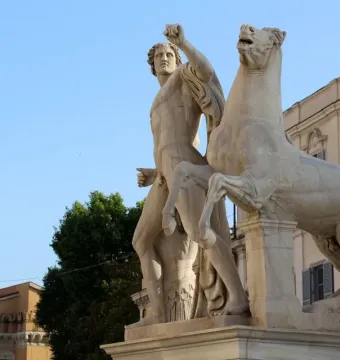
© Fred Romero · CC BY 2.0
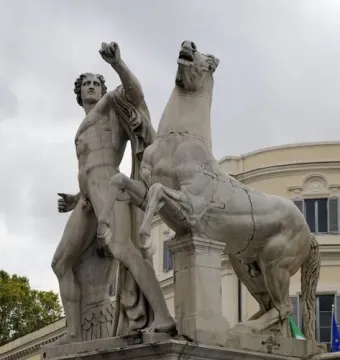
October 2025 © Falk2 · CC BY-SA 4.0
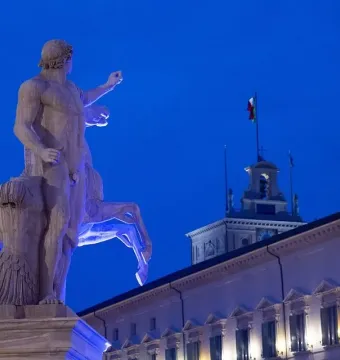
April 2016 © Presidenza della Repubblica · Attribution
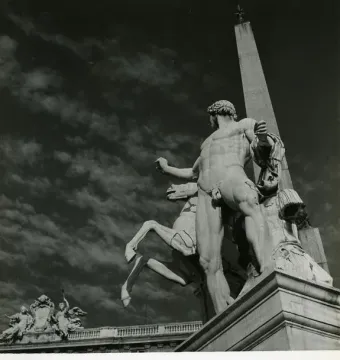
© Paolo Monti · CC BY-SA 4.0
© MM · Public domain
Identification | |
| Title | Horse Tamers |
| Alternative names | Domadores de Cavalos; Colossi of the Dioscuri; The Horse Tamers; "marble horses" (cavalli marmorei) |
| Type | Pair of colossal marble statues |
| Number of statues | Two |
Iconography and meaning | |
| Subject | The Dioscuri, usually identified as Castor and Pollux |
| Iconographic interpretation | Each figure holds the reins of an unruly horse; the group was also interpreted as Alexander the Great with Bucephalus, and as a symbol of the control of base natures by higher nature |
Historical context | |
| Date | Roman copies of Greek originals, probably based on 4th-century BC models |
| Historical presence | Located on the Quirinal Hill in Rome since antiquity; recorded from the 10th century and mentioned in medieval sources |
Discovery and provenance | |
| Original setting | Near the Baths of Constantine on the Quirinal Hill, Rome, standing on a large marble pedestal |
| Medieval hill name | The statues gave the Quirinal Hill the medieval name Monte Cavallo, which was still used in the 19th century |
Creator | |
| Attributed makers | Formerly attributed to Phidias and Praxiteles; modern scholarship regards them as Roman copies of Greek originals of unknown authorship |
| Modern scholarly opinion | Stephen Geppert considers them Antonine-period works |
Physical characteristics | |
| Appearance | The horses’ vigor has been admired, while the figures’ coarseness has been noted; the figures are heroic nudes |
| Condition | Among the best-preserved colossal sculptures surviving from the Roman Empire; generally in excellent condition with superficial weathering |
| Survival status | They have survived without ever being buried |
| Scale | Colossal; gigantic |
Materials | |
| Material | Marble |
History and restoration | |
| Restoration | Restored under Pope Sixtus V between 1589 and 1591 by Domenico Fontana and placed on new pedestals flanking the Fontana dei Dioscuri |
| Inscription | The bases bore the inscriptions OPUS FIDIÆ and OPUS PRAXITELIS, regarded as fanciful late-antique attributions; one inscription was under each statue and was later corrected to Phideæ during Sixtus V’s restoration |
| Rearrangement | In 1783–1786 the statues were set at an angle to each other and the Quirinal Obelisk was erected between them |
| Fountain | A granite basin, formerly used as a cattle drinking trough in the Roman Forum (Campo Vaccino), was installed between the statues in 1818 |
| Napoleonic removal attempt | After the 1797 Treaty of Tolentino, Napoleon’s agents tried to remove them to France, but they were too large to transport far |
Significance | |
| Influence | They were repeatedly noted in medieval works, inspired later works such as the Horses of Marly, and their model was copied many times |
| Related works | Capitoline Dioscuri (Dioscuri del Campidoglio) in Rome |
| Later replicas and copies | Paolo Triscornia made the first full-scale copies for the Manège in Saint Petersburg; Christian Friedrich Tieck placed cast-iron copies on Berlin’s Altes Museum; Peter Klodt von Urgensburg made four bronze Horse Tamers for the Anichkov Bridge in Saint Petersburg; Frederick MacMonnies cast a bronze copy in 1899 for the Ocean Parkway entrance to Prospect Park, Brooklyn |
| Other proposed or planned versions | In 1558 Onofrio Panvinio proposed Alexander and Bucephalus and suggested Constantine had moved the statues from Alexandria to Rome; in the 1640s bronze replicas were planned for the Louvre but the project failed; Richard Westmacott made a life-size bronze copy with shield and sword as a tribute to the Duke of Wellington, installed at Hyde Park Corner opposite Apsley House |