
Zeus of Otricoli
Zeus of Otricoli is an ancient Roman marble bust from the first half of the 1st century BC. It was discovered at Otricoli, the ancient Ocriculum, during excavations carried out in 1781–1782 under Pope Pius VI by Giuseppe Pannini and Vincenzo Cecchi. Measuring 58 cm in height, the bust was part of a larger statue and is regarded as one of the most famous depictions of Jupiter as well as the most faithful Roman reproduction of Phidias’ Zeus from Olympia. The sculpture is displayed in the Oval Hall of the Vatican Museums in Rome, in the Museo Pio-Clementino.
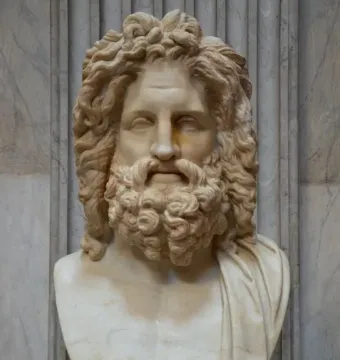
August 2015 © Carole Raddato · CC BY-SA 2.0
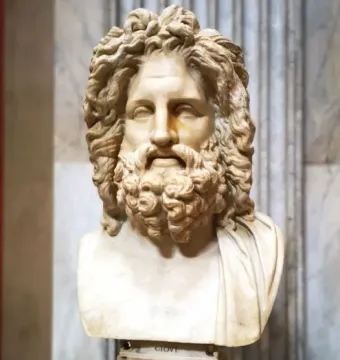
October 2018 © Biser Todorov · CC BY 4.0
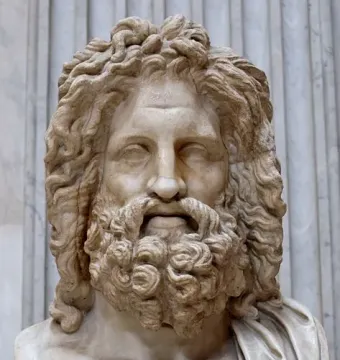
© Unknown artistUnknown artist · Public domain
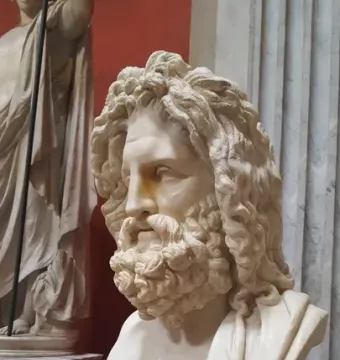
April 2017 © Jamie Heath · CC BY-SA 2.0
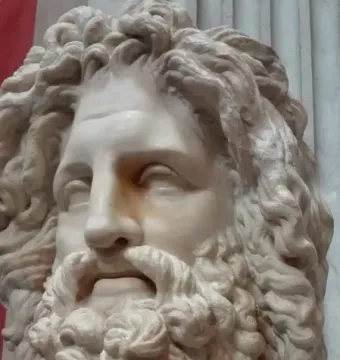
May 2019 © Sima Farshid · CC BY-SA 4.0
Identification | |
| Title | Zeus of Otricoli |
| Alternative names | Jupiter of Otricoli; Zeus from Otricoli |
| Original language title | Zeus z Otricoli; Зевс Отриколийский |
| Type | Ancient Roman marble bust |
| Subject | Jupiter (Zeus) |
Historical context | |
| Comparative evidence | It is noted as different from Capitoline Jupiter, the lost Zeus Olympios of Phidias, and an ancient statue of Zeus in the State Hermitage Museum in Saint Petersburg |
| Historical interpretation | The bust and the related Hermitage Jupiter were historically claimed to be late copies of Phidias's Zeus Olympios |
| Related ancient prototype | The bust has been connected with the statue of Jupiter in the Capitoline Temple in Rome |
| Possible later source | Some scholars think the Hermitage Jupiter may derive from the statue of Jupiter from the Roman Temple of Jupiter the Protector, founded by Emperor Domitian |
| Date | 1st century BC, probably made in the first half of the 1st century BC |
| Cultural origin | Roman |
| Original model | Probably a Roman copy of a Hellenistic original, possibly a modification by Lysippos from the era of Alexander the Great |
Creator | |
| Attribution | Some scholars have attributed it to a copy of Phidias's Zeus at Olympia, but this is disputed; numismatic reproductions and ancient descriptions suggest a different and later model |
Discovery and provenance | |
| Discovery location | Otricoli, ancient Ocriculum, Umbria, Italy |
| Discovery date | 1775 |
| Discovery context | Found during excavations financed or ordered by Pope Pius VI |
| Excavators | Giuseppe Pannini and Vincenzo Cecchi |
Physical characteristics | |
| Function in antiquity | Part of a large statue |
| Stylistic features | Retains Pheidian influence, including a half-open mouth, but the face is broader and more deeply modeled |
| Height | 58 cm |
Materials | |
| Material | White Carrara marble |
Iconography and meaning | |
| Iconographic interpretation | Represents Zeus/Jupiter as a paternalistic god |
Location and ownership | |
| Current location | Vatican Museums, Rome |
| Current display location | Sala Rotonda / Round Room, Pio-Clementino Museum |
Significance | |
| Artistic significance | Considered by some the most faithful Roman reproduction of Zeus from Olympia by Phidias |
| Notability | One of the most famous representations of Jupiter |
History and restoration | |
| Copy for Goethe | In 1786 Johann Wolfgang von Goethe had a faithful plaster copy made for himself during his journey to Italy |
| Later artistic influence | Used as a model for the Figure of God the Father on the facade of a now-lost Warsaw church of the Brigittines, and reproduced by the Baroque sculptor Stephan Schwaner |
| Current location of derivative work | The Figure of God the Father is now in Falenty, Poland |
| Other copies | A copy exists in the Stroganov Palace in Saint Petersburg; casts are also held by Cornell University, Bowdoin College Art Museum, and at the Boston Athenæum |
| Related ancient sanctuary | Ocriculum had a temple dedicated to Jupiter, Juno, and Minerva |