
The Cleveland Apollo
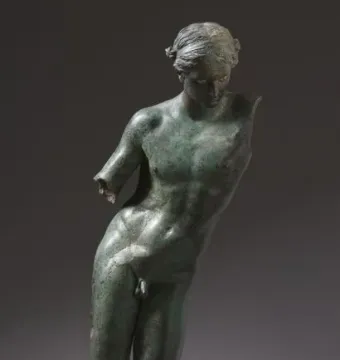
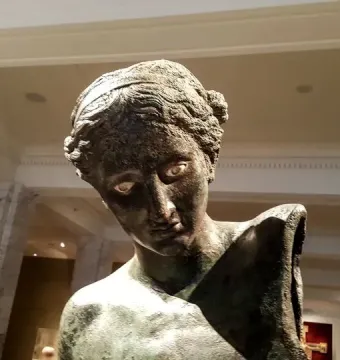
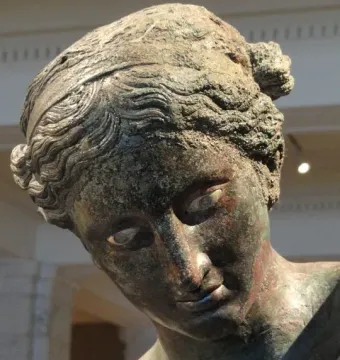
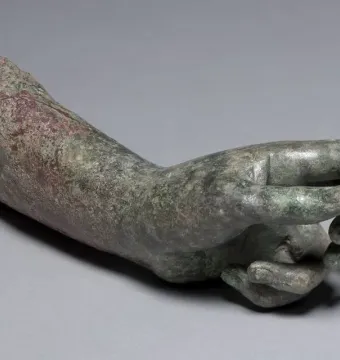
The Cleveland Apollo is a 4th-century BCE, life-size bronze Ancient Greek statue now in the Cleveland Museum of Art. It was acquired by the museum in 2004 using the Severance and Greta Millikin Purchase Fund. The museum attributed the work to Praxiteles, who lived circa 400 to 330 BCE, and its technical features are considered consistent with the Late Classical Period. Scientific investigation of the sculpture and its separated parts indicates that they are from the same casting. However, the age of the casting was still under review as of 2017, and scholarly research has raised questions about whether it is a Praxiteles original.
© Praxiteles · CC0
June 2018 © Tim Evanson · CC BY-SA 2.0
September 2012 © Daderot · CC0
© Praxiteles · CC0
© Praxiteles · CC0
Identification | |
| Title | The Cleveland Apollo: Apollo Sauroktonos (Lizard-Slayer) or Apollo the Python-Slayer |
| Alternative names | Apollo Sauroktonos (Lizard-Slayer); Apollo the Python-Slayer |
| Subject | Apollo Sauroktonos (Apollo the lizard-slayer) |
| Type | Life-size bronze statue |
Historical context | |
| Cultural origin | Ancient Greek |
| Date | 4th century BCE |
| Stylistic period | Late Classical Period |
Creator | |
| Attribution | Attributed to Praxiteles; the Cleveland Museum of Art claims it is a Praxiteles original |
| Attributed artist lifespan | c. 400–330 BCE |
Discovery and provenance | |
| Controversy | Its origin and possible recent illicit looting became controversial |
| Exhibition controversy | The Greek Central Archaeological Council asked the Louvre not to include it in the 2007 Praxiteles exhibition, and Italy demanded its return |
| Museum position | The Cleveland Museum of Art maintained the seller's version of the provenance |
| Current provenance status | Questionable provenance; rumors claimed it may have been looted from Italy or Greece |
| Discovery status | Previously unknown before it appeared on the art market in 2003 |
| First appearance on art market | 2003 |
| Reported provenance | According to the seller, from a private residence in the former East Germany (GDR), where it was considered a copy dating to the 18th or 19th century |
Location and ownership | |
| Current location | Cleveland Museum of Art |
| Inventory number | 2004.30 |
| Acquisition date | 2004 |
| Acquisition fund | Severance and Greta Millikin Purchase Fund |
Physical characteristics | |
| Pose | Strongly contrapposto, standing on the right leg with the left leg bent and the left foot placed behind the right heel |
| Reptile depiction | A small reptilian creature with asymmetrical, unnatural anatomy, interpreted as a smaller python from mythology |
| Appearance | Apollo leans toward a tree trunk, rests his raised left hand on it, and holds an arrow in his right hand while preparing to stab a lizard or python climbing the trunk |
| Condition | Preserved in fragments; relatively well preserved |
| Missing parts | Tree trunk and much of the arms |
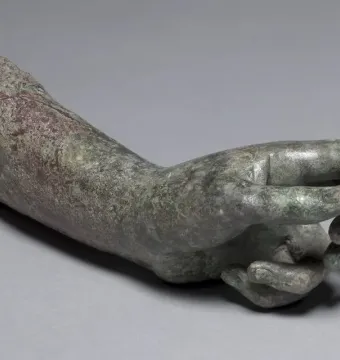
| Preserved parts | Right arm above the elbow, a large portion of the left arm, the shoulder, most of the left forearm, the left hand, and the small reptilian creature |
| Dimensions | 150 cm high; 66.8 cm wide; 50.3 cm deep |
Materials | |
| Primary material | Bronze |
| Other materials | Copper inlays; stone eyes; a different alloy in the base |
| Alloy | Highly leaded bronze |
Technique | |
| Casting technique | Indirect lost-wax casting |
| Manufacture | Some details, such as the hair held by a band, were modeled in wax before casting |
Appearance | |
| Surface details | The lips and nipples are inlaid with copper; the eyes are made of stone |
| Quality of execution | Highly accomplished, with firmer contours than in marble copies |
| Stylistic qualities | Youthful beauty, grace, a curved pose, and delicate modeling |
| Comparisons | Comparable in pose to the Apollo Sauroktonos in the Vatican and the Resting Satyr in the Capitoline Museums |
| Hair | Close-growing parted hair hanging over the forehead in symmetrical curls |
Iconography and meaning | |
| Interpretation | A serious mythological subject treated as a sport or pastime, with a slight allusion to a religious type |
| Stylistic influence | Influence of Polykleitos |
| Pliny's description | Praxiteles created a bronze sculpture of Apollo in his youth about to stab a lizard with an arrow, leaning toward a tree trunk with his raised left hand on it |
| Pliny's epithet | sauroktonos ('lizard-slayer') |
| Ancient literary source | Pliny the Elder, Natural History 34.69–70 |
| Iconographic subject | A youthful Apollo preparing to stab a lizard with an arrow; the type is also called Apollo the Python-Slayer |
History and restoration | |
| Fire damage | The figure shows traces of fire, possibly from an event after excavation |
| Research status | As of 2017, the age of the casting and the carbon-dated samples were still under review |
| Carbon-dating findings | Samples from the forearm produced very early dates, older than the Roman or Greek periods, but these may have been contaminated during restoration |
| Borescope findings | Inspection inside the head found several modern repair materials |
| Analysis methods | Visual examination, borescope inspection, CT scanning, and carbon dating were used |
| Surface interpretation | The patina and corrosion were taken as evidence of a long burial period with alternating dry and humid phases |
| Base interpretation | These findings were presented as evidence against a recent looting, and the lead may reflect later reuse of original material |
| Base | The base was made in a different alloy and may date to no earlier than the Renaissance; its lead at the right-foot contact point was dated to just under 100 years ago |
| Chemical analysis | Chemical examinations were said to show that the bronze is ancient |
| Surface condition | The statue is covered with patina and traces of corrosion |
| Scientific investigation | Scientific analysis showed that the surviving fragments belong together and were cast from the same melt, based on metal composition, lead content, and corrosion history |
Significance | |
| Rarity | The only known bronze version of the Apollo Sauroktonos type and the only existing full-scale bronze version of the type |
| Roman reception | Several marble copies made in Rome survive; the type was popular into the Imperial period, and wealthy Romans acquired copies for homes and country villas |
| Later representations | Roman coins and gems engraved with Apollo show the sculptural type |
| Name history | The type has been known as Apollo Sauroktonos since Roman times |
| Scholarly assessment | Questions remain about whether it is a Praxiteles original; how the sculpture achieved iconic status in art history is unclear and may deserve reexamination |
| Classical attribution note | It is considered a major work of Praxiteles, though there is no indisputably original freestanding sculpture by him |