
Tazza Farnese
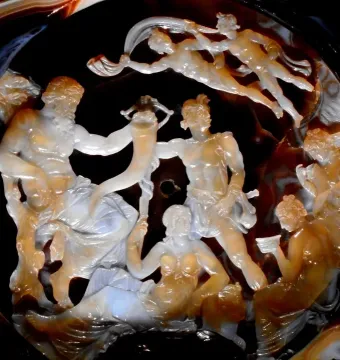
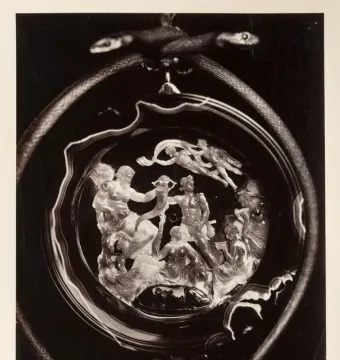
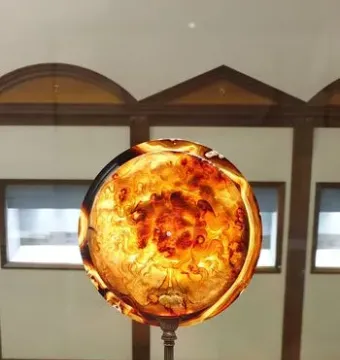
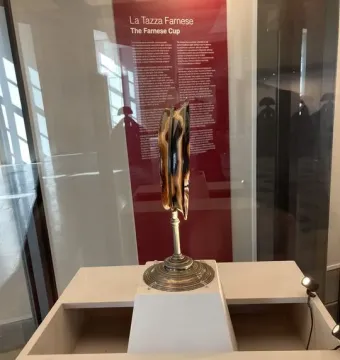
Tazza Farnese is a Hellenistic ancient sardonyx gem, now displayed in the National Archaeological Museum in Naples. Shaped like a dish about 20 cm in diameter, it was probably made for a Ptolemaic ruler in Egypt in the 1st century BC, though John Pollini dates it to the time of Augustus. One side shows the head of Medusa; the imagery on the other side is difficult to interpret, though the sphinx at the bottom suggests an Egyptian setting. The figures have been identified variously as Isis, Horus, and personifications of the Nile, or as Greek deities or Ptolemaic rulers. The gem was recorded in the early 15th century, later belonged to the Farnese family, and was damaged in 1925 before being restored.
September 2018 © Carlo Raso · Public domain
© Giorgio Sommer · Public domain
October 2019 © Jamie Heath · CC BY-SA 2.0
November 2023 © Richard Weil · CC0
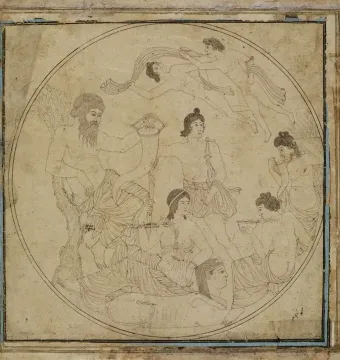
© Muhammad al-Khayyam · Public domain
Identification | |
| Title | Farnese Cup |
| Alternative name | Tazza Farnese |
| Type | Hellenistic hardstone cameo cup |
Historical context | |
| Date | Hellenistic period, probably 2nd century BC; some scholars date it as late as the Augustan period |
| Culture | Hellenistic Egypt |
Creator | |
| Place of creation | Probably Alexandria, Ptolemaic Egypt |
| Patron | Probably made for a Ptolemaic ruler, possibly Cleopatra; attribution is uncertain |
Physical characteristics | |
| Form | Shallow bowl or cup shaped like a Greek phiale or Roman patera, without a foot |
| Shape | Plate-shaped, circular |
| Dimensions | About 20 cm in diameter and about 8 cm high |
| Structure | Carved from a block with four visible layers |
| Central feature | A hole in the middle of the gem of unknown origin and purpose |
Materials | |
| Material | Sardonyx agate |
Technique | |
| Technique | Carved cameo with low reliefs on both interior and exterior surfaces |
Appearance | |
| Exterior motif | A large Medusa head |
| Interior scene | An allegorical scene with several figures, including a seated bearded figure, Triptolemus, two Horae, flying winds, and a woman seated on a sphinx |
| Decoration | Interior and exterior relief carving |
Iconography and meaning | |
| Interior scene meaning | Generally interpreted as an allegory, possibly of the Nile flood, fertility, or Ptolemaic rulership; scholarly interpretations differ |
| Exterior motif meaning | Probably apotropaic, intended to ward off evil |
Location and ownership | |
| Current location | National Archaeological Museum of Naples |
| Inventory number | 27611 |
Discovery and provenance | |
| Earliest recorded presence | Recorded in the early 15th century in Samarkand or Herat |
| Early viewer | Muhammad al-Chajjam |
| Arrival in Italy | Reached Italy in the mid-15th century, possibly brought by Byzantine Emperor John VIII or after the fall of Constantinople |
| Ownership history | In 1538 it became the property of the Farnese family, then passed with the family collections to Naples at the end of the 18th century |
| Associated collection | Farnese collection |
History and restoration | |
| Damage | In 1925 a museum guard smashed the display case, breaking the cup into several pieces |
| Restoration | The fragments were later reassembled and glued back together |
| World War II concealment | Hidden in a wall cavity inside the museum during World War II to protect it from Nazi looting |
Significance | |
| Assessment | Considered a technical masterpiece and one of the most important objects of Alexandrian Hellenistic art |