
Apollo Strangford
Apollo Strangford is a Greek sculpture of a nude youth in Parian marble, dating to around 500–490 BCE. It is one of the very last examples of the kouros type, yet it is also considered among the earliest Greek statues in the classical style. The figure stands frontally in balance on both legs, with the right leg slightly back and the left slightly forward. The upper arms were bent, though the hands are missing and were probably free from the body. The sculpture has been in the British Museum since 1864, when it was acquired from the collection of Percy Smythe, Viscount Strangford.
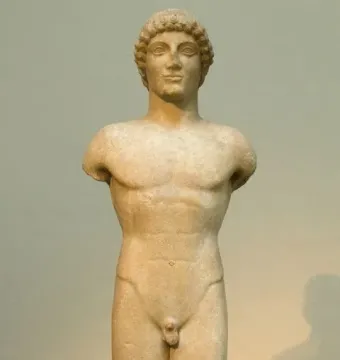
May 2014 © Zde · CC BY-SA 4.0
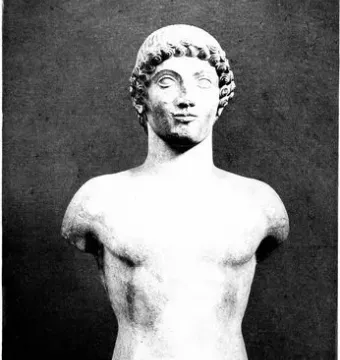
1914 © Internet Archive Book Images · No restrictions
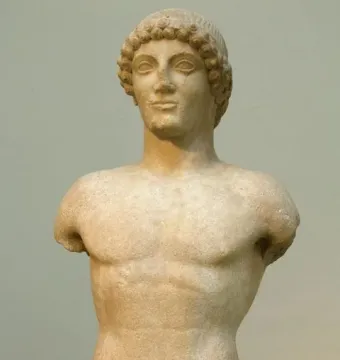
May 2014 © Zde · CC BY-SA 4.0
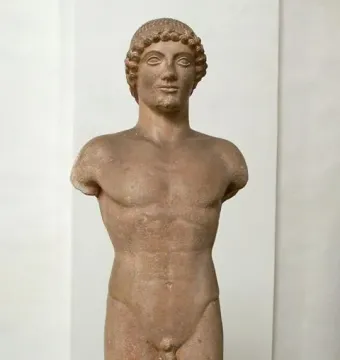
June 2018 © Zde · CC BY-SA 4.0
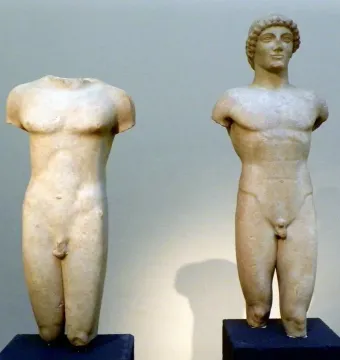
February 2016 © Peter O'Connor aka anemoneprojectors · CC BY-SA 2.0
Identification | |
| Title | Strangford Apollo |
| Type | Ancient Greek kouros statue |
| Subject | Nude young male figure |
| Identification | An archaic image of the god Apollo |
| Alternative names | Apollo of Anafi; Apollon Strangford; Apolo Strangford; kouros di Anafi; kuros de Ánafi |
Historical context | |
| Date | About 500–490 BCE |
| Style | Archaic style; transitional between the kouros tradition, the Severe style, and early Classical Greek sculpture |
| Art-historical classification | One of the latest known examples of the kouros type |
| Significance | Shows the rapid evolution in ancient Greek sculpture and the outward humanisation characteristic of late Archaic sculpture |
Creator | |
| Artist | Anonymous |
Discovery and provenance | |
| Former owner | Percy Smythe, 8th Viscount Strangford (Lord Strangford) |
| Museum acquisition | Purchased by the British Museum in 1864 by Charles Thomas Newton from the Strangford collection; Newton found it in Strangford's cellar |
| Former owner's role | British ambassador to the Sublime Porte in Constantinople, 1820–1825; ambassador to the king of Portugal in Brazil |
| Probable origin | The island of Aegina, probably made there |
| Acquisition history | Believed to have been acquired by Percy Smythe, 8th Viscount Strangford, in the 1820s, early in the Greek War of Independence |
| Possible function | Cult statue of the island's temple of Apollo Aigletes or a temple dedication; it may predate the temple |
| Basis for origin hypothesis | Similarities with figures on the pediments of the Temple of Aphaia on Aegina |
| Provenance | Uncertain; generally believed to have been found on Anafi, though Lemnos has also been suggested |
Physical characteristics | |
| Details | Five drilled holes in the hair: one in the middle of the forehead, one above the right ear, two above the left ear, and one larger hole on the top of the head |
| Proportions | More naturalistic than most earlier korai |
| Face | Rather serious, with a very slight archaic smile |
| Anatomy | Ribs are clearly marked under the armpits and framed toward the back by a relief; lower abdomen is too long; navel is high and eye-shaped; back is modeled with a strongly curved waist and heavy buttocks; thigh muscles are exaggerated; kneecaps are carefully worked; torso musculature is anatomically correct; build is strong and athletic |
| Condition | Arms and lower legs missing; in excellent condition |
| Hair | Short, orderly hair forming a crown of curls around the head; two rows of spiral curls over the forehead, with three curls in front of the ears; a narrow fillet runs around the head above the curls; the ends are raised from the neck in a crobylos |
| Head | Square head with a short, broad face |
| Arms | Both upper arms were folded, but the hands were free from the body and may have held something |
| Pose | Front-facing, standing with the body weight mainly on the right foot, left leg slightly advanced and bent as if taking a step forward |
| Height | 100 cm |
Materials | |
| Material | Parian marble |
Location and ownership | |
| Current location | British Museum, London |
| Collection | British Museum |
| Display status | On permanent display |
| Inventory number | GR 1864.2-20.1 |
| Museum catalog number | Sculpture B 475 |
History and restoration | |
| Later reuse | The face was used for the 'Colossus of Leone', a colossal prop for Sergio Leone's 1961 film The Colossus of Rhodes |
| Reason for later reuse | After Leone's wish to give the statue the face of Benito Mussolini was rejected |
Other | |
| Female equivalent | Korai (singular: kore) |
| Approximate type period | The kouros/kore type originated in the 7th century BCE during the Archaic period of Greek art |