
Dendera Zodiac
The Dendera Zodiac is a well-known bas-relief from Ancient Egypt, carved on the ceiling of the pronaos, or portico, of a chamber dedicated to Osiris in the Temple of Hathor at Dendera, Egypt. It is now displayed at the Louvre Museum in Paris and measures 253 by 255 cm. The relief includes images thought to correspond to the constellations Taurus and Libra. The chamber is dated to the late Ptolemaic period, and its pronaos was added during the reign of Emperor Tiberius. The most widely accepted date for the relief is around 50 BC, based on the positions of stars and planets shown in the carving.
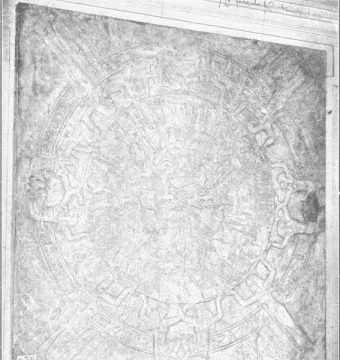
© Mansell · Public domain
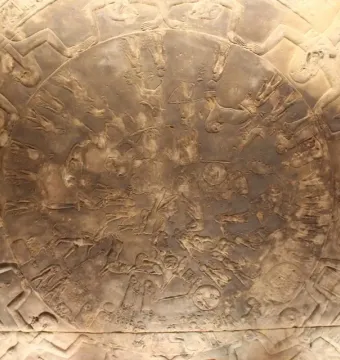
July 2016 © Gary Todd · CC0
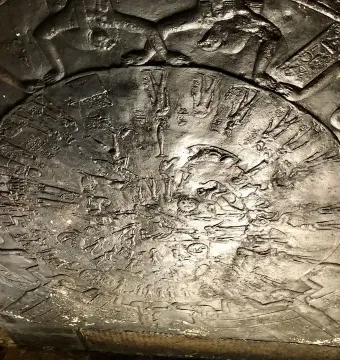
© Marie Thérèse Hébert & Jean Robert Thibault · CC BY-SA 2.0
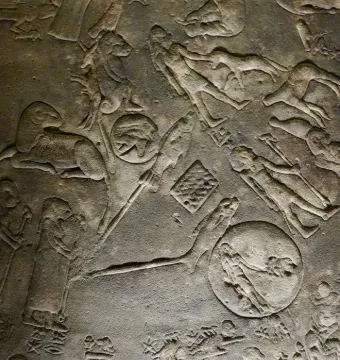
© Unknown artistUnknown artist · CC BY 3.0
September 2022 © Bautsch · CC0
Identification | |
| Title | Dendera zodiac |
| Culture | Ancient Egypt |
| Alternative names | Denderah zodiac; Zodiac of Denderah; so-called zodiac of Dendera |
| Type | Ancient Egyptian astronomical bas-relief |
Historical context | |
| Dating debates | Jean-François Champollion dated it to the Greco-Roman period; many of his contemporaries dated it to the New Kingdom; earlier and later proposed dates ranged widely, from thousands of years to a few centuries ago |
| Basis for dating | Its astronomical positions are said to match the sky as it would have appeared around 50 BC |
| Historical significance | The zodiac sparked major controversies and has been conjectured to have served as a basis for later astronomical systems |
| Date | Ptolemaic period; generally accepted today around 50 BC |
Creator | |
| Attributed interpreters | Jean-François Champollion; Joseph Fourier; Sylvie Cauville and Éric Aubourg |
Discovery and provenance | |
| Removal from temple | Removed in 1820 by Claude Lelorrain, commissioned by Sébastien-Louis Saulnier; extracted by cutting it out of the temple structure with saws, pliers, and gunpowder |
| Copies and reproductions | Graphic copies and later reproductions include Denon's colored drawing, the Jollois and Villiers du Terrage drawing, the 1822 Description de l'Égypte plates, a marble copy by Jean-Jacques Castex at the British Museum, a plaster copy for Prosper-Louis d'Arenberg in Brussels, a copy at Dendera, a plaster copy at the San José Egyptian Museum, a copy in Hexen, and a plaster copy at Louvre-Lens |
| Acquisition by France | Purchased in 1821 from Muhammad Ali by the king |
| First drawing | 1799 by Dominique Vivant Denon |
| Discovered by | French general Desaix during Bonaparte's Egyptian expedition, while pursuing the Mamluks near Thebes |
| Discovery date | November 1798 |
| First detailed survey | Later in 1799 by Prosper Jollois and Édouard de Villiers du Terrage |
Physical characteristics | |
| Dimensions | 253 × 255 cm |
| Form | Circular zodiac within an overall square composition |
| Material | Carved sandstone block |
| Condition after removal | A section of the ceiling came away with it, leaving a large hole and damaging nearby symbolic bird tableaux of the nomes |
Appearance | |
| Ursa Minor | Depicted as a jackal |
| Orientation note | Its original position was overhead, so it was not meant to be viewed face-on |
| Aquarius | Depicted as the flood god Hapi holding two water jars |
| Examples of Greco-Roman forms | Ram, Taurus, Scorpio, and Capricorn |
| Zodiac style | Some signs are shown in Greco-Roman forms and others in more Egyptian forms |
| Outer ring | 36 figures representing the 36 asterisms used in Egyptian night and year reckoning |
| Central motif | Sky disc centered on the north pole star |
| Additional constellations depicted | Eagle, Bouvier, Cassiopeia, Horse (Little), Swan-Lyra, Dragon, Wolf, Orion, Great Bear, Little Bear, and Serpent |
| Other celestial bodies depicted | The five known planets and Sirius |
| Zodiac signs depicted | The 12 signs of the zodiac |
| General subject | Astronomical representations of the celestial vault and its constellations |
| Support figures | Four women and four pairs of falcon-headed figures hold up the sky disc |
Iconography and meaning | |
| Eclipses depicted | A lunar eclipse of 52 BC and a solar eclipse of 51 BC |
| Solar eclipse symbolism | A circle containing Isis holding the baboon-headed god Thoth by the tail |
| Lunar eclipse symbolism | An Eye of Horus inside a circle |
| Outer ring meaning | The 36 figures correspond to the decans and the Egyptian divisions of night and the year |
| Interpretations | Rogers described it as a complete map of an ancient sky and a complete copy of the Mesopotamian zodiac; Hoffmann suggested it may be a Babylonian star chart with Greco-Egyptian additions and variants |
Location and ownership | |
| Current location | Louvre Museum, Paris, France; room 12bis, Sully Wing |
| Current display status | On display |
| Original location | Ceiling of the pronaos (portico) of a chapel dedicated to Osiris in the Temple of Hathor at Dendera, Egypt |
| Construction context | The chapel was begun in the late Ptolemaic period, and the pronaos was added under Emperor Tiberius |
| Associated chapel deity | Osiris |
| Associated temple | Temple of Hathor (Great Temple of Hathor) at Dendera |
History and restoration | |
| Copy at original site | A copy was later installed at the original location in Dendera, though the installation date is uncertain |
| Related scholarly publication | Included in Champollion-Figeac's four-volume Monuments de l'Égypte et de la Nubie, volume 4 (1845), in two versions |
| Museum interpretation | The Louvre's explanatory panel identifies the planets, zodiacal constellations, other constellations, Sirius, and the two eclipses |
Significance | |
| Notable description | John H. Rogers described it as 'the only complete map of an ancient sky we have' |
| Historical controversy | It was famous for having caused much controversy |