
Sarcophagus of Junius Bassus
The Sarcophagus of Junius Bassus is a 4th-century marble sarcophagus considered one of the most outstanding examples of early Christian funerary art. It was discovered in 1597 in the Vatican Grottoes beneath St. Peter’s Basilica and is now in the Museo Storico del Tesoro della Basilica di San Pietro in Vatican City. Made of Pentelic marble, it was created for Junius Bassus, a neophyte who died in 359 and had been consul in 331 and prefect of Rome. Its front is divided into two richly decorated registers with ten relief scenes from the Old and New Testaments, including Christ enthroned, the Judgment of Pilate, the Sacrifice of Isaac, and the Entry into Jerusalem. The damaged lid preserves only fragments of its decoration.
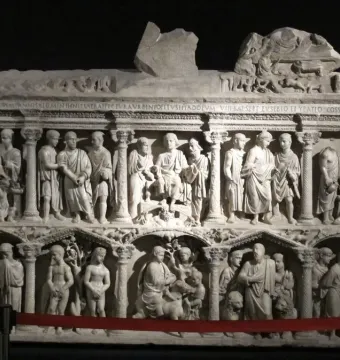
December 2011 © sailko · CC BY-SA 3.0
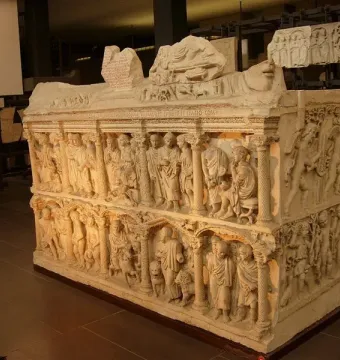
April 2009 © xiquinhosilva · CC BY 2.0
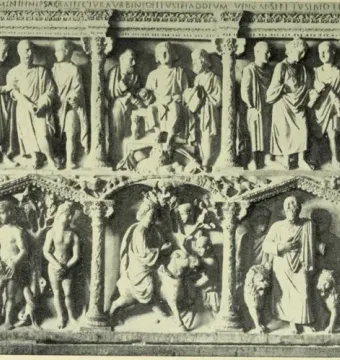
1911 © Internet Archive Book Images · No restrictions
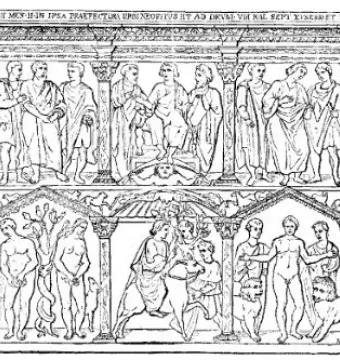
1872 © J.W. Appell · Public domain
© AnonymousUnknown author · Public domain
Identification | |
| Type | Early Christian marble sarcophagus |
| Title | Sarcophagus of Junius Bassus |
Historical context | |
| Date | 4th century |
| Period | Early Christian period; late antique Rome |
| Junius Bassus's offices | Consul in 331; prefect of the city of Rome (urban prefect) |
| Religious conversion | According to the inscription, Junius Bassus converted to Christianity shortly before his death, possibly on his deathbed |
Creator | |
| Commissioned for | Junius Bassus |
| Buried person | Junius Bassus |
| Junius Bassus | Roman senator and prefect of Rome; a neophyte who died in 359 at age 42 |
| Father of the buried person | Junius Annius Bassus, praetorian prefect |
Discovery and provenance | |
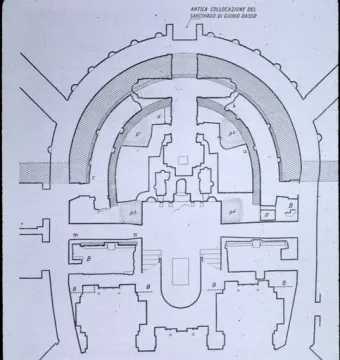
| Original location | Old Saint Peter's Basilica or beneath it |
| Discovery place | Vatican Grottoes beneath St. Peter's Basilica |
| Discovery date | 1595 or 1597 |
Location and ownership | |
| Current location | Museo Storico del Tesoro della Basilica di San Pietro, Vatican |
Physical characteristics | |
| Material | Marble; probably Pentelic marble, possibly Carrara marble |
| Dimensions | Approximately 2.4 × 1.4 × 1.0 m |
| Dimensions of base | Approximately 1.2 × 2.4 × 1.2 m |
| Decorated sides | Three sides decorated |
Technique | |
| Carving technique | High relief |
Appearance | |
| Lid condition | Heavily damaged; most decoration survives only fragmentarily |
| Style | Soft, static, idealized, and highly carved |
| Inscription | An elogistic inscription on a damaged plaque surmounting the lid praises Junius Bassus and records him as a recent convert |
| Lid decoration | The lid originally included a funerary banquet scene with the deceased reclining on a couch, masks in the corners, and a funerary procession |
| Upper register architecture | Columns topped by a flat entablature with pierced architraves |
| Lamb figures | Small lambs appear in the spandrels and beneath the dividing line between the registers |
| Figure arrangement | Each scene contains two or three figures |
| Column decoration | Columns include vegetal ornament, diagonal fluting, vine-harvesting putti, and twisted shafts on some examples |
| Lower register architecture | Columns topped alternately by arched and triangular pediments, some shaped like shell valves in perspective |
| Front composition | The front is divided into two registers with ten scenes in niches separated by small columns |
Iconography and meaning | |
| Pagan references | Caelus, putti, and other pagan artistic motifs are retained |
| Side panels | Scenes of agricultural work and seasonal imagery, including vine harvest, grain harvest, hunting, and other putti |
| Spandrel scenes | Scenes of the multiplication of the loaves, the Baptism of Christ, the Three Fiery Youths, Moses bringing water from the rock, the Resurrection of Lazarus, the Lamb with the book, and related symbols |
| Upper register scenes | Binding or sacrifice of Isaac; arrest of Peter; Christ in Glory (Traditio Legis) or Christ enthroned between Saints Peter and Paul; Christ brought before Pontius Pilate or delivery to Pilate; Pilate washing his hands |
| Lower register scenes | Job in destitution; Adam and Eve in Paradise or with the tree of sin; Entry of Christ into Jerusalem; Daniel in the lions' den; arrest of Paul or arrest of Peter |
| Christ depiction | Christ appears as a beardless, short-haired youth in a youthful Christ type |
| Religious symbolism | The biblical scenes and allegories express Christian theology while retaining references to pagan artistic tradition |
| Iconographic program | A complex program of symbolic and allusive correspondences presenting salvation history and the triumph of Christ |
| Subject matter | Biblical scenes from the Old and New Testaments |
Stylistic group | |
| Stylistic group | Pasion sarcophagi |
Significance | |
| Art historical significance | One of the most outstanding and most famous examples of early Christian funerary and relief sculpture |
| Comparative works | Related to the Sarcophagus of the Two Brothers, the Sarcophagus of the Two Testaments, and the Dogmatic Sarcophagus |