
Torres de Satélite
Torres de Satélite is a group of monumental urban sculptures in Ciudad Satélite, Naucalpan, in the State of Mexico. Planned in 1957 by Luis Barragán, Jesús Reyes Ferreira, and Mathias Goeritz, it became one of the country’s first large-scale urban sculptures. The original concept called for seven towers, including one intended to reach 200 meters, but budget cuts reduced the project to five towers. The tallest now stands 52 meters high and the shortest 30 meters. Goeritz first imagined different shades of orange, but the final color scheme was changed to one tower each in red, blue, and yellow, plus two white towers. The work was inaugurated in early March 1958 as a symbol of the new Ciudad Satélite.
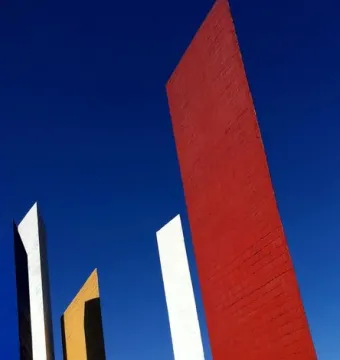
October 2553 © Juan Barrios · CC BY-SA 2.0
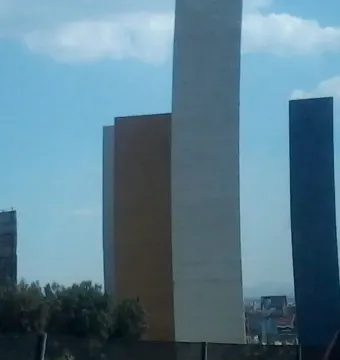
September 2012 © Nallely Ayane · CC BY-SA 3.0
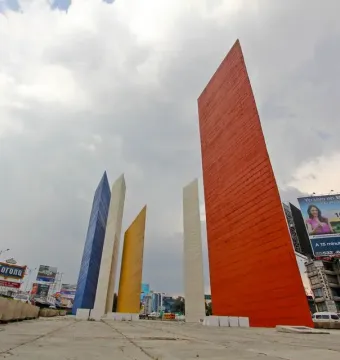
September 2013 © Cheomargrem · CC BY-SA 3.0
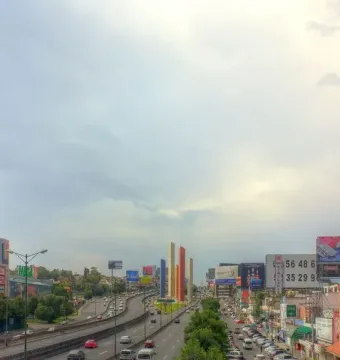
© Octavio Alonso Maya Castro · CC BY-SA 3.0
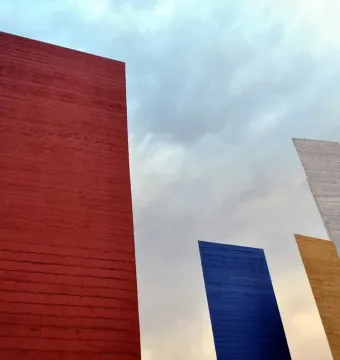
February 2012 © ProtoplasmaKid · CC BY-SA 4.0
Identification | |
| Title | Torres de Satélite |
| Type | Group of sculptures |
| English title | Satellite Towers |
Location and ownership | |
| Location | Ciudad Satélite, Naucalpan de Juárez, State of Mexico, Mexico, on Anillo Periférico in the northern section |
| Threat to surroundings | Heavy traffic and the passage of the elevated Viaducto Bicentenario along one side |
| Current concern | Local residents are worried about the integrity of the structures and their visual surroundings |
Historical context | |
| Date of inauguration | Early March 1958 |
| Stylistic concept | Architecture of emotion |
| Significance | One of the first large-scale urban sculptures in Mexico |
| Reason fewer towers were built | Lack of budget |
| Original intended placement | At the entrance to the emerging city |
| Influence visit | A 1951 trip by Goeritz and Barragán, accompanied by art historian Justino Fernández, to San Gimignano |
| Main influence | The towers of San Gimignano, Italy |
| Associated person | Miguel Alemán Valdés supposedly lived in Ciudad Satélite |
| Associated origin | The idea of Ciudad Satélite originated during the presidency of Miguel Alemán Valdés |
| Inauguration context | Officially opened as a symbol of the newly born modern Ciudad Satélite |
| Original design | Originally planned as a large fountain at the entrance to the city |
| Original planned number of towers | Seven |
| Final number of towers | Five |
| Original planned height | 200 meters |
| Planning began | 1957 |
Creator | |
| Commissioned by | Mario Pani |
| Suggested by | Luis Barragán |
| Collaborators | Mathias Goeritz and painter Jesús Reyes Ferreira |
| Planned by | Luis Barragán, Jesús Reyes Ferreira, and Mathias Goeritz |
Physical characteristics | |
| Form | Triangular prisms of different sizes |
| Height | 30 to 52 meters |
Materials | |
| Surface color | Originally different shades of orange; later repainted in various color schemes, including red, blue, yellow, white, and orange ochre |
History and restoration | |
| Reason for design change | Budget reduction eliminated two towers |
| 2008 restoration | For the 50th anniversary, the towers were refurbished by the Municipality of Naucalpan and private donors |
| Lighting status | Out of use, and it is unknown whether it will be repaired |
| 2008 lighting | Architectural lighting was installed |
| 2008 paint used | 7,000 liters of anti-graffiti paint |
| 2008 restoration result | The towers were returned to their original colors |
| 2008 restoration method | Previous paint layers were removed by firing polyurethane foam at them |
| Later repainting | Around 1974 the towers were repainted into the present multicolored scheme |
| 1989 restoration traces | Paint can remnants remain inside the ochre tower |
| Final color scheme | One red tower, one blue tower, one yellow tower, and two white towers |
| Condition before 1989 repainting | They had shown some deterioration due to time and pollution |
| Surface area | 6,644 square meters |
| Color change in 1967 | The towers were painted in orange tones at Goeritz's initiative to create better contrast with the blue sky |
| Original color plan | Different shades of orange |
| Reason for original color change | Pressure from builders and investors |
| 1989 restoration | The surface was repainted by Nervión and Bayer de México |
Iconography and meaning | |
| Color symbolism | The red, blue, and yellow towers were described as the primary subtractive colors |
Significance | |
| Heritage proposal | Proposed as a UNESCO World Cultural Heritage site |
| Quoted characterization | Described as 'a huge billboard turned into architecture' |
| Historical significance | A distinctive symbol of the Satélite area and the emerging Ciudad Satélite |
Appearance | |
| Stated aesthetic effect | Large geometric volumes and simple tonal ranges create a unique effect in the urban landscape |
Other | |
| Appears in film | The Holy Mountain |
| Film scene detail | The unnamed protagonist is hoisted up the red tower, enters it through a circular hole painted for the film, meets the Alchemist inside, and begins a metaphysical transformation |
| Appears in music video | Fool Again by Westlife |
| Appears in comic book | Comic book #14 of Marvel Comics' Champions series, likely as an artistic choice by penciller Humberto Ramos |