
The Cathedral by Auguste Rodin
The Cathedral is a sculpture by the French artist Auguste Rodin, conceived in 1908. It shows two right hands belonging to two different figures, placed so they seem about to intertwine. The work measures 62.3 cm high, 28.8 cm wide, and 31 cm deep. It was made in stone, and later cast in bronze. At first, it was titled The Arch of the Alliance, referring to the harmony of communication suggested by the two hands. It later received the title The Cathedral after the publication of Rodin’s 1914 book The Cathedrals of France, which reflected his fascination with French cathedrals and the harmony he saw between architecture and sculpture.
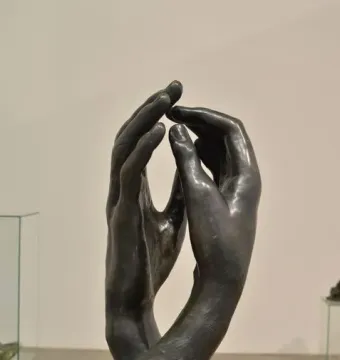
May 2013 © Antanana · CC BY-SA 3.0
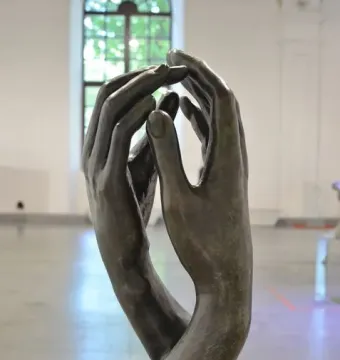
May 2013 © Antanana · CC BY-SA 3.0
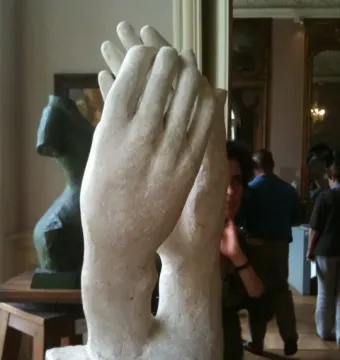
June 2010 © LanguageTeaching · CC BY 2.0
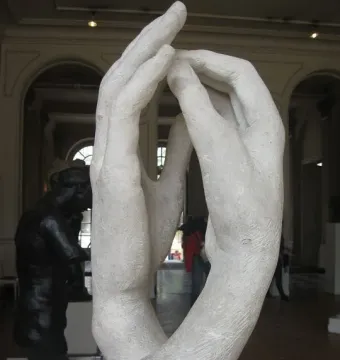
June 2010 © LanguageTeaching · CC BY 2.0
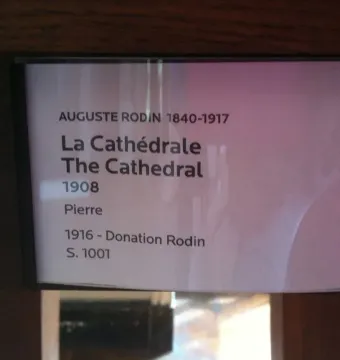
June 2010 © LanguageTeaching · CC BY 2.0
Identification | |
| Title | The Cathedral |
| Original title | La Cathédrale |
| Former title | L'Arche d'Alliance (The Arch of the Covenant) |
| Type | Sculpture |
Creator | |
| Artist | Auguste Rodin |
| Artist nationality | French |
Historical context | |
| Date of conception | 1908 |
| Historical context | Created during a period of ideological and material recovery of the medieval era, including the restoration of Gothic cathedrals and other medieval buildings |
Discovery and provenance | |
| Related publication | Les Cathédrales de France (1914), a book of notes Rodin made about French cathedrals during his travels |
| Title change reason | The title was likely adopted after the publication of Les Cathédrales de France |
| Rodin's travels in France | He traveled throughout France for 40 years |
Physical characteristics | |
| Dimensions | 64 × 29.5 × 31.8 cm |
Materials | |
| Material | Stone |
| Later versions | Bronze editions were cast from the same work |
Technique | |
| Technique | Carved roughly, with visible tool marks |
Appearance | |
| Subject | Two right hands, belonging to two different people, positioned so they do not touch |
| Composition | The hands are slightly separated, creating a space between them |
Iconography and meaning | |
| Meaning | The two hands symbolize cathedrals and allude to the harmony of communication |
| Reference | The gap between the hands recalls the arches of Gothic architecture |
| Commemorative meaning | It honors part of the history and landscape of France |
Other | |
| Classification | Symbolic work |
| Assessment | One of Rodin's last works |
| Series | Part of Rodin's series of hand sculptures |
| Series material | Marble |
| Series date | After 1900 |
| Related works in series | The Secret; The Hand of God; The Hand of the Devil; The Hands of the Lovers; Hand Emerging from the Tomb |
| Rodin's view of cathedrals | He felt fascination and admiration for them |
| Architectural ideas mentioned by Rodin | Use of reason, submission to physical laws, play of light and shadow, and harmony achieved through the combination of geometric planes |
| Architecture-sculpture link | Rodin considered harmony one of the characteristics linking architecture and sculpture |
| Artist's interest | The work reflects Rodin's taste and passion for hands as a subject |