
Monument to Peter I
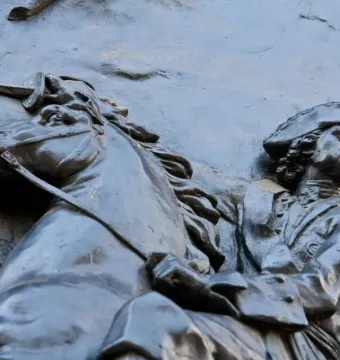
Monument to Peter I is a bronze equestrian monument of Peter the Great in front of St. Michael's Castle in Saint Petersburg, Russia. Commissioned in 1716 by Peter the Great, it was designed by Carlo Bartolomeo Rastrelli to commemorate Russian victories in the Great Northern War. Although the model was approved in 1724, the work was not completed until 1747 and the statue was not erected until 1800, during the reign of Paul I. The pedestal is faced with Finnish marble and decorated with bas-reliefs of the battles of Poltava and Hangö, along with an allegorical composition of trophies. During World War II, the statue was removed for safekeeping and restored to its pedestal in 1945.
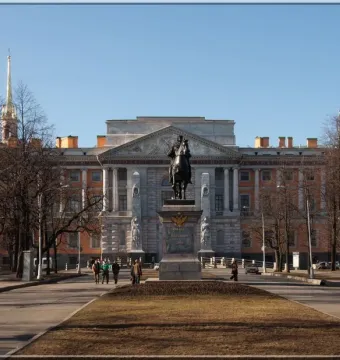
April 2011 © Andrey Korchagin · CC BY-SA 2.0
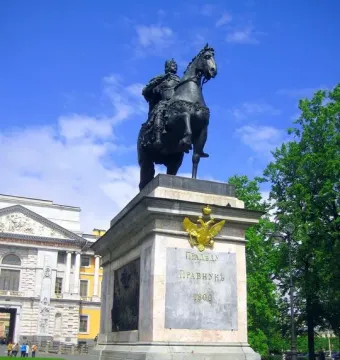
June 2017 © GAlexandrova · CC BY-SA 4.0
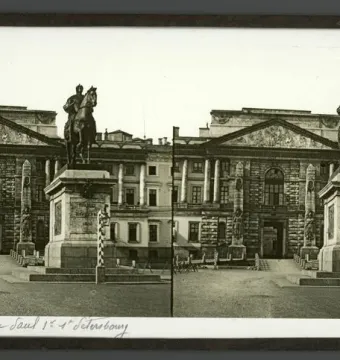
© Rijksmuseum · CC0
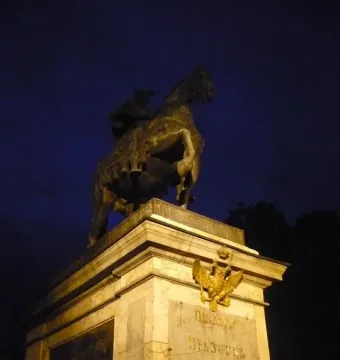
© Ринат Камалиев · CC BY-SA 3.0
July 2011 © Mihail Grishagin · CC BY-SA 3.0
Identification | |
| Title | Monument to Peter I |
| Original-language names | Памятник Петру I; Pomnik Piotra I; Denkmal Peters des Großen |
| Type | Bronze equestrian monument |
| Subject | Peter I of Russia (Peter the Great) |
Historical context | |
| Commissioned by | Peter the Great |
| Commission date | 1716 |
| Purpose | To commemorate Russian victories over Sweden in the Great Northern War |
| Planned as lifetime monument | Yes |
Creator | |
| Model approval date | 1724 |
| Model approved by | Peter the Great |
| Modeling period | Eight years |
| Relation to Bartolomeo Rastrelli | Father of Bartolomeo Rastrelli the Younger |
| Designer | Carlo Bartolomeo Rastrelli, an Italian sculptor active in Russia |
History and restoration | |
| Placement history | Originally planned for Vasilyevsky Island and later for the Winter Palace square, but neither project was realized |
| Transfer history | Given by Catherine II to Prince G. A. Potemkin in 1782, then kept under a wooden canopy near the Troitsky Bridge until 1798 |
| Paul I relocation plans | In 1798–1799 Paul I ordered the monument moved first to Kronstadt, then to the square in front of Mikhailovsky Castle |
| Inscription | "To the great-grandfather from the great-grandson" ("Прадеду — правнук") |
| Inscription ordered by | Paul I |
| Inscription alludes to | The Latin inscription 'Petro Primo Catherina Secunda' on the Bronze Horseman |
| Pedestal decoration | Bronze bas-reliefs and military trophies |
| Bas-relief subjects | The Battle of Poltava and the Battle of Gangut (Hangö) |
| Stored before erection | Kept in a warehouse on site for 53 years |
| Restored and returned | 1945 |
| Removed during World War II | Removed from its pedestal during the Siege of Leningrad to protect it from artillery shelling |
| Erected during reign of | Emperor Paul I |
| Erected | 1800 |
| New project date | 1720 |
| Casting completed after sculptor's death | Yes |
| Casting completed | 1747 |
| Work stopped | After Peter the Great's death in 1725 |
| Later completion work | Chasing, finishing, and pedestal making remained after the bronze casting |
Location and ownership | |
| Location | In front of the main entrance to Michael Palace (St. Michael's Castle), Saint Petersburg, Russia, near Constable's Square |
Physical characteristics | |
| Form | Four-sided pedestal with an equestrian statue |
Materials | |
| Statue material | Bronze |
| Pedestal colors | Green, red, white, and pink slabs |
| Pedestal material | Marble, including Finnish marble and Olonets marble |
Appearance | |
| Artistic characterisation | Described as a 'Petersburg condottiere' |
| Visibility | Visible from all sides |
| Rider pose | The rider sits calmly and impassively |
| Horse pose | The horse moves majestically and solemnly |
| Attributes | Laurel wreath, commander’s staff, ermine mantle, battle breastplate, sword at left hip, open Roman sandals |
| Depiction | Peter the Great shown on horseback as a Roman Caesar and victorious commander |
Technique | |
| Workshop facilities | A workshop with a small casting furnace and a large casting barn was provided |
| Casting method | The monument was first modeled in lead, then cast in bronze with a wax model for casting |
Significance | |
| Historical significance of battles | They helped Russia become the dominant power in northern Europe |
| Artistic assessment | Praised for monumentality, visual integrity, and a silhouette readable from every angle |
| Comparative reference | Often compared with Falconet's Bronze Horseman, which is said to be more pictorial and less sculptural |