
Ecstasy of Saint Teresa
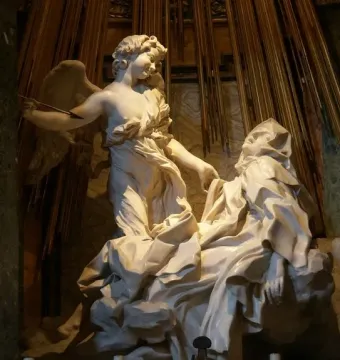
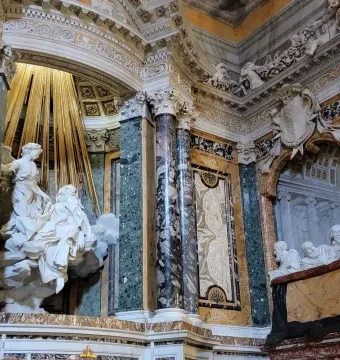
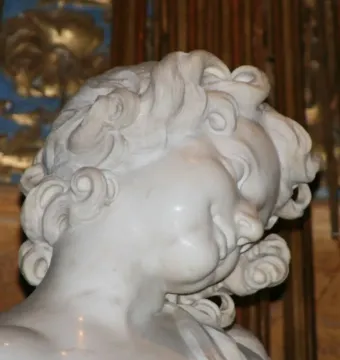
Ecstasy of Saint Teresa is a Baroque sculptural group by Giovanni Lorenzo Bernini, created between 1647 and 1652 for Cardinal Cornaro’s family chapel at Santa Maria della Vittoria in Rome. Carved in white marble, it is placed in a niche within the altar setting of the Cornaro Chapel, separated from the church’s main space by a low balustrade. The composition depicts Saint Teresa of Ávila and an angel at the moment of her ecstatic vision, with the saint reclining on a cloud as the angel approaches with an arrow. The scene is treated in a strongly theatrical manner, reinforced by sculpted members of the Cornaro family in бокed loges at the sides. Long admired and later criticized for its eroticism, the work is regarded as one of Bernini’s most famous and accomplished achievements.
March 2005 © Dnalor 01 · CC BY-SA 3.0 at
November 2021 © Викидим · CC BY-SA 4.0
1640 © Gian Lorenzo Bernini · Public domain
© sailko · CC BY-SA 3.0
· CC BY-SA 2.5
Identification | |
| Title | Ecstasy of Saint Teresa |
| Alternative titles | The Transverberation of Saint Teresa; Die Verzückung der heiligen Teresa; Die Entrückung der heiligen Teresa; L'Estasi di Santa Teresa; Santa Teresa in estasi; Transverberazione di santa Teresa; El Éxtasis de santa Teresa |
| Type | Baroque sculptural group |
Creator | |
| Artist | Gian Lorenzo Bernini |
| Artist description | Italian Baroque sculptor and painter; one of the greatest sculptors of the 17th century |
Historical context | |
| Date of creation | 1645–1652 |
| Completion date | 1652 |
| Style | Baroque |
| Art-historical characterization | A classic example of Baroque theatricality and one of the masterpieces of Roman High Baroque sculpture |
| Commissioned by | Cardinal Federico Cornaro |
| Commission context | Commissioned for Cornaro's funerary chapel during the papacy of Innocent X, when Bernini had reduced access to papal patronage |
| Intended location | The Cornaro family's chapel in the church of Santa Maria della Vittoria, Rome |
Discovery and provenance | |
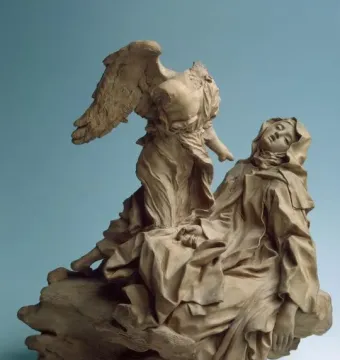
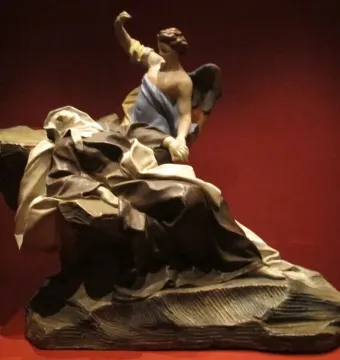
| Related small model | The Hermitage Museum preserves a small terracotta version dated 1644–1647 and 47 cm high |
| Cost | 12,000 escudos, described as exorbitant at the time |
| Previous chapel subject | It replaced an earlier representation of Saint Paul in ecstasy |
Physical characteristics | |
| Height | 350 cm |
| Scale | Small dimensions |
| Type of work | Sculptural group and chapel decoration |
| Composition | A front-facing composition placed in a niche and framed as a chapel aedicule or proscenium |
| Setting | Cornaro Chapel, left transept of Santa Maria della Vittoria, Rome |
Materials | |
| Main material | White Carrara marble |
| Additional materials | Gilded bronze; polychrome marble; gilded metal; spotted marble; yellow glass |
| Chapel interior materials | Polychrome marble slabs with gilded friezes and column capitals |
Technique | |
| Sculptural technique | Marble carved with exceptionally fluid, wax-like softness |
| Architectural modification | The depth of the transept was enlarged to create the chapel setting |
Appearance | |
| Angel's action | Extending a spear, arrow, or dart toward Teresa |
| Bronze rays | A burst of gilded bronze rays descends behind the figures, symbolizing divine love |
| Lighting and background | A hidden upper yellow-glass window provides top light that illuminates the figures and intensifies the golden rays behind them |
| Drapery treatment | Both figures are wrapped in swirling drapery with deep shadows; Teresa's mantle falls disordered over her body |
| Pose of Teresa | She rises on a cloud with limp limbs, reclining half-lying and appearing abandoned |
| Appearance of the angel | A youthful, delicate cherub with a playful or mysterious smile |
| Expression of Teresa | Eyes closed or half-closed, mouth open as if groaning, face sweet and emotional |
| Scene | Teresa's mystical transverberation, with the angel piercing her heart with the arrow or spear of divine love |
| Figures depicted | Saint Teresa of Ávila and an angel/cherub |
Iconography and meaning | |
| Subject source | Saint Teresa's autobiographical Book of Life, especially her description of a fiery angelic transverberation |
| Narrative moment | The moment when Teresa, losing consciousness, awaits or receives the piercing of her heart |
| Symbolic meaning | The scene represents the mystical ecstasy of divine love and the pain-and-joy of transverberation |
| Inscription | Nisi coelum creassem, ob te solam crearem |
| Inscription translation | If I had not created the heavens, I would have created them for you alone |
| Inscription source | A legend about Saint Teresa of Ávila |
Location and ownership | |
| Patron family | Cornaro family |
| Church | Santa Maria della Vittoria |
| Chapel | Cornaro Chapel |
| Current location | Cornaro Chapel, Church of Santa Maria della Vittoria, Rome, Italy |
History and restoration | |
| Chapel design | The chapel is designed like a theater stage, with side loggias or boxes containing members of the Cornaro family |
| Lighting design | A concealed window and bronze rays create a spotlight-like effect |
| Space concept | Bernini turns the chapel into a literal theater and a model of theatrum sacrum |
| Reception at the time | Widely admired by contemporaries |
| Later reception | Later baroque admiration turned into criticism, especially for the plump angels and perceived eroticism |
| Influence | It became a model for numerous later works of sacred art and Bernini's cloud-and-putti solutions |
Significance | |
| Art-historical significance | Considered one of Bernini's supreme achievements and a masterful synthesis of architecture, sculpture, and painting |
| Critical assessments | Jan Białostocki emphasized its illusionistic power; Julian Pagaczewski called it the best sculptural expression of mystical-ecstatic religiosity in the Counter-Reformation |
| Interpretive controversies | Some art historians have suggested a sexual interpretation; Ernst Gombrich compared the angel's appearance to Eros |
| Religious and cultural context | Created to satisfy Counter-Reformation ideals of intelligible, emotionally persuasive sacred art |
| Related saint | Saint Teresa of Avila, the Spanish Carmelite reformer, writer, and first Carmelite saint canonized in 1622 |