
Pietà (Michelangelo)
Pietà is a Carrara marble sculpture by Michelangelo Buonarroti, created in 1498–1499 for Saint Peter’s Basilica in Vatican City. It depicts the moment Jesus is taken down from the cross and given to his mother Mary, and is widely seen as a key work of Italian Renaissance sculpture and an early High Renaissance masterpiece. The statue was commissioned by French cardinal Jean Bilhères de Lagraulas for his funeral chapel in Old St Peter’s, later moved to its current location in the new basilica. It is the only work Michelangelo ever signed. After vandalism in 1972, the sculpture was restored and protected behind glass, which was modernized in 2024.
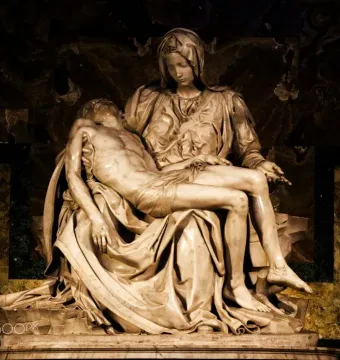
September 2017 © Kaan Yurdakul · CC BY-SA 3.0
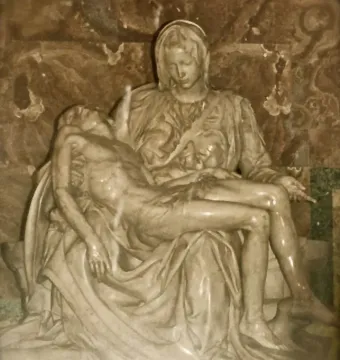
July 2012 © Heribert Pohl --- Thanks for half a million clicks! · CC BY-SA 2.0
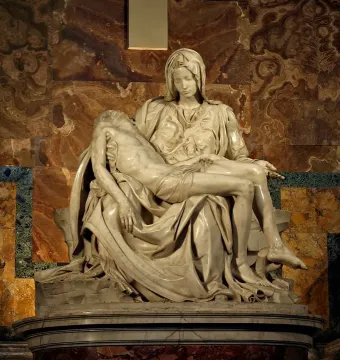
© Stanislav Traykov · CC BY 2.5
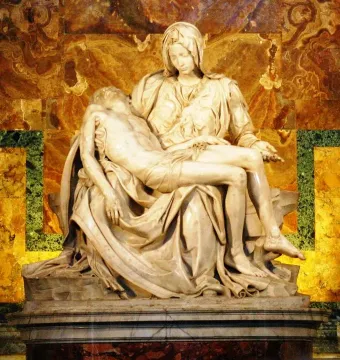
© Fabio Poggi · CC BY 3.0
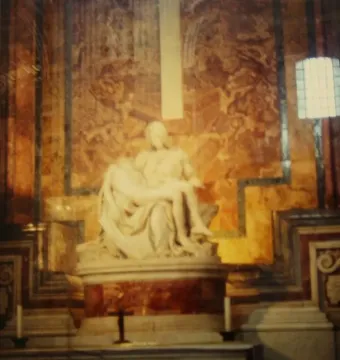
June 2000 © Gary Todd · CC0
Identification | |
| Title | Pietà |
| Alternative titles | Madonna della Pietà; Vatican Pietà; Roman Pietà; La Piedad del Vaticano; Lamentation of Christ |
| Translation of title | [Our Lady of] Pity |
Historical context | |
| Date | 1498–1499 (some sources extend completion to 1500) |
| Creation period | Made during Michelangelo's first stay in Rome, 1496–1501 |
Creator | |
| Signature translation | "Michelangelo Buonarroti, Florentine, was making it" |
| Signature significance | The only work Michelangelo signed |
| Signature | MICHAEL A[N]GELVS BONAROTVS FLORENT[INVS] FACIEBAT, carved on the Virgin's shoulder strap |
| Artist | Michelangelo Buonarroti |
| Age of artist at completion | About 24–25 years old |
Discovery and provenance | |
| Commissioner's titles | Benedictine abbot of Saint-Denis; ambassador of Charles VIII to the Holy See |
| Commission arranged through | Jacopo Galli |
| Commission date | 26 August 1498 |
| Contract price | 450 gold ducats (one-third of an agreed 500 ducats) |
| Commissioner | French cardinal Jean Bilhères de Lagraulas |
| Intended function | Funerary sculpture, probably intended as an altarpiece |
| Intended placement | The cardinal's chapel in Old St. Peter's / Santa Petronilla, Vatican |
| Original placement | On the prelate's tomb in the Chapel of Saint Petronilla in Old St. Peter's |
| Marble selection | Michelangelo personally selected a marble block at the Carrara quarries in March 1498 and supervised its transport to Rome |
| Completion date | December 1499 (finished two days before the deadline; some sources say 1499 or 1500) |
| Contract deadline | One year |
Physical characteristics | |
| Type | Marble sculpture group |
| Dimensions | 174 cm high × 195 cm wide |
Materials | |
| Material | Carrara marble |
Appearance | |
| Depiction of Christ | Christ is dead and deliberately shown to appear older than his mother |
| Depicted figures | The Virgin Mary holding the dead body of Jesus Christ after the Crucifixion |
| Composition | A calm triangular composition with a preferred frontal viewpoint |
| Depiction of Mary | Mary is shown as a young, beautiful, pious woman, younger than Jesus, with her garments falling in numerous folds |
Iconography and meaning | |
| Subject | The Pietà motif: the Virgin Mary holding the dead Christ |
| Religious theme | Represents the Sixth Sorrow of the Virgin Mary |
| Interpretation | Mary's youth is linked to purity and the Immaculate Conception; the scene emphasizes tenderness and grief rather than extreme pain |
| Possible inspiration | A passage in Dante's Divine Comedy, especially Paradiso, Canto XXXIII |
Location and ownership | |
| Current location | St. Peter's Basilica, Vatican City |
| Current placement | First chapel on the north/right side after the entrance, also called the Chapel of the Pietà |
| Current location date | Since 1749 |
History and restoration | |
| Exhibition history | Removed from St. Peter's Basilica only once, for the 1964 New York World's Fair (1964–1965) |
| Restoration after vandalism | Restored in 1972 by Deoclecio Redig de Campos's team using original fragments where possible and a glue-and-Carrara-marble-powder fill; completed on 21 December 1972 |
| Protection | Protected by bulletproof glass since the 1972 attack; the screen was replaced and modernized in November 2024 in preparation for the 2025 Jubilee |
| Vandalism | Attacked with a hammer by László Tóth on 21 May 1972 (Pentecost Sunday), severely damaging the Virgin's face, left arm, elbow, nose, and eyelids |
| First recorded damage | Four fingers of the free left hand were broken off during a rearrangement; later restored in 1736 by Giuseppe Lirioni, though the restoration may not have been exact |
| Preservation history | Preserved when Old St. Peter's was demolished |
| Early relocation history | Moved within St. Peter's several times, including to the sacristy shortly before 1517, the Vergine della Febbre chapel in 1517, the old Sistine choir in 1568, the altar of Saints Simon and Jude during construction work, and the new choir in 1626 |
Significance | |
| Art-historical significance | A key work of Italian Renaissance sculpture, often taken as the start of the High Renaissance and considered one of the most important and most famous works of Western sculpture |
| Artistic significance | Praised for combining early naturalism with Renaissance classical beauty; considered Michelangelo's first masterpiece and one of his most famous sculptures |
| Sculptural significance | The Roman Pietà is the first known Pietà of this type created by an Italian sculptor |
| Reception | Immediately admired and highly praised; Giorgio Vasari praised its design, grace, strength, delicacy, polish, and marble carving |
| Place in Michelangelo's oeuvre | The first of Michelangelo's Pietà depictions, with later related works including the Florentine Pietà, Palestrina Pietà, and Pietà Rondanini |
| Overall style | Serene Classical Renaissance |