
Beautiful Madonna of Wrocław
Beautiful Madonna of Wrocław is a Gothic full-figure sculpture of Mary and the Child Jesus, and one of the most valuable works known as Beautiful Madonnas. It belongs to the Beautiful Style, a trend in Gothic art active in Central Europe around the turn of the 14th and 15th centuries. The figure combines graceful composition, idealized beauty, and rich drapery with notable realism in the poses, anatomy, and details. Its symbolism connects Mary with the New Eve and Christ with the New Adam, while the red and white of her garments are linked to salvation. Before 1945, the sculpture was in Wrocław; it is now on display in the Medieval Art Gallery of the National Museum in Warsaw.
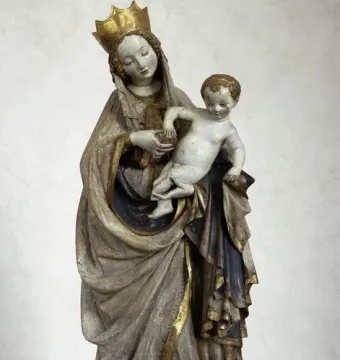
© Autor nieznany / Reprodukcja cyfrowa wykonana przez Muzeum Narodowe w Warszawie z egzemplarza pochodzącego ze zbiorów MN w Warszawie. · CC0
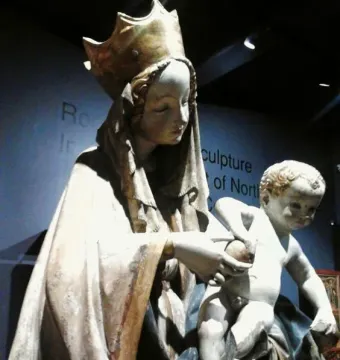
© Master of Beautiful Madonnas · CC0
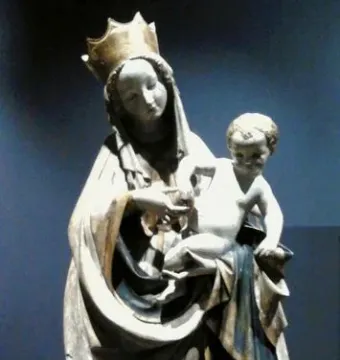
© Master of Beautiful Madonnas · CC0
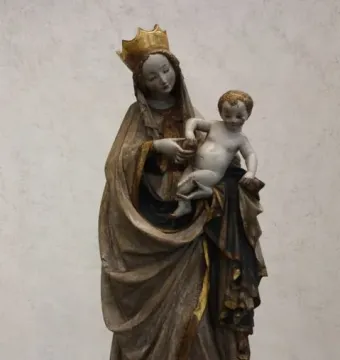
© Master of Beautiful Madonnas (Silesia or Bohemia) · CC BY 3.0
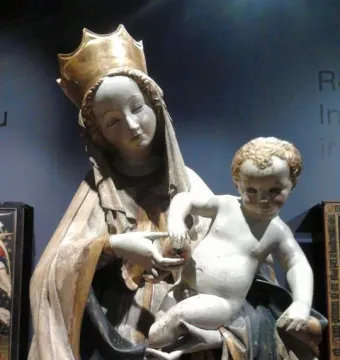
© Master of Beautiful Madonnas · CC0
Identification | |
| Title | Beautiful Madonna of Wrocław |
| Original names | Piękna Madonna z Wrocławia; Schöne Madonna von Breslau; Madonna z Wrocławia; Wrocławska Piękna Madonna; Madona de Breslavia |
| Type | Gothic full-round sculpture of the Virgin Mary with the Child Jesus |
| Artistic genre | Beautiful Madonna |
Historical context | |
| Style | Beautiful Style |
| Art-historical context | A trend in Gothic art in Central Europe at the turn of the 14th and 15th centuries |
| Date | Around 1390–1400 |
| Regional context | Silesia and Wrocław were important artistic centers in the Crown of Bohemia |
Creator | |
| Artist origin | Probably Silesia or Bohemia |
| Artist | Unknown |
Discovery and provenance | |
| Probable origin | Church of St. Elizabeth in Wrocław |
| Former location | Museum of Silesian Crafts and Antiquities in Wrocław |
| Former location date | Until 1945 |
| Current location | Gallery of Medieval Art, National Museum in Warsaw |
| Patron or intended recipient | Unknown |
| Original destination | Unknown |
Physical characteristics | |
| Height | 113 cm |
| Form | Fully three-dimensional figure |
| Base | Octagonal |
Materials | |
| Polychromy | Partially polychromed; original paint survives in fragments |
| Material | Limestone |
Appearance | |
| Right side drapery | Cascade-like forms, similar to the veil |
| Mary's age | Young |
| Child Jesus gesture | Gently touching the apple with his right hand and looking at it |
| Child Jesus appearance | Nude, seated on Mary's left shoulder, with softly modeled body |
| Colors | Mary and Child skin tones were delicate white-peach; the mantle lining was dark blue; the tunic was white; the edges of the garments, Mary's crown, and the infant's hair were gilded; the mantle may originally have been white or red; the base preserves traces of green paint |
| Left side drapery | Strong parallel curves |
| Drapery | The mantle clings closely to the back and falls in decorative folds at the front |
| Mary's pose | Contrapposto: she supports herself on her right leg, bends the left leg forward, and inclines the head and torso in opposite directions |
| Mary's hair and headwear | Hair styled in curls, covered by a veil with a crown on top |
| Mary's features | Beautiful face with delicate features, high bare forehead, eyelids slightly lowered over the eyes, and small mouth |
Iconography and meaning | |
| Subject | Virgin Mary with the Child Jesus |
| Apple symbolism | Mary is shown as the New Eve, and Christ as the New Adam, through the symbolic apple |
| Meaning of Child Jesus' nudity | It emphasizes Christ's humanity and is associated with the Eucharist |
| Mary's clothing symbolism | The red and white garments symbolize salvation; red may evoke the blood of Christ's Passion, and white is associated with the body of Christ and the Lamb of God in Revelation 7:9–15 |
| Mary's beauty | Her realistic feminine beauty is understood as a reference to the spiritual beauty of the Mother of God |
Artistic significance | |
| Artistic value | One of the most valuable full-figure depictions of Mary with the Child Jesus in the Beautiful Madonna genre |
| Style features | Dynamic and fluid composition, slight idealization, abundant drapery, and realism in the pose, modeling, proportions, anatomy, spatial treatment, and detail |
Other | |
| Comparative context | Comparable works include the Madonna from Český Krumlov, the Beautiful Madonna of Toruń, and related sculptural devotional works from the same milieu in Wrocław and nearby churches |
| Scholarly discussion | The origins, geographical range, characteristics, and duration of the Beautiful Style/Beautiful Madonna genre are debated |