
Mary Magdalene
Mary Magdalene, also known as La Belle Allemande, is a late Gothic wooden sculpture by Gregor Erhart, dated to around 1510. Made of lime wood and partly covered with polychromy, it is a life-sized full-figure work showing Mary Magdalene as a young woman with delicate features, a slight tilt of the head, and hands clasped in prayer. Her nude body is animated and partly concealed by long, wavy hair with a reddish tint. The sculpture was probably once in a Dominican church in Augsburg, later belonged to Siegfried Lämmle’s Munich collection, and was purchased for the Louvre in 1902, where it remains today.
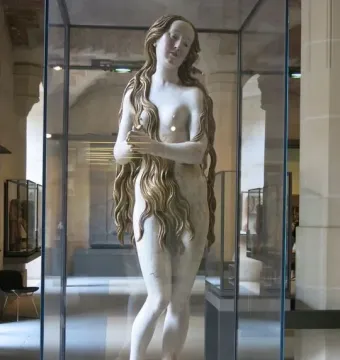
August 2017 © Tangopaso · Public domain
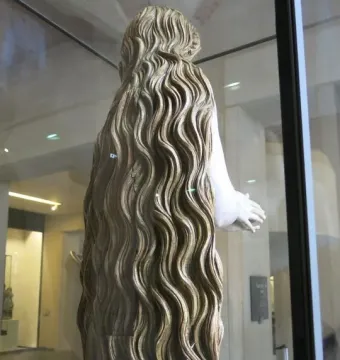
August 2017 © Tangopaso · Public domain
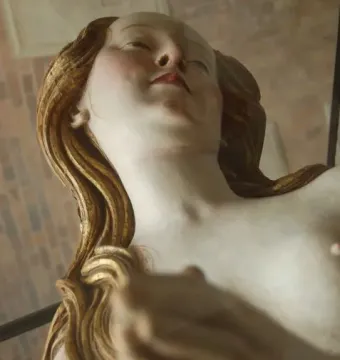
June 2007 © Gautier Poupeau · CC BY 2.0
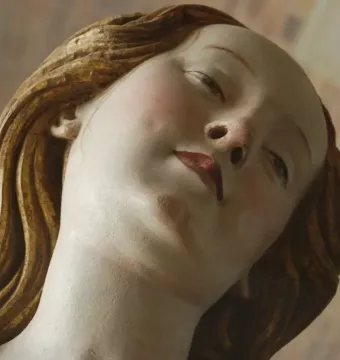
June 2007 © Gautier Poupeau · CC BY 2.0
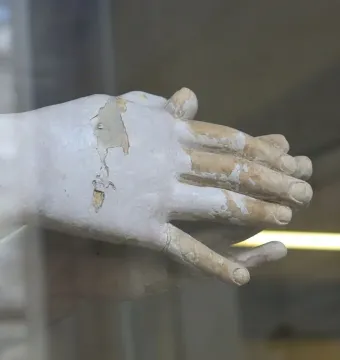
August 2017 © Tangopaso · Public domain
Identification | |
| Alternative titles | La Belle Allemande; Saint Mary Magdalene; Penitent Magdalene; La Maddalena penitente; Erhart Magdalene |
| Title | Mary Magdalene |
Creator | |
| Artist | Gregor Erhart |
| Artist nationality | German |
| Artist training | Trained in Ulm under his father |
| Attribution | Attributed to Gregor Erhart |
Historical context | |
| Historical use | Church decoration in 16th-century Bavaria |
| Early history | The earliest history of the figure is unknown |
| Art historical context | Combines new ideas arriving from Italy with the late Gothic tradition that survived in the German Empire through the first half of the 16th century; situated between Gothic art and Renaissance art |
| Style | Late Gothic sculpture |
| Date | circa 1510–1520 |
Materials | |
| Material | Lime wood (wood; linden wood) |
| Surface treatment | Partially covered with polychromy; original polychromy preserved |
Technique | |
| Technique | Wood carving |
Physical characteristics | |
| Facial features | Small eyes and mouth; delicate features |
| Hair | Long, wavy, reddish hair covering the body |
| Body depiction | Nude |
| Dimensions | Life-size |
| Hands | Folded in prayer |
| Pose | Contrapposto |
| Form | Fully three-dimensional; carved on all sides; back sculpted as fully as the front |
| Type | Life-size free-standing wooden sculpture |
| Head position | Slightly inclined and turned to the left |
Appearance | |
| Viewability | Visible from all sides |
| Attachment device | Hanging device on the back/front for suspension in a church nave |
| Missing elements | Angels originally surrounded the figure |
| Original installation | Suspended from the vault and supported by flying angels |
Iconography and meaning | |
| Legend depicted | After going to Provence, Mary Magdalene lived in the Sainte-Baume cave, covered only by her hair, praying; angels carried her daily to hear the heavenly choirs |
| Possible inspiration | A Dürer engraving or woodcut showing Mary Magdalene may have inspired the pose |
| Depiction | Mary Magdalene nude, wrapped only in long hair |
| Iconographic source | Legenda Aurea (The Golden Legend) by Jacobus/Jacques de Voragine |
| Figure type | Penitent Magdalene |
| Subject | Mary Magdalene, the penitent sinner who repented and joined the disciples of Christ |
Location and ownership | |
| Probable original location | The Dominican Church of St. Magdalene / Santa Maria Maddalena in Augsburg |
| Former ecclesiastical context | The church was attached to a monastery of the Dominican Order |
| 19th-century ownership | Siegfried Lämmle collection; held in private collections |
| Acquisition by the Louvre | Purchased by the Louvre in 1902 using funds from the bequest of Madame Émile Louis Sévène, née Laure Eugénie Declerck |
| Current location | Louvre Museum, Paris |
| Current status | On display at the Louvre |
History and restoration | |
| Later alterations | Voids left by the attachment points for suspension and the angels were filled in; small cavities remain from clothing tacked on in the 17th or 18th century; the base and front part of the feet were restored in the 19th century |
| World War II history | Coveted by Hermann Göring during World War II; taken to Germany during the Nazi occupation in 1943 at Göring's request; recovered by the Allies in 1945 from Berchtesgaden; returned to the Louvre |
| Nazi-era dispute | Göring claimed he had not stolen the sculpture; he acquired it in exchange for French artworks from his collection, including a Coypel canvas stolen from the Parisian Rothschild family |
Significance | |
| Art-historical assessment | Described by Grove Art Online as an astonishing advance toward a new autonomy in sculpture |
| Comparative context | The medieval nude was rare; the penitent nude Mary Magdalene became widespread in Renaissance painting and printmaking; compared with late Gothic Adam and Eve sculptures once in Würzburg town hall |
| Stylistic features | Blends the peaceful grace and gentle physiognomy of the South German tradition with blossoming female forms of the Renaissance |