
Bust of Charlemagne
The Bust of Charlemagne is a reliquary made around 1350 in the form of Charlemagne’s bust. According to tradition, it contains his skullcap as a relic. The work belongs to the late medieval furnishings of Aachen Cathedral and is kept in the Aachen Cathedral Treasury. It is regarded as one of the most important examples of Gothic goldsmiths’ work and is probably the best-known reliquary bust of all. The sculpture is an idealized image rather than a portrait of Charlemagne. Its crown is older than the bust itself, probably made in a Prague workshop, and was used for the coronations of Charles IV in 1349 and Sigismund in 1414, when the imperial crown was unavailable.
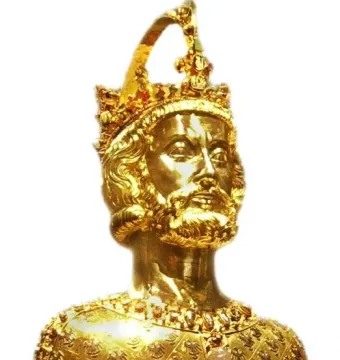
May 2007 © Lokilech · CC BY-SA 3.0
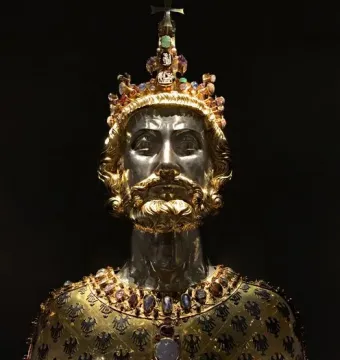
September 2022 © Florian B. Gutsch · CC BY-SA 4.0
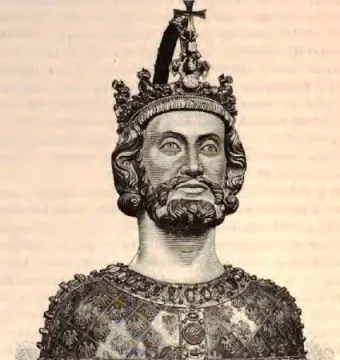
1898 © Spyridōn Paulou Lampros · Public domain
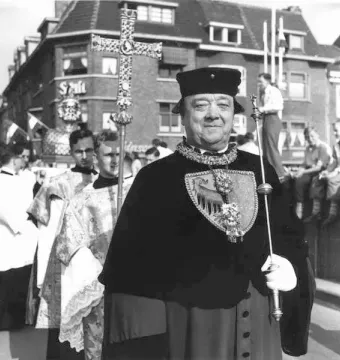
July 1955 © Naseman · CC BY-SA 3.0
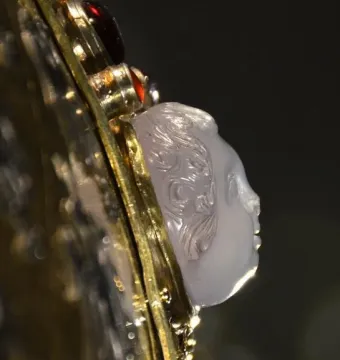
September 2016 © Vassil · CC0
Identification | |
| Title | Bust of Charlemagne |
| Original name | Karlsbüste |
| Type | reliquary bust |
| Subject | Charlemagne |
Historical context | |
| Date created | circa 1350 |
| Tradition of creation | According to Aachen tradition, it was made on the occasion of Charles IV's sponsorship at the time of his coronation at Aachen Cathedral; the donation is not documented but is considered probable because of Charles IV's admiration for Charlemagne |
Creator | |
| Maker | An Aachen goldsmith, possibly trained in France |
Discovery and provenance | |
| Place of manufacture | Mosan region (the valley of the River Meuse) |
| Associated with | late medieval furnishings of Aachen Cathedral |
| Original patron/donor | According to Aachen tradition, Charles IV |
Location and ownership | |
| Current location | Aachen Cathedral Treasury, Aachen |
| Display location | Cathedral treasury room in Aachen Cathedral |
| Current placement for liturgical occasions | Set up in Aachen Cathedral for the Karlsfest and the Feast of the Ascension |
Physical characteristics | |
| Garment border | Gold filigree border set with precious stones |
| Body decoration | Damascened silver imperial eagles on a gold ground |
| Face and neck | Chased silver with pronounced modeling; partly gilt |
| Hair and beard | Gilded |
| Base | Octagonal pedestal with openings on two sides for a carrying pole or wooden carrying frame |
| Representation | An idealized depiction of Charlemagne with some individualized facial features; not a realistic portrait |
| Form | Portrait bust |
| Crown | Gold lily crown set with precious stones; probably modified for Charles IV's coronation and later restored by August Witte in 1873 |
Materials | |
| Main material | Silver-gilt |
| Additional materials | Precious stones, including antique gems such as cameos and intaglios |
Technique | |
| Metalworking technique | Chased and repoussé silver, partly gilded, with damascening and filigree |
Iconography and meaning | |
| Crown use | Used for the coronations of Charles IV in 1349 and Sigismund in 1414 when the imperial crown was not available |
| Crown modification | The central arch with a cross, or strap holding the cross, was probably added for Charles IV's coronation |
| Liturgical use | Carried in processions and brought before the king at coronations, where the ruler was symbolically received by Charlemagne as his legitimate successor |
| Crown provenance | According to a charter of 1262, Richard of Cornwall granted the crown to Aachen Minster for all time |
| Ritual meaning | The new ruler venerated the relic of Charlemagne as his predecessor |
| Function | A reliquary that, according to tradition, contains the skullcap of Charlemagne as a relic |
| Meaning | The imperial eagles and fleur-de-lis refer to Holy Roman imperial dignity and French kingship; the antique gems and cameos allude to Roman antiquity and medieval imperial ideology |
Significance | |
| Art-historical significance | One of the most important examples of Gothic goldsmithing and a masterpiece of late Gothic metalwork and figural sculpture; a high point of Rhenish-Mosan goldsmithing |
| Historical influence | Helped initiate a flourishing period of silver-gilt, naturalistically modeled bust reliquaries |
| Fame | Probably the best-known and most famous reliquary bust in the world |
| Use in modern symbolism | A central stylized element in the signet/logo of the Charlemagne Prize Foundation and a recognizable symbol of Aachen |