
Fountain of the Great Lakes
Fountain of the Great Lakes, also known as Fountain of the Spirit of the Great Lakes, is an allegorical bronze sculpture by Lorado Taft. Created between 1907 and 1913, it is located in the South Stanley McCormick Memorial Court of the Art Institute of Chicago, in the Loop community area of Chicago, Illinois. The fountain depicts five women, with water flowing over and from them in a way that evokes the movement of water through the Great Lakes between the United States and Canada. It is regarded as one of Taft’s best-known and finest works. Commissioned by the Benjamin Ferguson Fund, the fountain originally faced south before being moved in 1963 to its current westward orientation.
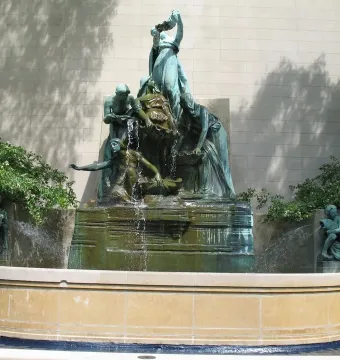
June 2007 © User:TonyTheTiger · CC BY 2.0
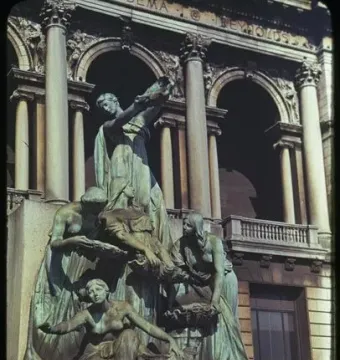
1941 © IMLS Digital Collections & Content · CC BY 2.0
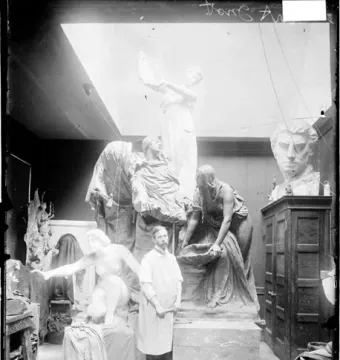
1909 © Chicago Daily News · Public domain
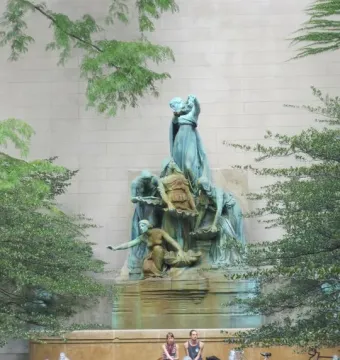
September 2010 © Teemu008 · CC BY-SA 2.0
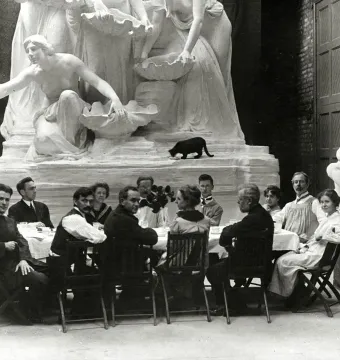
© Unknown authorUnknown author · Public domain
Identification | |
| Title | Fountain of the Great Lakes |
| Alternative titles | Fountain of the Spirit of the Great Lakes; Spirit of the Great Lakes Fountain; Fontana dei Grandi Laghi; La fontaine des Grands Lacs; B. F. Ferguson Fountain of the Great Lakes |
| Type | Allegorical fountain and sculpture |
Creator | |
| Artist | Lorado Taft |
Discovery and provenance | |
| Commissioned by | Benjamin Ferguson Fund / Ferguson Trust Board |
| Funding source | Benjamin Ferguson's $1 million charitable trust gift in 1905 to memorialize events in American history |
| Commission status | First commission of the Ferguson Fund |
| Conceptual origin | Inspired by Daniel Burnham's complaint at the 1893 World's Columbian Exposition that sculptors had not represented the great natural resources of the West, especially the Great Lakes |
| Design origin | Began as an assignment to Taft's students in spring 1902 |
| Awards for model | Won first prize in sculpture from the Chicago Municipal Art League and the Society of Chicago Artists Medal |
| Commission date | October 31, 1907 |
| Contract date | December 16, 1907 |
| Contract amount | $38,000 |
| Site-selection history | The final site remained undecided for some time after the contract was signed; proposed sites included Grant Park south of the Art Institute, a submerged garden south of the Art Institute, the south wall of the Art Institute of Chicago Building, and the intersection of 35th Street and Grand Boulevard (now Martin Luther King, Jr. Drive) |
| Delays | Delays were caused by funding problems, uncertainty over whether the work should be a sculpture or a portrait, and legal uncertainty over Grant Park land use |
| Publicity and advocacy | Taft published an image of Spirit of the Great Lakes in Century Magazine to gain support; Buffalo, New York also showed interest, and the Buffalo Illustrated Times featured the work in February 1907 |
| Early study / model | A plaster model was made in mid-January 1906 and shown at the Art Institute of Chicago annual exhibition in late January 1906 |
Physical characteristics | |
| Style | Large allegorical work in an Old World / Beaux-Arts idiom |
| Base designer | Shepley, Rutan and Coolidge |
| Nudity | Semi-nude; three of the five figures have nude upper torsos |
| Subject | Five women personifying the Great Lakes |
| Number of figures | 5 |
Materials | |
| Material | Bronze |
| Model material | Plaster |
Technique | |
| Casting | The model was dismantled in May 1913 and taken to Jules Berchem's foundry to be reassembled and cast in bronze |
Appearance | |
| Water imagery | Water flows from and over the five figures |
Iconography and meaning | |
| Iconography | The figures and water flow represent the Great Lakes and the direction of water flow through them |
| Geographic reference | The flow begins in Lake Superior and moves eastward through the lakes to Lake Ontario, then to the sea via the Saint Lawrence River |
| Mythological reference | The imagery loosely references Greek mythology, especially Danaus and his 49 daughters |
| Interpretive note | The sculpture was meant to show the Great Lakes as inland seas with dignified, quiet water rather than heroic or violent motion |
Location and ownership | |
| Inscription | B. F. Ferguson Fountain of the Great Lakes |
| Rear plaque visibility | The plaque is now practically not visible and no longer legible |
| Rear plaque inscription | The fund must be used for erecting and maintaining enduring statuary and monuments |
| Rear relief visibility | It is no longer visible after the 1963 relocation |
| Rear relief | A relief portrait of Benjamin Ferguson is carved on the back panel |
| Relocation | Moved in 1963 next to the Morton Wing addition at the Art Institute of Chicago and reoriented to face west |
| Original visibility | In its original position it was visible from the Jackson and Michigan Avenue intersection, then known as the 'route center' to the south |
| Reason for relocation | Construction of the new Morton Wing at the Art Institute of Chicago Building |
| Current orientation | Facing west |
| Original installation | Originally installed facing south on an elevated platform near the original Art Institute of Chicago building |
| Current location | South Stanley McCormick Memorial Court, Art Institute of Chicago, Loop, Chicago, Illinois, United States |
History and restoration | |
| Assembly date | Mid-August 1913 |
| Dedication date | September 9, 1913 |
Recognition | |
| Notability | Considered one of Lorado Taft's best-known and most famous works |
| Critical reception | Reception was generally positive, though some critics questioned the symbolism, geographic correspondence, decorum, and old-fashioned style of the sculpture |
| Cultural controversy | It was also discussed in relation to public nudity and Chicago obscenity laws |
| Career significance | Taft described the commission as a turning point that brought him publicity, more commissions, and greater recognition, lifting him beyond the level of a portraitist |
| Civic ideal | Taft hoped the fountain would begin a new era of civic beautification and help establish a Chicago school of sculpture |