
The Destroyed City
The Destroyed City is a bronze memorial sculpture by Russian-born French artist Ossip Zadkine in Rotterdam, the Netherlands. Unveiled in 1953, it commemorates the German bombing of Rotterdam on 14 May 1940, which destroyed the city’s medieval centre. The sculpture shows a stylized human figure leaning against a tree stump, with both hands raised, head thrown back, and a hole in the chest and abdomen symbolizing the loss of the city’s heart. It is Zadkine’s largest and best-known work, and one of Rotterdam’s best known sculptures. The work stands on a granite plinth near the Maritime Museum Rotterdam, was registered as a Rijksmonument in 2010, and has been known by several local nicknames.
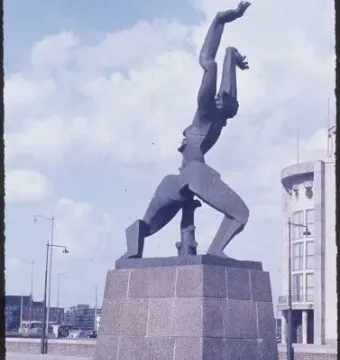
July 1956 © Peter H. Feist · CC BY-SA 4.0
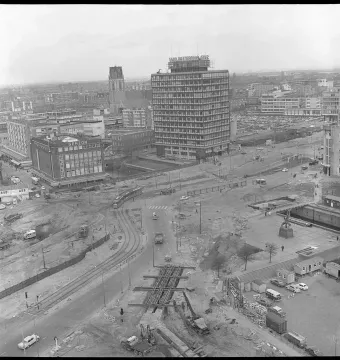
© Ary (A.) Groeneveld · CC0
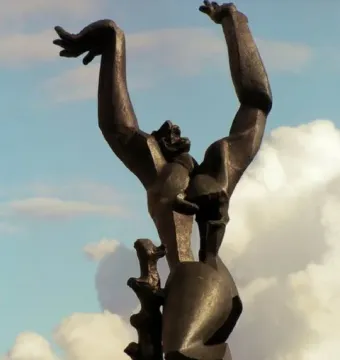
April 2014 © Miyoli · CC BY-SA 3.0 nl
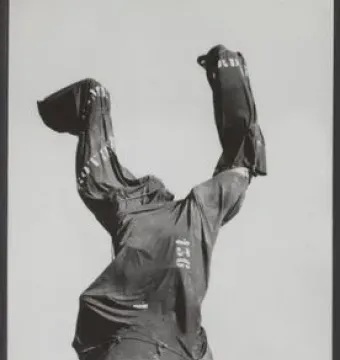
May 1953 © van Duinen / Anefo · CC0
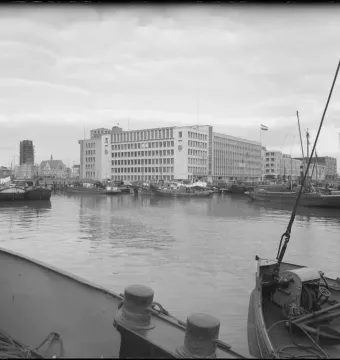
February 1957 © Fototechnische Dienst Rotterdam (Gemeentewerken, Openbare Werken) · CC BY 4.0
Identification | |
| Title | The Destroyed City |
| Dutch title | De verwoeste stad |
| French title | Monument à la ville détruite de Rotterdam |
| Alternative titles | La ville détruite; La ville dévastée; La ville déchirée; The Devastated City; The Torn City; Monument to the Destroyed City of Rotterdam |
| Nicknames | Stad zonder hart ('City without a heart'); Zadkini; Jan Gat; Jan met de handjes ('Jan with little hands'); Jan met de jatjes |
| Type | Bronze memorial sculpture |
| Original title | Разрушенный город |
Creator | |
| Artist | Ossip Zadkine |
| Artist background | Russian-born French sculptor |
| Artist lifespan | 1890–1967 |
Historical context | |
| Purpose | Made in memory of the bombing of Rotterdam and the destruction of the city |
| Historical effect commemorated | Destruction of Rotterdam's medieval centre |
| Commemorated event | The German bombing of Rotterdam on 14 May 1940 |
Discovery and provenance | |
| Bronze model exhibition | Exhibited at the Museum Boijmans Van Beuningen in Rotterdam in December 1949 |
| Production period | 1951–1953 |
| Casting foundry | Susse Frères foundry, Paris |
| Opponent's description | Called it a 'madly demonic scourge' that would 'paralyze the heart of my city forever' |
| Opponent of proposal | Tillema, director of Rotterdam's Department of Public Works |
| Plinth designer | Tillema, director of Rotterdam's Department of Public Works |
| Donation condition dispute | The condition that it remain at the exact location later led to numerous discussions |
| Donor identity | Unknown until 1978 |
| Gift status | Presented to the city as an anonymous gift on condition that Zadkine choose its location and that it remain permanently there |
| Early terracotta exhibitions | Exhibited in Berlin and Prague in 1947 |
| Commission cost | About 24,500 guilders |
| Commission purpose | To be donated to the municipality of Rotterdam after the Rotterdam De Bijenkorf store had been heavily damaged in the bombing |
| Commissioned by | Management of the De Bijenkorf department store |
| Plaster exhibitions | Exhibited in Brussels and at the Stedelijk Museum Amsterdam in 1948 |
| Plaster model | A similar plaster model, about 1.5 m high, made because the terracotta was fragile and unsuitable for transport |
| Terracotta damage | Damaged in transit |
| Early terracotta model | A 1947 terracotta memorial model, intended as a memorial to the victims of war, about 70 cm high |
| Friend visited | Hendrik Wiegersma, a doctor and painter in Deurne |
| Inspiration | Probably inspired in 1946 or 1947 when Zadkine saw the ruined centre of Rotterdam from a train traveling from Paris to Deurne |
Physical characteristics | |
| Pedestal | Tapering, conical base about 2 meters high |
| Body condition | A gaping hole in the chest and abdomen where the heart would be |
| Figure depicted | A stylized human figure leaning against a tree stump with both arms raised and head thrown back as if crying in grief |
| Height | About 6.5 meters |
| Scale | Life-size |
Materials | |
| Main material | Bronze |
| Pedestal material | Labrador granite blocks |
| Plinth material note | The stone reportedly had been intended for a sculpture of Adolf Hitler in Berlin |
Technique | |
| Artistic influences | Rodin and Cubism |
| Expressive style | Powerful expressive forms designed to be seen from below |
Appearance | |
| Pose and gesture | The figure appears to be screaming, leans against a tree stump, raises its arms toward the sky, and throws its head back as if crying in grief |
Iconography and meaning | |
| Interpretation | A cry of horror against the inhuman brutality of tyranny |
| Comparison | Compared to the figure with arms raised in terror at the far right of Picasso's Guernica |
| Artist statement | Zadkine described the work as 'a cry of horror against human cruelty' and as a personification of the human grief the city had to endure |
| Symbolism of missing heart | Symbolizes the destruction of Rotterdam's centre and the city's lost heart |
| General symbolism | Symbolizes human suffering, despair, discouragement, and resistance to inhuman cruelty |
Location and ownership | |
| Unveiled by | Jacoba van Walsum, wife of Mayor Gerard van Walsum |
| Listed as cultural heritage | Included in the list of cultural heritage objects of the Netherlands |
| Protected status year | 2010 |
| Protected status | Dutch national monument (Rijksmonument), number 530902 |
| Ownership | Gift to the city of Rotterdam from the management of De Bijenkorf |
| Installation cost | 24,500 guilders |
| Unveiling date | 15 May 1953 |
| Original unveiling location | Plein 1940, near Leuvehaven and the Maritiem Museum, Rotterdam |
| Placed in front of | The Maritime Museum Rotterdam and the former training ship De Buffel |
| Returned by | Mayor Ivo Opstelten |
| Returned on | 14 May 2007 |
| Temporary removal in 2005 | Removed temporarily for construction works and restored while in storage |
| Moved in 1975 | Moved about 60 metres before construction of a new metro line |
| Nearby landmark | Blaakse Bos cube house complex designed by Piet Blom |
| Current site | Outside the Maritime Museum Rotterdam, opposite the former training ship De Buffel and near the Blaakse Bos cube houses |
| Original site | North side of the basin at the beginning of Leuvehaven in central Rotterdam |
| Location | Plein 1940, Leuvehaven, Rotterdam, Netherlands |
History and restoration | |
| Restoration | Extensively restored in 2005 and returned in 2007 |
| Proposed relocation | A 2014 proposal to move it outside Rotterdam Centraal station was soon abandoned |
Significance | |
| Notability | Zadkine's largest sculpture and best-known work, and one of the best-known sculptures in Rotterdam and the Netherlands |
| Media mention | Its emotional impact was discussed in the BBC Radio 4 programme Pen Pals in February 2019 |
Other | |
| Photographic note | A 5 May 1953 photo shows the statue not yet mounted on its pedestal |