
Hercules of the Forum Boarium
Hercules of the Forum Boarium is a gilded bronze statue of Hercules discovered during excavations at Rome’s Forum Boarium under Pope Sixtus IV. The sculpture is 241 cm tall and is generally thought to have stood in the surviving Temple of Hercules Victor at the site in antiquity. Pliny the Elder mentions such an image in his Natural History. Hercules is shown holding a club in his right hand and three apples of the Hesperides in his left. The statue is dated to the 2nd century BC and is displayed on the Capitoline. A related gilded bronze Hercules, depicted with the Nemean lion skin, was found in 1864 among the ruins of Pompey’s Theatre.
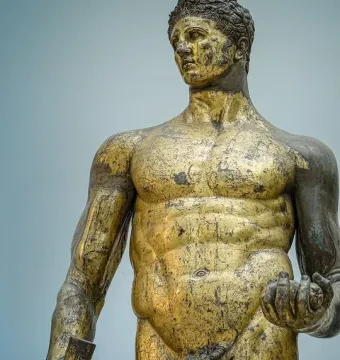
© Mary Harrsch · CC BY-SA 4.0
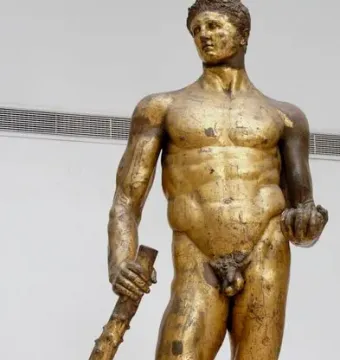
· Public domain
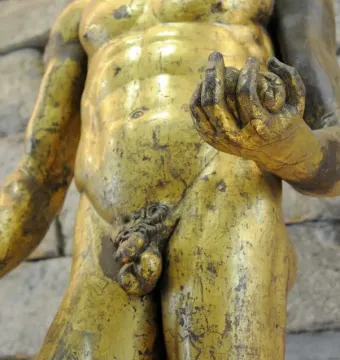
© Son of Groucho · CC BY 2.0
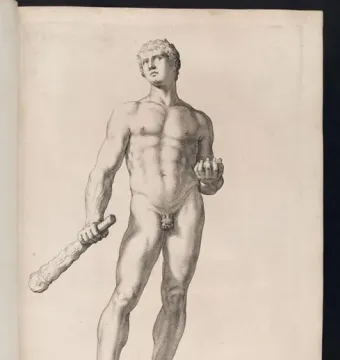
1646 © Bloemaert, Cornelis; Ferrari, Giovanni Battista; Mascardi, Vitalis.; Scheus, Hermann · Public domain
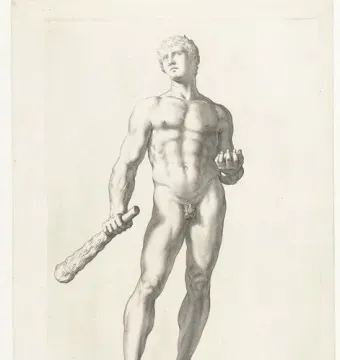
© Rijksmuseum · CC0
Identification | |
| Title | Hercules of the Forum Boarium |
| Original-language name | Геркулес с Бычьего форума |
| Type | Ancient Roman gilded bronze statue |
| Subject | Hercules (Heracles) |
| Alternative names | Capitoline Hercules; Hercules Capitolinus; Hercules Aemilianus; Hercules Mastai or Mastai Righetti |
Historical context | |
| Date | 2nd century BC |
| Period | Hellenistic |
Creator | |
| Stylistic model | Based on Lysippus' canon of proportions |
Discovery and provenance | |
| Discovery location | Forum Boarium, Rome |
| Discovery context | Found during excavations at the Forum Boarium under Pope Sixtus IV, among the remains of the temple dedicated to it |
| Original cult context | Associated with the cult of Ara Maxima, dedicated to Hercules by the Greek king Evander |
| Probable original location | Temple of Hercules Victor at the Forum Boarium |
| Possible identification in ancient sources | Probably the cult statue mentioned by Pliny the Elder in the Natural History |
| Inventory date | Already inventoried in 1510 |
| One of | One of two surviving gilded bronze Hercules statues found at the Forum Boarium |
Physical characteristics | |
| Pose | Contrapposto, with the figure's weight on one foot |
| Head features | Finely modeled head with short athlete-like hair |
| Proportions | Slender figure with a proportionally smaller head and exaggerated musculature |
| Size | Slightly larger than life-size |
| Height | 241 cm |
Materials | |
| Material | Gilded bronze |
| Surface treatment | Gilded |
Appearance | |
| Iconography | Hercules holds a club in his right hand and three golden apples of the Hesperides in his left |
Iconography and meaning | |
| Depicted episode | Retrieving the Golden Apples of the Hesperides for Eurystheus, one of the Twelve Labors of Hercules |
| Mythological context | Hercules encountered Prometheus, who told him where to find the apples; Atlas helped him obtain them; Ladon guarded them |
| Roman foundation legend | In Roman tradition, Hercules founded an altar where the Forum Boarium later stood, and he killed Cacus after Cacus tried to steal the cattle of Geryon |
Location and ownership | |
| Acquisition | Acquired by the Conservators |
| Moved to Palazzo dei Conservatori | 1950 |
| Earlier location | Displayed in the courtyard and later in the Conservators' apartment on the Capitoline Hill |
| Stored in | Palazzo dei Conservatori |
| Current location | Palazzo dei Conservatori, Capitoline Museums, Rome |
History and restoration | |
| Inscription | F.C.S. on the covering slab |
| Expansion of inscription | Fulgor conditum summanium |
| Interpretation of inscription | A lightning strike was believed to have hit the statue, requiring it to be buried and losing its magical significance |
| Temple history | The temple remains were demolished under Sixtus IV and later converted into a church |
| Placement history | Both gilded bronze Hercules statues from the Forum Boarium were placed in safety in the Palazzo dei Conservatori in 1950 and remain there |
Significance | |
| Comparative sculpture | Compared with the Hercules from the Theatre of Pompey (Hercules Invictus / Hercules Mastai or Mastai Righetti), also a gilded bronze statue discovered in 1864 and now in the Vatican Rotunda |
| Artistic comparison | The figure is slimmer and less corpulent than the Hercules Farnese |
Other | |
| Bibliographic sources | Haskell and Penny, Taste and the Antique: The Lure of Classical Sculpture 1500-1900 (1981), cat. no. 45; Platner and Ashby, A Topographical Dictionary of Ancient Rome (1926), entry 'Aedes Herculis Victoris' |