
Antikythera Ephebe
Antikythera Ephebe is an Ancient Greek bronze sculpture recovered in 1900 from the Antikythera shipwreck, the same wreck that yielded the Antikythera Mechanism. One of the few bronze works to survive from Classical Antiquity, it is now in the National Archaeological Museum in Athens. The statue shows a nude youth standing in contrapposto, with his right arm raised and his hand shaped as if once holding a lost object; the eyes are inlaid with colored stone. It measures 1.94 m high and was cast in several joined parts. Its original author, date, and provenance remain debated, as do the identity of the figure and its stylistic classification.
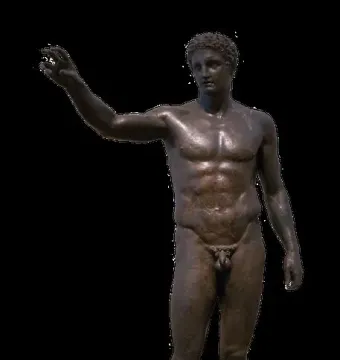
June 2016 © Jebulon · CC0
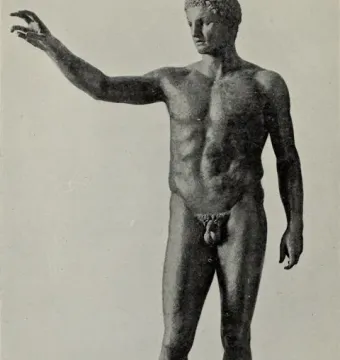
1915 © Internet Archive Book Images · No restrictions
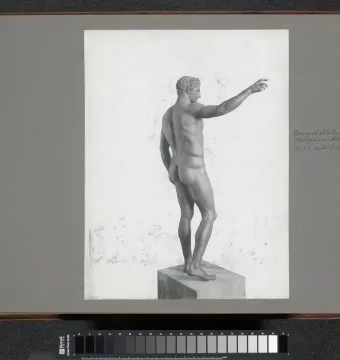
© Rijksmuseum · CC0
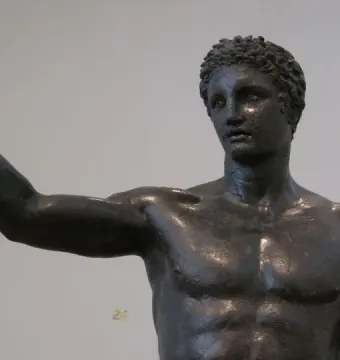
March 2009 © Tilemahos Efthimiadis · CC BY 2.0
November 2009 © Rogeriopfm · CC BY-SA 3.0
Identification | |
| Title | Antikythera Ephebe |
| Alternative names | Ephebe of Antikythera; Youth of Antikythera; Antikythera Youth; Efebo de Anticitera; L'éphèbe d'Anticythère; Bronze statue of a youth |
| Type | Ancient Greek bronze sculpture |
Historical context | |
| Date | Around 340–330 BC; possibly a Hellenistic work inspired by classical models |
| Style | Classical contrapposto nude figure; debated as High Classical, Late Classical, or Hellenistic eclectic style |
| Artistic tradition | Peloponnesian bronze sculpture; associated by some scholars with the Polyclitan tradition |
Creator | |
| Possible sculptor | Perhaps Euphranor |
| Ancient literary attribution | Pliny mentions a work by Euphranor identified as Paris |
Materials | |
| Primary material | Bronze |
| Eyes | Inset colored stone eyes |
Technique | |
| Casting | Cast in several separately made parts joined later |
Physical characteristics | |
| Height | 1.94 m |
| Size | Slightly larger than life-size |
| Pose | Standing front-facing nude youth with weight on the left leg, right leg bent and slightly drawn back, right arm raised |
| Head | Hair in curls |
Appearance | |
| Gaze | Looking toward the extended right hand |
| Character | Languid elegance; individuality and character |
| Musculature | Strongly rendered musculature |
Iconography and meaning | |
| Iconographic model | Does not correspond to any known iconographic model; no copies of this type are known |
| Other proposed held objects | Laurel wreath, ball, garland of flowers, phiale, prize, or apple |
| Perseus hypothesis | Possibly Perseus holding the head of Medusa; considered the least probable hypothesis in one account |
| Heracles hypothesis | Possibly a youthful, beardless Heracles holding an apple from the Garden of the Hesperides |
| Paris hypothesis | Possibly Paris presenting the Apple of Discord to Aphrodite, though this is questioned because Paris is usually shown younger, clothed, and wearing a Phrygian cap |
| Held object | A spherical object, probably in the right hand; the left hand may also have held another object, possibly part of a lion skin |
| Subject | Youth or ephebe; identity uncertain |
| Identification hypotheses | Paris with the Apple of Discord; Heracles with the apples of the Hesperides; Perseus holding Medusa's head; Apollo; Hermes; an athlete; a funerary statue of a young man; a god, hero, or mortal |
Discovery and provenance | |
| Associated finds | The Antikythera Mechanism; a fragmentary statue of a Stoic philosopher; other bronze and marble statues; many coins, including Pergamene cistophoric tetradrachms and Ephesian coins |
| Cargo origin note | No recovered cargo element has been identified as coming from mainland Greece |
| Wreck voyage origin | Possibly the Ionian coast, perhaps Ephesus |
| Condition when found | Recovered broken into many fragments and heavily corroded by seawater exposure |
| Shipwreck date | Around 70–60 BC |
| Discovery location | Among the wreckage of the Antikythera shipwreck off the coast of Antikythera, Greece |
| Discoverers | Sponge divers |
| Discovery date | 1900 |
Location and ownership | |
| Current location | National Archaeological Museum, Athens |
| Inventory number | X 13396 |
History and restoration | |
| Initial restoration | Reconstructed soon after discovery in 1901–1902 by P. Kaloudis and Alfred André |
| Initial restoration issues | Missing fragments were recreated, especially in the abdomen, pelvis, flanks, and shoulders; corrosion treatment damaged the surface; a plaster-like coating and full repainting obscured the original surface and style and hindered scientific study |
| Later restoration | A second restoration was carried out in 1947–1953 in the 1950s under the direction of Christos Karouzos and a team of specialists from the National Archaeological Museum in Athens |
| Later restoration work | Removed added plaster and paint, dismantled the sculpture, and reassembled it in a more suitable position |
| Later restoration changes | The abdomen, eye focus, connection between the torso and upper right thigh, and the position of the right arm were revised |
| Later restoration assessment | Generally considered correct and a success; many of André's reintegrated fragments were found to be misplaced |
| Publication on restoration | An article describing the restoration was published in 1969 |
Significance | |
| Critical reputation | Highly valued by specialists and regarded as a masterpiece of the Greek tradition |
| Art-historical impact | The discovery helped transform modern views of ancient Greek sculpture and began a series of later bronze-sculpture finds in the Aegean and Mediterranean |