
Çineköy inscription
The Çineköy inscription is an ancient bilingual inscription written in Hieroglyphic Luwian and Phoenician. It dates to the second half of the 8th century BC and was uncovered in 1997 near the village of Çine, about 30 km south of Adana in southern Turkey. The find was first reported and described in 1999, and the first edition was published in 2000. Further important interpretations were added in 2007, 2012, 2015, and 2017. It is closely related to the earlier Karatepe inscription, and both texts trace the kings of ancient Adana from the “house of Mopsos.”
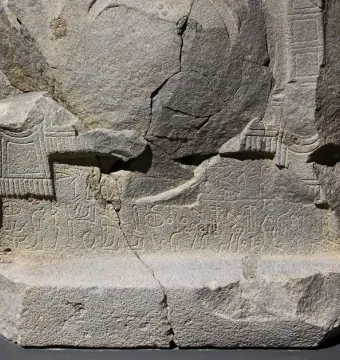
September 2017 © Ingeborg Simon · CC BY-SA 3.0
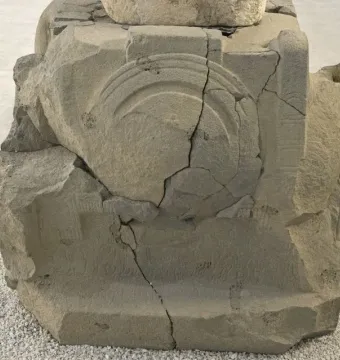
March 2013 © Dosseman · CC BY-SA 4.0
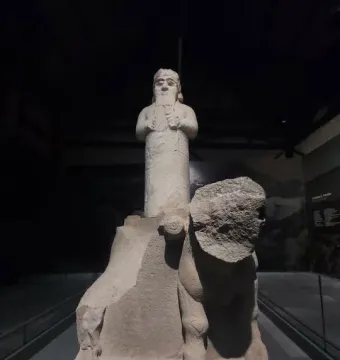
© Tpinar · CC BY-SA 4.0
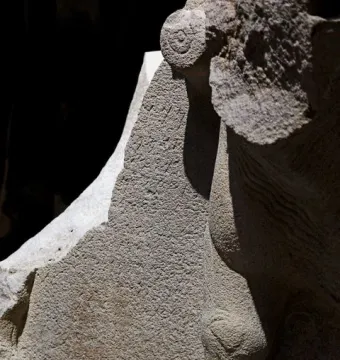
September 2017 © Ingeborg Simon · CC BY-SA 3.0
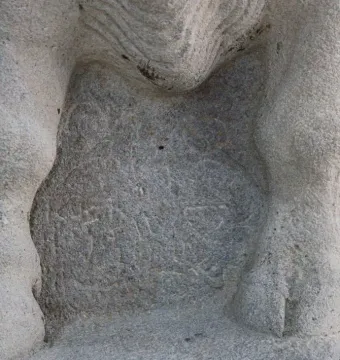
May 2012 © Klaus-Peter Simon · CC BY-SA 3.0
Identification | |
| Title | Çineköy inscription |
| Type | ancient bilingual inscription |
| Languages | Hieroglyphic Luwian and Phoenician |
| Scripts | Luwian hieroglyphs and Phoenician letters |
| Alternative name | Royal Luwian-Phoenician bilingual of Çineköy |
Historical context | |
| Date | second half of the 8th century BC |
Discovery and provenance | |
| Excavation institution | Adana Archaeological Museum |
| Interpretation updates | 2007, 2012, 2015, and 2017 |
| First publication | 2000 |
| Find report date | 1999 |
| Discovery circumstances | Found by a farmer while ploughing |
| Excavators | İzmet İpek and A. Kazım Tosun |
| Excavation date | November 1997 |
| Discovery context | Recovered from a field |
| Discovery location | Near the village of Çineköy (Yüreğir), about 30 km south of Adana, Adana Province, ancient Cilicia, southern Turkey |
| Discovery date | 30 October 1997 |
| Related inscription | Karatepe inscription |
Creator | |
| Political status of inscriber | Vassal king of Quwê (Assyrian name for Cilicia); Luwian name of the region: Hiyawa |
| Possible identification of inscriber | Possibly the same person as Awar(i)ku of the Karatepe inscription, but this is disputed |
| Inscriber | Urikki, known as War(a)ika in Luwian |
Iconography and meaning | |
| Possible symbolism of front walls | May symbolize the kingdom of Awarik |
| Dedication | A monument to the storm god Tarhunza/Tarhunzas |
| Depicted figure | Weather god Tarhunza/Tarhunzas, generally identified with Baal in the Phoenician text |
| Associated deity | Tarhu / Tarhunza, the storm god |
| Vehicle depicted | A wagon or chariot drawn by bulls |
| Historical content | The inscription presents the kings of ancient Adana as belonging to the house of Mopsos and refers to relations between the kingdom and Assyria |
| House of Mopsos | Muksa in Hieroglyphic Luwian; mps in Phoenician; Mopsos is described as a legendary king of antiquity |
| Interpretive issue | The Luwian and Phoenician versions of the same sentence differ in meaning: the Phoenician says Awariku built 15 fortresses, while the Luwian has been misinterpreted as referring to destroying fortresses |
Materials | |
| Other material | Basalt |
| Main material | Soft limestone |
Physical characteristics | |
| Object | Statue monument with an inscription engraved on its base |
| Figure type | Anthropomorphic deity figure |
| Base/stand | Basalt stand or base |
| Standing socket | 40 × 40 cm, 30 cm deep |
Appearance | |
| Front of platform | Walls with three towers are visible |
| Chariot wheels | Eight-spoked wheels, only partly preserved |
| Animal depiction | The bulls are shown in motion, with muscles, veins, hooves, a long braided tail, and other details clearly visible |
| Right bull condition | Missing except for a remnant of the left hind leg |
| Left bull condition | Head broken off at the eyes; the rest, including the yoke, is well preserved |
| Hair | Long, smooth hair |
| Depiction on stand | The god stands on a chariot drawn by two bulls |
| Hands | Held in front of the chest around an unidentifiable object; the right hand has eight small holes, possibly for attaching another object |
| Lower-body clothing | Poorly discernible |
| Waist clothing | A belt at the hips with a fabric band running from the left shoulder to the ground |
| Upper clothing | A short-sleeved cloak or robe ending above the elbows |
| Facial features | Eyes and ears are clearly visible |
| Beard | Trimmed beard |
| Headgear | A tasselled headdress with a diadem bearing two horns |
Location and ownership | |
| Current location | Adana Archaeological Museum |
History and restoration | |
| Display status | Still on display at the Adana Archaeological Museum |
| Original location assessment | The lack of additional finds suggests that the statue was not originally located at the discovery spot |
| Further excavation | In summer 1998 the museum continued excavations but found no further parts of the work |
| Restoration | Restored under the direction of the Central Workshop for Restoration and Conservation in Istanbul |
| Transfer to museum | The statue was taken to the museum on 13 November 1997; the other basalt parts were brought shortly afterward |
Significance | |
| Historical significance | Key evidence for the etymology of the term Syria and for a direct connection between Syria and Assyria |
| Scholarly issue | The relationship between the terms Syria and Assyria has been debated since 1871 |
| Early explanation | Theodor Nöldeke proposed that Syria derives from Assyria |
| Scholarly reception | Nöldeke's explanation later received majority support among scholars |
| Contribution of the inscription | Provided additional evidence for the direct connection between Syria and Assyria |
| Robert Rollinger analysis | In 2006, Robert Rollinger argued that the Luwian section shows Syria was originally used as a synonym for Assyria |
| Quoted Phoenician text | 'And the king [of Asshur and (?)] the whole "house" of Asshur ('ŠR) was for me father [and] mother, and DNNYM, and the Assyrians ('ŠRYM) were one "house".' |
| Quoted Luwian text | '§VI And then, the Assyrian king and the whole Assyrian "House" became for me father and mother, §VII and Hiyawa and Assyria were made one "House".' |
| Related terms in text | Phoenician: Ashur ('ŠR) and the Assyrians ('ŠRYM); Luwian: Assyrian king, Assyrian House, Assyria; other place/entity mentioned: Hiyawa |
| Later scholarly work | Some researchers have analyzed similar terms in other contemporary inscriptions and proposed additional interpretations |
Other | |
| Article fragment note | The supplied fragment includes Spanish quotations and some bracketed or partially uncertain readings |