Proserpina Sarcophagus
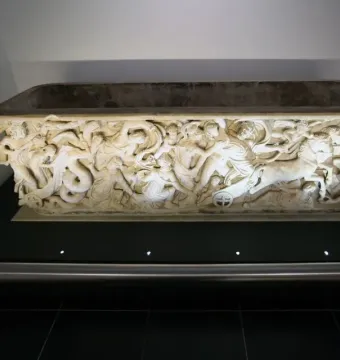
The Proserpina sarcophagus is a Roman marble sarcophagus from the first quarter of the third century AD. It has long been associated with the burial of Charlemagne, who was probably interred in it on 28 January 814 in Aachen Cathedral, though historians dispute this. Some sources suggest it may instead have been used later, after the exhumation of Charlemagne’s grave in 1165. By 1215 at the latest, Charlemagne’s bones had been transferred elsewhere, and the empty sarcophagus remained in Aachen Cathedral. It was later moved to Paris by Napoleon in 1794, returned to Aachen in 1815, and has been on display in the Cathedral Treasury since 1979.
August 2014 © HOWI · CC BY-SA 3.0
© Unknown artistUnknown artist · Public domain
1905 © Internet Archive Book Images · No restrictions
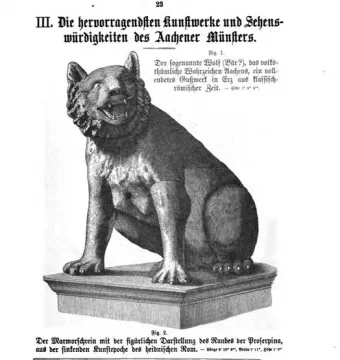
1867 © unknow engraver · Public domain
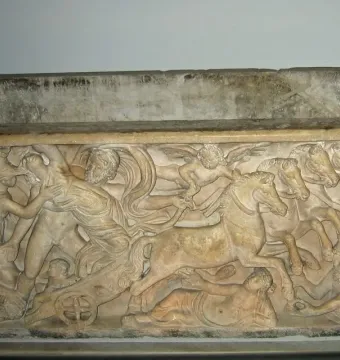
June 2006 © Zde · CC BY-SA 4.0
Identification | |
| Title | Proserpina sarcophagus |
| Alternative name | Persephone Sarcophagus |
| Object type | Roman marble sarcophagus |
Historical context | |
| Date | First quarter of the 3rd century AD |
| Workshop | A workshop in ancient Rome |
Materials | |
| Material | Carrara marble |
Physical characteristics | |
| Dimensions | 205 cm long, 50 cm wide, 49 cm deep |
| Condition | Generally well preserved, but with a transport break running through the front relief; heavy damage occurred when it was hoisted up to the gallery |
| Lid | Not preserved |
Technique | |
| Decoration | High-relief sculpture |
Appearance | |
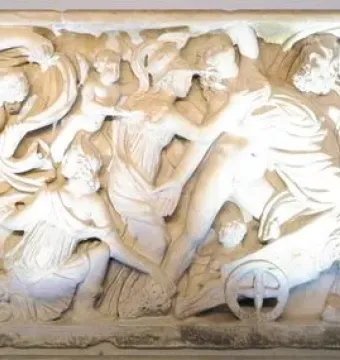
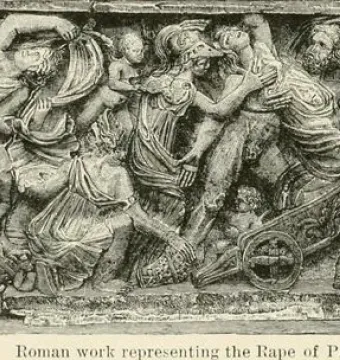
| Front decoration | An elaborate multi-figure relief showing the abduction of Persephone (Proserpina) |
| Side decoration | Each short side is decorated with a three-figure relief group |
| Front figures | Hades/Pluto abducting Persephone on a quadriga; Athena/Minerva behind him; Eros/Cupid in front guiding him; Hermes/Mercury at the right edge; Cerberus near Hermes' feet; Tartarus beneath the horses; Demeter following in a chariot drawn by serpents, holding two torches; Aphrodite above as an accomplice; two frightened handmaidens on the ground protecting their baskets |
| Right side scene | A fruit-bearing boy accompanied by two shepherds |
| Left side scene | Two young girls and a boy picking flowers |
Iconography and meaning | |
| Interpretation | The pagan Persephone myth was given a Christian interpretation, especially as a metaphor for resurrection and return to earth |
| Depicted myth | The abduction of Persephone (Proserpina), also known as the Rape of Persephone |
Discovery and provenance | |
| Place of production | A workshop in the city of Rome |
| Possible original use | Possibly among the marble brought by Charlemagne from Rome and Ravenna for the Palatine Chapel, according to Einhard's Vita Karoli Magni |
| Historical association with Charlemagne | Possibly used for Charlemagne's burial in 814; alternatively, Dieter Hägermann suggested it was first used in 1165 after Frederick Barbarossa's exhumation of Charlemagne's grave to hold Charlemagne's bones; the association is disputed |
| Removal of remains | By 1215 at the latest, Charlemagne's bones had been removed and placed in the Karlsschrein |
Location and ownership | |
| Current location | Aachen Cathedral Treasury |
| Location from 1843 | On the inaccessible Michaelsempore of the Nikolauskapelle |
| Location in 1815 | Returned to Aachen and placed in the Nikolauskapelle / Saint Nicholas Chapel |
| Location in 1794 | Taken to Paris by Napoleon I together with the ancient columns of the cathedral |
| Associated object | Probably displayed with a 14th-century wooden figure of Charlemagne now in the treasury, likely part of a Charlemagne memorial |
| Location after 1215 | Empty sarcophagus displayed in the lower ambulatory of Aachen Cathedral, visible only from the front through a grille |
History and restoration | |
| Documentation | A drawing of the front relief survives in the Codex Coburgensis; travelers first described its appearance in the 16th century and recognized it as an ancient work |
| Transport break date | 1843 |
| Restoration | Restored in 1998; all break edges were closed flush |
Significance | |
| Art historical context | One of many Roman sarcophagi depicting the abduction of Persephone |
| Burial significance | Traditionally associated with the burial of Charlemagne |
Other | |
| Related historical figures | Charlemagne, Frederick Barbarossa, Napoleon I, Dieter Hägermann |