
Athena Giustiniani
Athena Giustiniani, formerly known as Minerva Medica, is a celebrated statue of the Greek goddess Athena, now kept in the Pio-Clementino Museum of the Vatican. Carved in Parian marble and standing 2.21 meters tall, it is considered a Roman copy of a lost Greek original, though its date remains debated. The goddess wears a tunic with an aegis on her chest, a Corinthian helmet, and a Persian tiara beneath it, and she holds a spear while a serpent rests at her feet. The statue’s original arms, spear, and helmet top are probably modern restorations. Its fame grew after entering the Vatican collections, and it became especially admired by Neoclassical artists, writers, and Grand Tour travelers.
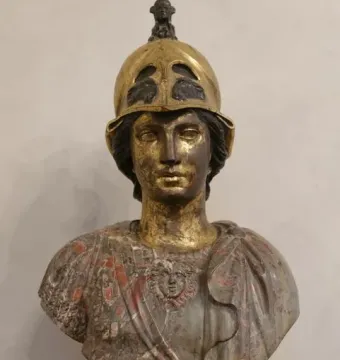
2017 © Marie-Lan Nguyen · Public domain
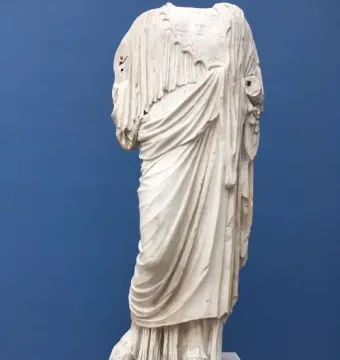
September 2018 © MumblerJamie · CC BY-SA 2.0
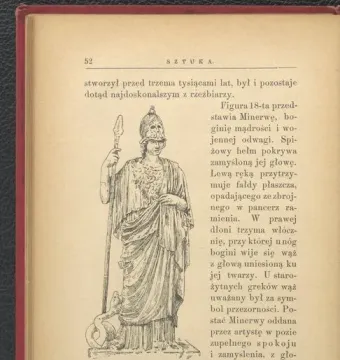
© Elie Jean Pécaut · Public domain
Identification | |
| Title | Athena Giustiniani |
| Subject | Athena (Minerva) |
| Alternative names | Minerva Medica; Athena-Minerva Giustiniani; Giustiniani Minerva |
| Type | Roman marble statue |
Historical context | |
| Date | Roman copy of a lost Greek original, probably from the Antonine period |
| Original Greek model date | Late 5th century BC to early 4th century BC |
| Original attribution status | The precise date and authorship of the Greek model are disputed |
Creator | |
| Possible original sculptor | Locro of Paros, if the Pausanias identification is correct |
Discovery and provenance | |
| Discovery date | Early 17th century |
| Discovery note | The Orto di Minerva account is supported by Pietro Santi Bartoli and is considered more probable by many modern scholars |
| Possible original location | Possibly near the Porta Maggiore in Rome, or near Santa Maria sopra Minerva in Rome |
| Name origin | Named after Vincenzo Giustiniani and his collection |
| First owner | Vincenzo Giustiniani |
| Collection | Giustiniani collection |
| Early documentation | Illustrated in Galleria Giustiniana, published in the 1630s or 1640s |
| Discovery location | Rome; traditionally in the ruins of the Esquiline Hill nymphaeum identified as the Temple of Minerva Medica, alternatively in the Orto di Minerva next to Santa Maria sopra Minerva |
Physical characteristics | |
| Chest attribute | Aegis with a gorgoneion on the chest |
| Attributes | Spear; coiled serpent at the goddess's right foot |
| Arms and hands | Right arm bent to hold or clasp a spear; left arm crosses the body to hold the edge of the garment |
| Headgear | Corinthian helmet with a sphinx; a Persian tiara underneath is mentioned in one account |
| Garments | Thin chiton with a heavier himation or peplos draped over the left shoulder |
| Pose | Standing |
| Height | 2.21–2.25 m |
Materials | |
| Material | Parian marble |
Iconography and meaning | |
| Serpent meaning | The serpent may allude to Erichthonius, the autochthonous king of Athens |
| Cult status | Described as a cult image and also as a decorative cultural trophy |
History and restoration | |
| Restorations | The forearms, parts of the fingers, the spear, the sphinx on the helmet, and the head and part of the serpent's coils are modern restorations |
| Ownership history | Kept by Vincenzo Giustiniani in his Roman palace in the 17th century; acquired by Lucien Bonaparte in 1805; sold to Pope Pius VII in 1817; entered the Vatican Museums in 1817 and was installed in the Braccio Nuovo in 1822 |
Location and ownership | |
| Current location | Vatican Museums, Braccio Nuovo, Vatican City |
| Inventory number | 2223 |
Significance | |
| Reception | Highly admired by Neoclassicists and English Grand Tour visitors; praised by Goethe, Stendhal, and Feuerbach |
| Stylistic importance | It established a distinct sculptural type that was widely copied and highly valued by the Romans |
| Reproductions and influence | Frequently copied for private collections, art schools, museums, engravings, paintings, and later mass production; inspired Clodion's terracotta Minerva and Queen Louise of Prussia's court-ball costume |
| Exhibition history | Displayed in the German pavilion at the 1904 Louisiana Purchase Exposition in St. Louis |
| Related copy sold in 2010 | A Roman bust copy, one of eight known ancient copies of Athena, was sold at Sotheby's New York in 2010 for $4.1 million |
| Notable comment | Goethe described it in Italian Journey as a Minerva of noble, severe style approaching the Beautiful |