
Venus Felix
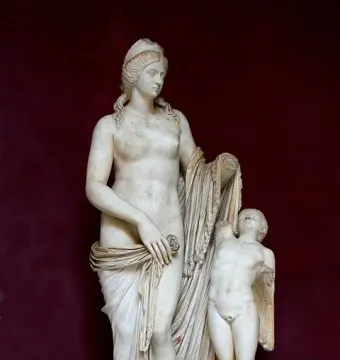
Venus Felix is an antique sculpture conserved in the Vatican Museums. Its name can be translated as “Happy Venus,” and it shows the goddess Venus accompanied by her son Cupid. According to the inscription on the plinth, the statue was dedicated to Venus Felix by Sallustia, a Roman matron, and her son Helpidius. The work is thought to be a Roman marble copy, dated around 180–200 AD, after a Greek original by Praxiteles, the Aphrodite of Cnidus. The face of Venus is identified either as the empress Orbiana or Faustina the Younger. Discovered near the Basilica of Santa Croce in Jerusalem in Rome, it is now displayed in the Octagonal Court of the Pio-Clementino Museum in the Vatican.
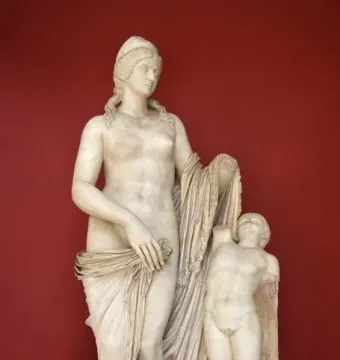
April 2025 © Darafsh · CC BY-SA 3.0
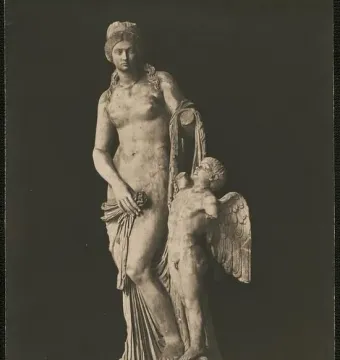
© Catsimpoolas, Nicholas; Moscioni, Romualdo · Public domain
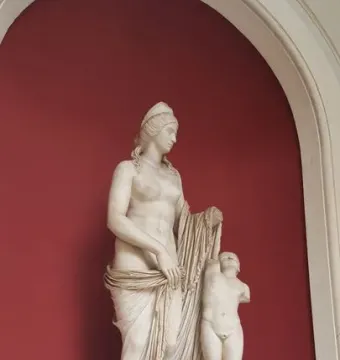
April 2017 © Jamie Heath · CC BY-SA 2.0
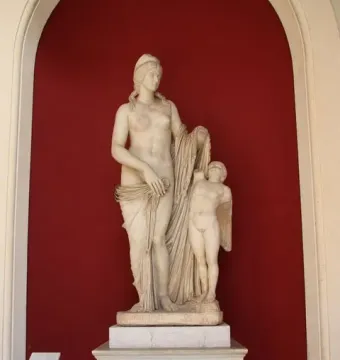
August 2019 © Gary Todd · Public domain
· CC BY-SA 3.0
Identification | |
| Title | Venus Felix |
| Type | Ancient Roman marble sculpture |
| Other names | Венера Счастливая; Venera Shchaslyva; Venera Feliks |
Historical context | |
| Date | 2nd century AD, about 180–200 AD |
Creator | |
| Artist | Unknown |
| Model or source | Roman imitation or descendant of Praxiteles' Aphrodite of Cnidus |
Discovery and provenance | |
| Discovery location | Unknown; Francesco Ficoroni claimed it was found near the Basilica of Santa Croce in Gerusalemme, Rome, but there is no evidence for this claim |
| Discovery date | Unknown; Ficoroni reported an 18th-century discovery |
| Recorded in papal collections | 1509 |
| Dedication | Votive offering to Venus Felix by Sallustia and her son Helpidius, according to the pedestal inscription |
| Inscription on pedestal | Veneri Felici Sacrum Sallustia Helperidus |
Physical characteristics | |
| Height | 2.14 meters |
| Condition | Venus is missing part of her left arm; Cupid is missing both arms |
Materials | |
| Material | Marble |
Appearance | |
| Depicted figures | Venus and Cupid |
| Pose | Venus stands on a pedestal, resting on her right leg |
| Hand and drapery details | Her right hand covers the lower part of her body and supports the peplos; her left hand is missing |
| Cupid details | Cupid is shown beside her, possibly offering her an object |
| Hair and headwear | Venus has hair arranged in a hairstyle falling over her shoulders and wears a possible diadem or tiara |
| Possible attributes | Her lost left hand may originally have held an apple or a mirror |
Iconography and meaning | |
| Subject | Venus with her son Cupid |
| Dedication meaning | Dedicated to Venus Felix, meaning 'Happy Venus' |
| Portrait resemblance | The face or head may resemble Faustina the Younger; another hypothesis identifies the face with Orbiane |
| Alternative identification | It has also been suggested that the figures depicted are Sallustia and Helpidius |
Location and ownership | |
| Current location | Vatican Museums, Pio-Clementino Museum, Octagonal Courtyard, Vatican City |
History and restoration | |
| Previous identification | Previously identified as Sallustia Orbiana on the basis of the inscription, but this identification is rejected because the statue does not resemble known portraits of Sallustia Orbiana on coins |