
Pitti Tondo
Pitti Tondo is a marble relief sculpture by Michelangelo, made around 1503 and now preserved in the Museo Nazionale del Bargello in Florence. It measures 82 cm wide and 85.5 cm high. The circular composition includes three figures: the Virgin Mary with the infant Jesus and Saint John. The Virgin breaks away from the static cubic seat, while her forward-facing head gives the work strong dynamism. The two figures extend beyond the circular frame, and the pyramid-like arrangement is enriched by horizontal and diagonal lines that create a lively sense of plasticity. The child appears on the right, resting on an open book on his mother’s knees. The work was commissioned by Bartolomeo Pitti and later passed to Luigi Guicciardini before being acquired in 1823 for display in the Bargello.
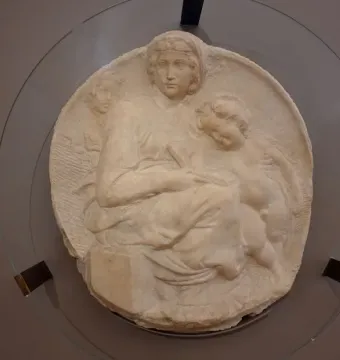
June 2019 © Richard Mortel · CC BY 2.0
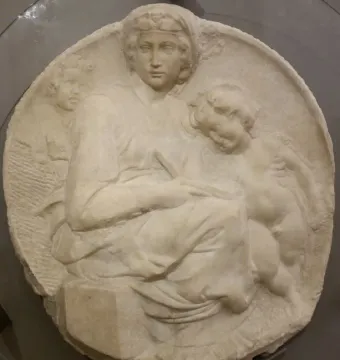
April 2018 © M-i-k-e-v · CC BY-SA 3.0
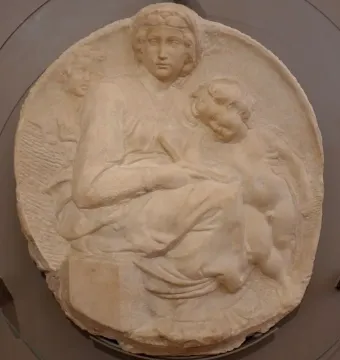
June 2019 © Richard Mortel · CC BY 2.0
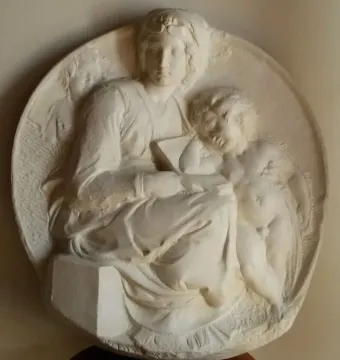
August 2018 © Giuseppeconforti · CC BY-SA 4.0
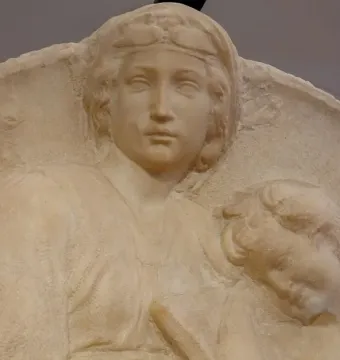
June 2019 © Richard Mortel · CC BY 2.0
Identification | |
| Title | Pitti Tondo |
| Alternative names | Tondo Pitti; Madone Pitti; Il Tondo Pitti |
| Type | Tondo (round relief sculpture) |
Historical context | |
| Date | c. 1503–1505 |
| Place of creation | Florence |
| Context of creation | Made while Michelangelo was working on David and before he moved to Rome in 1505 |
Creator | |
| Artist | Michelangelo Buonarroti |
| Commissioned by | Bartolomeo Pitti |
| Work status | Unfinished; described as non finito, though scholars dispute how unfinished it is |
Discovery and provenance | |
| Collection history | Held at the Uffizi from 1823; transferred in 1873 to the National Museum of the Bargello |
| Recorded in 1564 | Seen by Benedetto Varchi in the house of Piero, Luigi Guicciardini's nephew |
| Acquisition by Florentine authorities | Purchased in 1823 for 200 scudi from Fedele Acciai |
| Later ownership | According to Vasari, Bartolomeo Pitti's son Miniato (Fra Minyato), a monk at Monte Oliveto Maggiore, gave it to Luigi Guicciardini |
Location and ownership | |
| Copies and casts | Plaster casts are held in the Victoria and Albert Museum, London; the Fitzwilliam Museum, Cambridge; and the Pushkin Museum of Fine Arts, Moscow |
| Current location | Museo Nazionale del Bargello, Florence |
Physical characteristics | |
| Form | Slightly oval tondo; not perfectly round |
| Dimensions | 85.5 × 82 cm |
| Relief depth | High relief |
Materials | |
| Material | Marble |
History and restoration | |
| Condition | Many details are missing and the sides are not polished |
Appearance | |
| Composition | Mary is the focal point and fills most of the composition; the oval format and her head projecting beyond the rim keep the group from feeling cramped |
| Mary's pose | Seated on a cubic stone bench, holding an open book on her knees with her right hand and embracing her son with her left |
| Mary's head | Her head turns to the left and projects beyond the tondo's rim |
| Mary's expression | Her gaze seems distracted, as if looking into the distance and meditating on her son's fate |
| Jesus's pose | Leaning on the book in a lively contrapposto |
| John the Baptist's position | Barely visible in the background, behind Mary |
| Composition | The work is intended to be viewed from below upward |
| Composition | Frequent horizontal and oblique lines create dynamism and plasticity; the overall composition is pyramidal |
| Depicted figures | Mary, the infant Jesus, and Saint John the Baptist |
Iconography and meaning | |
| Book symbolism | The open book symbolizes wisdom and the prophecies of Sacred Scripture |
| Cherub symbolism | A cherub on Mary's forehead symbolizes her knowledge of the prophecies |
| Emotional tone | Maturity, sorrow, and doom |
| Interpretation | When viewed from below, Mary appears as the Queen of Heaven seated on a throne of an ideal cube within the circle of the tondo |
| Stylistic interpretation | The unfinished background and more finished Virgin create depth and atmospheric linkage |
Significance | |
| Comparisons and influences | Compared with the Taddei Tondo, the Bruges Madonna, the Madonna of the Stairs, Donatello's Padua Madonna and Child, ancient genius figures from the Phaedra sarcophagus in Pisa's Camposanto, and works by Jacopo della Quercia; some scholars also proposed influence from Leonardo da Vinci's lost cartoon of Saint Anne and later comparison with Raphael's Madonna della Sedia |
| Artistic assessment | Noted for its compact, circular form, high relief, chiselled surface, and strong expressiveness; scholars have said it points toward a new classical image of man in Michelangelo's work |