
Great Cameo of France
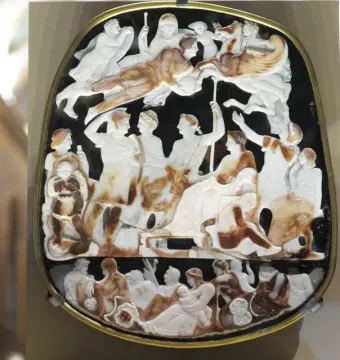
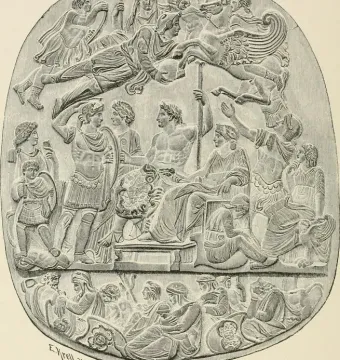
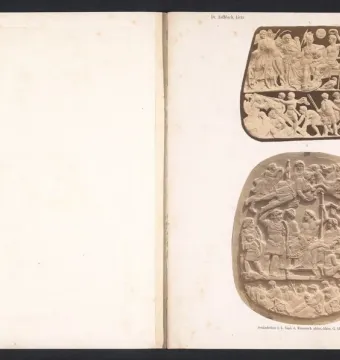
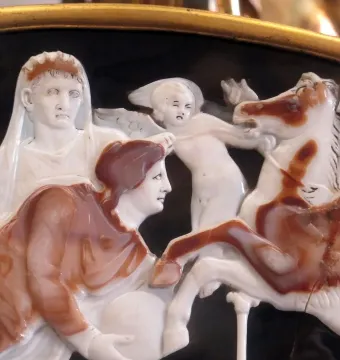
The Great Cameo of France is a five-layer onyx cameo dating to around 23 CE and measuring 31 by 26.5 cm, making it the largest surviving gem from Antiquity. It belongs to a group of spectacular engraved gems often called “State Cameos,” probably produced in the court circle of Augustus. The cameo was originally in the Imperial Treasury of the Caesars in Rome and later passed to the Byzantine emperors. Its history includes ownership by Baldwin II of Constantinople, Louis IX of France, the Sainte-Chapelle treasury, the Avignon popes, and the French National Assembly. It is now in Paris at the National Library. The carved scene shows 24 figures in three levels, expressing Julio-Claudian dynastic legitimacy.
October 2022 © GFreihalter · CC BY-SA 4.0
1905 © Internet Archive Book Images · No restrictions
© Rijksmuseum · CC0
© sailko · CC BY-SA 3.0
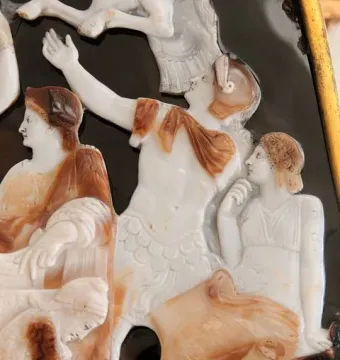
© Unknown · CC BY 2.5
Identification | |
| Title | Great Cameo of France |
| Original title | Le Grand Camée de France |
| Original language title | O Grande Camafeu da França |
| Type | cameo |
| Subtype | onyx cameo |
Historical context | |
| Date | c. 23 AD; other proposed dates include 17–41 AD and 50–54 AD |
| Place of creation | Imperial Rome |
| Historical period | Julio-Claudian Rome |
Creator | |
| Probable patron | probably a member of the Julio-Claudian dynasty; Tiberius or Antonia are proposed patrons |
| Probable maker | Dioscorides of Aegae, a gem engraver based in Rome |
Discovery and provenance | |
| Later owners | the Byzantine emperors; Baldwin II of Constantinople; Louis IX of France; the papacy of Avignon; Charles V of France; the French National Assembly; Napoleon's police; M. Babelon; the National Library in Paris |
| Lost frame rediscovered | 8 September 1912, in the possession of M. Babelon |
| Recovered | 1805; found in Amsterdam and returned without its original gold frame |
| Stolen | 1804 |
| Transferred to Cabinet of Medals | 1791, ordered by Louis XVI |
| Placed back in Sainte-Chapelle | 1379 |
| Returned to France | about 1363, brought back by the dauphin, the future Charles V |
| Sent to Rome | 1343, by Philip VI, because the pope wished to examine it |
| Frame | original gold frame lost; current frame is a gilded bronze frame ordered by Napoleon |
| Possible acquisition by Louis IX | possibly sold by Baldwin II of Constantinople to Louis IX of France |
| Historical name | The Triumph of Joseph in Egypt |
| First recorded inventory | an inventory of the treasury of Sainte-Chapelle before 1279 |
| Original setting | possibly the center of a flat reliquary decorated with precious stones |
| Probable purpose | probably to decorate the golden urn containing the ashes of Germanicus |
| Original owner | the Imperial Treasury of the Caesars of Rome |
| Possible earlier location | Byzantium |
| Probable origin | the court circle around Augustus |
| Provenance | Exact provenance is unknown |
| Christianized name | Triumph of Joseph and the Court of Pharaoh |
Location and ownership | |
| Current location | Cabinet des médailles, Bibliothèque nationale de France, Paris |
| Current inventory number | 264 |
Physical characteristics | |
| Number of figures | 24 |
| Value | an object of great value and prestige in antiquity |
| Superlative | the largest surviving ancient Roman imperial cameo |
| Composition | figures arranged in three registers or levels |
| Condition | in good condition, with three large cracks made before 1480 and two missing prisoner heads |
| Material | five-layer sardonyx |
| Dimensions | 31 cm × 26.5 cm |
| Number of layers | five |
Appearance | |
| Upper register central figure | Augustus, shown in divine or apotheosis imagery; in some interpretations he appears as Divine Julius, with a radiate crown or as pontifex maximus, and in another he is shown in the guise of Alexander the Great |
| Middle register central figure | Tiberius, shown with imperial attributes such as a scepter, lituus, aegis, or half-naked form depending on the interpretation |
| Lower register central figure | a Parthian enemy of Rome reclining near Tiberius's throne |
| Lower register | barbarian captives and defeated enemies of Rome, including Parthians, Germans, Celts, and other eastern peoples |
| Middle register | living members of the Julio-Claudian dynasty, centered on Tiberius, with Livia, Germanicus, Agrippina the Elder, Nero, Drusus III, Caligula, Claudius, Agrippina the Younger, and other related figures depending on the dating interpretation |
| Upper register | deified or deceased members of the Julio-Claudian dynasty, including Augustus; possible figures include Drusus the Younger, Drusus the Elder, Germanicus, Aeneas, Iulus, and Aion |
Iconography and meaning | |
| General interpretation | the work presents a propagandistic assertion of Julio-Claudian dynastic continuity, legitimacy, and the unity of the imperial family, while glorifying its origins |
| Iconographic uncertainty | the identity of some figures and the intended meaning and iconography remain much debated |
| Likely scene | the apotheosis of Augustus is the likely overall scene |
| Probable audience | an elite, restricted audience; some divine and sexual aspects would not have been shown to a wider audience |
| Possible purpose | to celebrate Tiberius's adoption of his grandsons, the sons of Germanicus, as heirs in AD 23, or a related dynastic program |
| Interpretive comparison | the composition recalls the Capitoline Triad, with Jupiter between Juno and Minerva |
| Political sensitivity | depiction of Augustus with divine attributes was politically sensitive at the time of production |
Significance | |
| Historical significance | one of the most important engraved gems from Antiquity and a highly prestigious object in its time |
| Related works | the Blacas Cameo, the Gemma Augustea, and the Gemma Claudia |