
Athena relief of Sömek
The Athena relief of Sömek is a Greco-Roman rock relief carved into living rock near the village of Sömek in Silifke district, Mersin province, Turkey. It stands about 1.5 metres above the ground and measures 1.3 metres in total height. The goddess Athena appears in a niche with a conch-shaped top, dressed in a peplos. She holds a lance in her raised right hand and a shield in her left, with a snake winding around the lance and column beside her. The relief also includes symbols such as a star, crescent moon, thunderbolt, and traces of a horse and severed heads. An inscription identifies the figure as Athena Krisoa and also refers to her as Oreia.
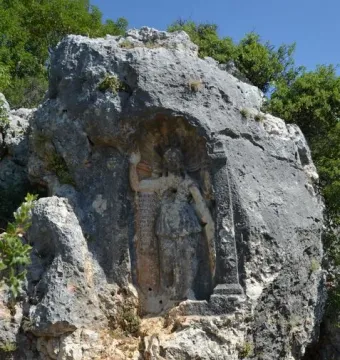
July 2017 © Carole Raddato · CC BY-SA 2.0
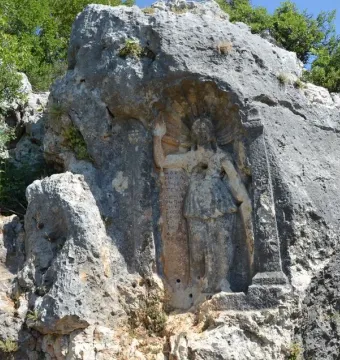
July 2017 © Carole Raddato · CC BY-SA 2.0
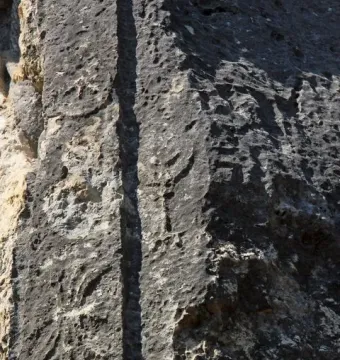
September 2013 © Klaus-Peter Simon · CC BY-SA 3.0
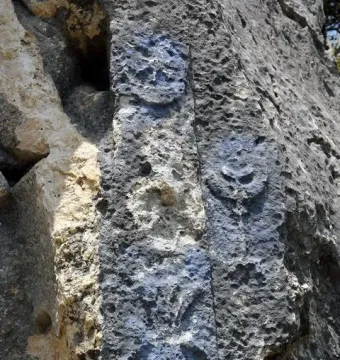
June 2016 © Ingeborg Simon · CC BY-SA 3.0
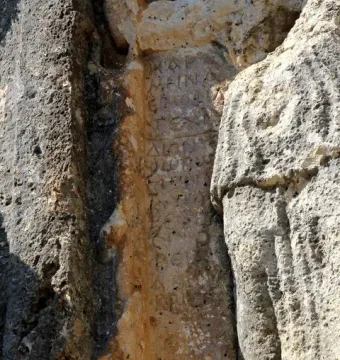
September 2013 © Klaus-Peter Simon · CC BY-SA 3.0
Identification | |
| Title | Athena relief of Sömek |
| Type | Greco-Roman rock relief |
| Subject | Athena |
Historical context | |
| Historical geographic context | In antiquity, the Limonlu River (ancient Lamos) formed the border between Rough Cilicia (Kilikia Tracheia) in the west and Plain Cilicia (Kilikia Pedias) in the east |
Location and ownership | |
| Location | About 2 kilometres north of Sömek, Silifke district, Mersin Province, Turkey, near the valley of the Limonlu River (ancient Lamos) |
| Nearby ancient city | An ancient Cilician city was located in the valley |
| Nearby monument | About 600 metres northwest lies the Warrior relief of Efrenk |
Creator | |
| Research period | 1980s |
| Researcher | Serra Durugönül |
Physical characteristics | |
| Medium | Carved in the living rock |
| Setting | A niche with a shell-shaped top, bordered by pilasters |
| Dimensions | About 1.3 metres high and about 1.5 metres above the ground |
| Niche top | Shell-shaped or clam-shell vault |
| Pilasters | Blocky pilasters with wide capitals; the left pilaster is unadorned |
Materials | |
| Material | Rock |
Appearance | |
| Additional symbol | To the right of the image border is a symbol with a stand, two crescent moons, and a sphere with a star |
| Pilaster decoration | One pilaster bears a star, a crescent moon, and a thunderbolt; traces of a removed bust or head are visible between the moon and the thunderbolt; similar traces are found beside the other pilaster |
| Horse motif | The head and mane of a bridled horse are visible above the shield and Athena’s left arm; the body disappears behind her right arm |
| Snake motif | A snake winds around the spear and column and extends along the ground to Athena’s feet |
| Spear support | The spear rests on a column directly attached to the pilaster |
| Pose | Right arm raised holding a spear; left arm lowered holding a shield on edge |
| Dress | Peplos with apoptygma, girdled at the waist; the lower garment clings closely to the body, showing the calves, and hangs over the ankles and feet with folds extending to the ground |
Iconography and meaning | |
| Jewish symbols in Cilicia | Jewish symbols such as the menorah are not uncommon in Cilicia |
| Relation to prototype | One of many ancient copies or imitations of Phidias’ statue; the relief preserves features such as the clothing, shield, and column, although the column no longer serves its original function because Nike is absent |
| Model for depiction | Phidias’ statue of Athena Parthenos in the Parthenon on the Athenian Acropolis |
| Iconographic type | Athena Parthenos type |
| Interpretation of mixed symbols | Durugönül interpreted the coexistence of Jewish and pagan symbols as evidence for the coexistence of Jews and Romans in the region |
| Other iconographic symbols | A five-armed menorah and Zeus’ bundle of lightning bolts |
| Interpretation of additional symbol | Serra Durugönül suggested it may be a lamp, interpreted as a cult object and as a simplified representation of a Jewish menorah |
| Comparative inscription | The same epithet appears on another inscription in the region |
| Associated place name | Krisoa (Κρισοα), not yet located, probably in northern Rough Cilicia |
| Meaning of epithet | Krisoa is a local epithet derived from a place name and indicates a local variant of the goddess |
| Alternative epithet in inscription | Oreia (ΟΡΕΙΑ), meaning roughly 'mountain-dweller' |
| Inscribed epithet | Athena Krisoa (ΑΘΗΝΑ ΚΡΙΣΟΑ) |
| Inscription | A 13-line Greek inscription between the spear and the figure |
History and restoration | |
| Dating | Durugönül proposed either the time of Claudius and Nero in the 1st century AD or the post-Hadrianic period in the 2nd and 3rd centuries AD; on comparative grounds she preferred the 2nd century AD |
| Dating basis | Comparison with other rock reliefs of Asia Minor, including a moon-god relief at Sumatar Harabesi in Osrhoene dated by inscription to after 165 AD |
Significance | |
| Art historical context | A small-scale rock relief from Asia Minor, comparable to other rock reliefs in the region |