
Winged Horses of Tarquinia
The Winged Horses of Tarquinia are an Etruscan sculpted group in terracotta and high relief, preserved in the National Archaeological Museum of Tarquinia. It comes from the pediment of the temple of the Ara della Regina, on the Civita hill, part of the ancient Etruscan acropolis of Tarquinia. The work shows Hellenistic influence and was probably painted, although no trace of the original polychromy survived the restoration. The museum offers a graphic reconstruction of the colors in the exhibition room. The sculpture is sometimes confused with the “little horses” mentioned in Marguerite Duras’s novel, but that reference concerns painted tomb frescoes from the Monterozzi necropolis, not this piece.
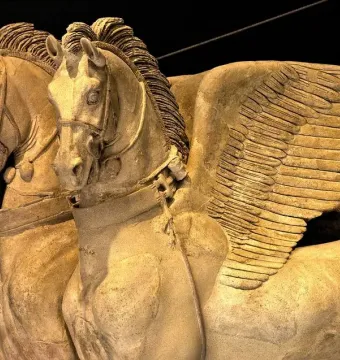
August 2016 © Paolo Villa · CC BY-SA 3.0
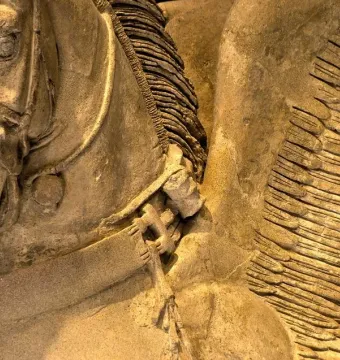
August 2016 © Paolo Villa · CC BY-SA 3.0
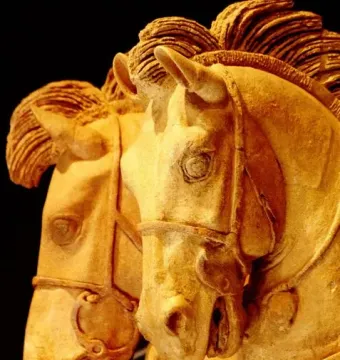
August 2016 © Paolo Villa · CC BY-SA 3.0
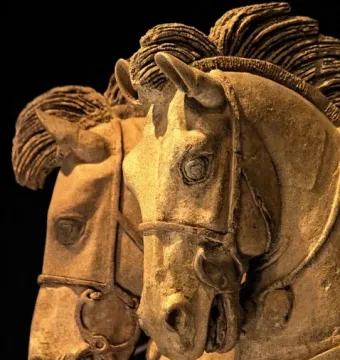
August 2016 © Paolo Villa · CC BY-SA 3.0
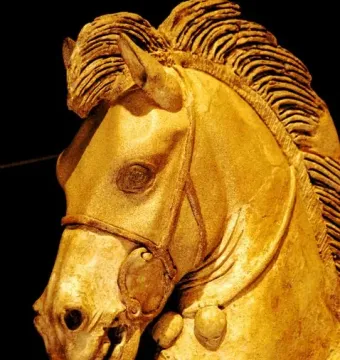
August 2016 © Paolo Villa · CC BY-SA 3.0
Identification | |
| Title | Winged-horses of Tarquinia |
| Original-language name | Les chevaux ailés de Tarquinia |
| Type | high-relief fragment |
| Subject | a pair of winged horses |
Historical context | |
| Culture | Etruscan art |
| Date | mid-4th century BC; some researchers argue for a later date, possibly after the 3rd century BC |
Creator | |
| Discoverer | Pietro Romanelli |
Discovery and provenance | |
| Discovery | Discovered during archaeological excavations at the temple site in 1938, found broken into pieces |
| Provenance | From the pediment of the Temple of the Ara della Regina (the Major Temple of Tarquinia) |
| Original location | The Ara della Regina temple in the ancient Etruscan city of Tarquinia, on the hill of Civita |
| Associated temple | Temple of the Ara della Regina, better known as the Major Temple of Tarquinia |
| Temple dedication | Unknown; possibly dedicated to Artume, identified by the Romans with Diana |
Physical characteristics | |
| Technique | High relief |
| Material | Terracotta |
Appearance | |
| Description | A skillfully rendered pair of winged horses, highly realistic except for the wings |
| Original composition | The surviving relief was probably the left part of a larger composition; the missing right part may have shown the horses harnessed to Artume's chariot |
| Original polychromy | Probably painted, but no trace of the paint survived the restoration |
History and restoration | |
| Condition at discovery | Found broken into pieces |
| Restoration | Restored by assembling the surviving fragments and reconstructing missing details |
| Preservation | The right part of the relief has not survived |
Location and ownership | |
| Current location | National Archaeological Museum of Tarquinia, Tarquinia, Province of Viterbo, Lazio, Italy |
| Display status | permanently exhibited |
| Museum setting | part of an archaeological complex |
| Museum reconstruction | The museum displays a graphic reconstruction of the polychromy on a wall in the exhibition room |
Iconography and meaning | |
| Identification note | The group cannot be identified with Pegasus or with the horses that drew Apollo's chariot |
| Interpretation | Purely decorative; adapted to the Etruscan world |
Significance | |
| Symbolic meaning | The image of the winged horses became a symbol and emblem of Tarquinia |