
Venus Landolina
Venus Landolina is a Roman marble sculpture from the first half of the period, preserved in the Paolo Orsi Regional Archaeological Museum in Syracuse. The Roman sculptor created an original figure by departing from a model close to the Pudica Aphrodite, itself derived from Praxiteles’ Aphrodite of Knidos. The statue is thought to represent a Venus Anadyomene, emerging from the waters, symbolized by a dolphin, and modestly covering herself with a drapery held in her left hand. Her right arm is missing, and the figure leaves her legs, back, and buttocks exposed. The work takes its name from archaeologist Saverio Landolina, who discovered it in 1804 in a nymphaeum in Syracuse’s Acradina district.
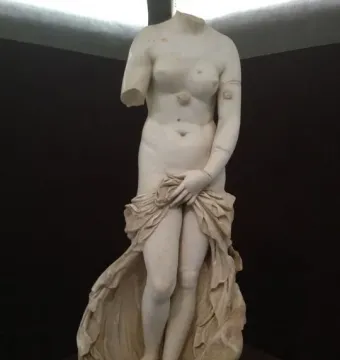
July 2014 © Davide Mauro · CC BY-SA 3.0
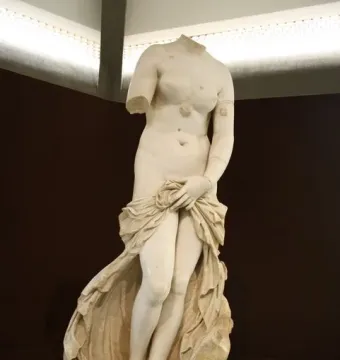
November 2014 © G.dallorto · Attribution
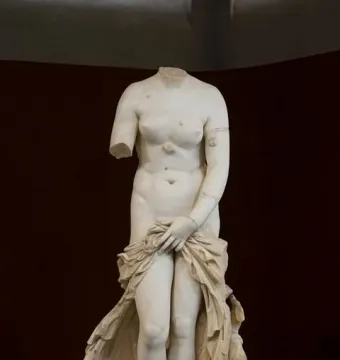
July 2023 © Fabrizio Garrisi · CC0
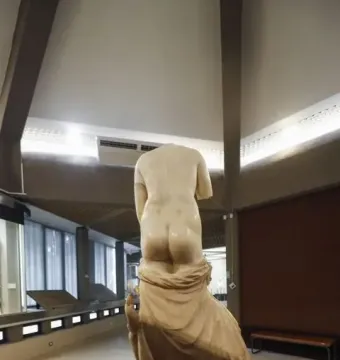
June 2025 © Fabrizio Garrisi · CC0
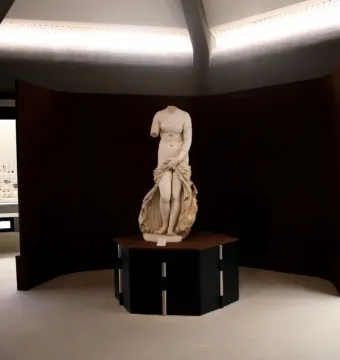
November 2014 © G.dallorto · Attribution
Identification | |
| Title | Venus Landolina |
| Alternative names | Venus of Syracuse; Aphrodite Landolina; Syracuse Venus |
| Type | Roman marble sculpture |
Historical context | |
| Date | Roman copy, probably 2nd century AD; date disputed, with some sources suggesting Julio-Claudian or Flavian production |
Creator | |
| Attribution | Probably a Roman workshop copy or adaptation of a Greek original, ultimately derived from Praxiteles' Aphrodite of Cnidus |
| Original model | Lost Greek original, probably from the 2nd or 1st century BC; some sources instead describe it as an unpreserved 4th-century BC original by Praxiteles |
Discovery and provenance | |
| Attempted transfer | Prince di Cutò, the governor-general, requested that it be moved to Palermo, but this did not happen |
| Public reaction | The discovery attracted great interest throughout Sicily |
| Discovery location | A nymphaeum in Orti Bonavia (later Giardino Spagna), Syracuse, near the present civic hospital Umberto I |
| Discovery date | 7 January 1804 |
| Discoverer | Saverio Landolina Nava |
| Associated finds | Fragments of columns and other architectural remains were found with the statue |
Physical characteristics | |
| Condition | Headless; part of the right arm is missing; the left arm is assembled from several parts; the body has some defects |
| Pose | Right leg bent and advanced; weight on the left leg |
| Nudity and drapery | The figure is nude except for a drapery held by the left hand, which covers the pubic area and reveals the legs |
| Missing features | The right arm is missing; the left arm survives but is partly reconstructed; the purpose of the marble protrusion on the left shoulder is unclear |
Materials | |
| Material | Marble |
Iconography and meaning | |
| Iconographic lineage | The iconography ultimately derives from Praxiteles' Aphrodite of Cnidus |
| Comparisons | Compared with the Capitoline Venus and the Venus de' Medici |
| Iconographic type | Venus Anadyomene, or Venus pudica |
| Artistic qualities | Naturalistic yet idealized rendering of the naked female body |
| Subject | Venus/Aphrodite |
| Symbolic element | A dolphin symbolizing the water |
Location and ownership | |
| Current location | Paolo Orsi Regional Archaeological Museum, Syracuse |
| Heritage status | Part of the Immovable Heritage of the Region of Sicily, added on 27 June 2013 |
History and restoration | |
| Maupassant's description | He described it as beautiful, headless, missing one arm, and both real and symbolic, contrasting it with the Venus de Milo |
| State at Maupassant's visit | Recently rediscovered |
| Later reception | Guy de Maupassant saw the statue during his 1885 trip to Sicily and described it in Voyage en Sicile / Viaggio in Sicilia |
| Early display location | The archiepiscopal palace of Syracuse, now the Paolo Orsi Archaeological Museum |
Significance | |
| Historical significance | Its emphasis on the idealized female body pushed the goddess's earlier sacred meanings into the background |
Other | |
| Ancient testimony | Lucian of Samosata said there was a temple in Syracuse dedicated to the pagan deity before the 2nd century |
| Related works | Aphrodite of the Capitol; Venus de' Medici; a variant preserved in the National Archaeological Museum of Athens under the name Aphrodite of Syracuse |
| Known copies | Several copies are known, including a later complete head copy in the National Archaeological Museum of Athens |
| Head copy hairstyle | The Athens head copy has a hairstyle identical to that of the Capitoline Venus |
| Associated reconstruction hypothesis | Art historians suggest the missing right arm was bent at the elbow and the hand covered the left breast, based on marble protrusions on the body and left breast |
| Associated object | Remains of a lost dolphin are presumably near the left leg |
| Unclear feature | The purpose of the marble protrusion on the left shoulder remains unclear |