
Rampin Rider
Rampin Rider is an archaic Greek marble equestrian statue made around 550 BC. It survives in fragmentary condition and is considered the oldest documented equestrian statue on the Acropolis, as well as a masterpiece of the Archaic period. The rider’s head was found on the Acropolis of Athens in 1877, later donated to the Louvre, while the body and horse fragment were found a decade later in a well and are now in the Acropolis Museum. The two parts were identified as belonging to the same statue in 1936 and reunited with casts of the missing sections. The nude rider wears a leafy crown and the work preserves traces of paint and metal fittings.
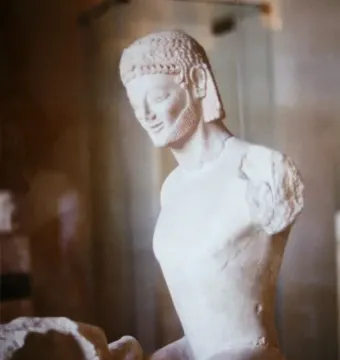
June 2000 © Gary Todd · CC0
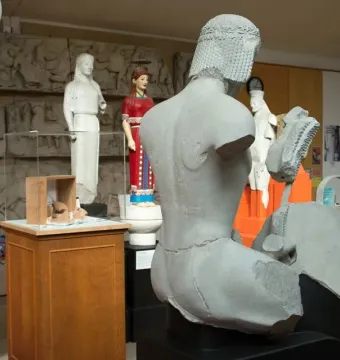
September 2015 © Zde · CC BY-SA 4.0
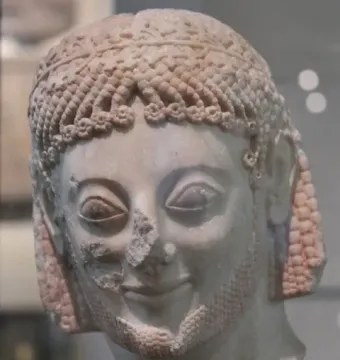
March 2025 © GFreihalter · CC BY-SA 4.0
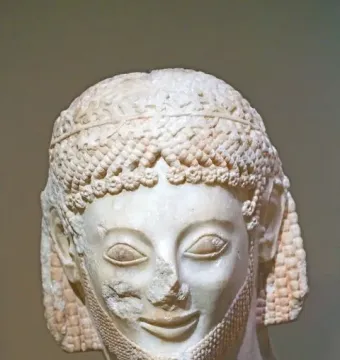
October 2021 © Jean-Pierre Dalbéra · CC BY 2.0
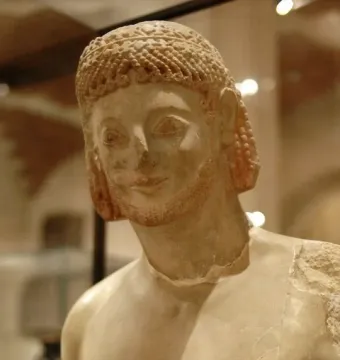
2006 © Marie-Lan Nguyen · Public domain
Identification | |
| Title | Rampin Rider |
| Type | Archaic equestrian statue |
| Alternative titles | Rampin Horseman; O Cavaleiro Rampin; Jeździec Rampin; Der Reiter Rampin; Cavaliere Rampin |
Historical context | |
| Date | c. 550 BC |
| Period | Archaic period |
| Origin | Greece; Attic style |
Creator | |
| Artist | Unknown; conventionally called the Rampin Master / Master of the Rampin Rider |
| Attribution basis | Attributed on stylistic similarities to other works |
Discovery and provenance | |
| Head donation | Donated to the Louvre in 1896 by Georges Rampin |
| Head inventory number | Louvre inv. no. 3104 |
| Torso inventory number | Acropolis Museum inv. no. 590 |
| Head acquisition | Purchased by Georges Rampin, a French collector and diplomat |
| Discovery context | Found in stages among sculpture remains discarded after the Persian sack/invasion of Athens in 480 BC; the torso and horse fragments were found in 1867 or 1886, and the head was found in 1877 at the same site |
| Discovery site | Acropolis of Athens |
Physical characteristics | |
| Anatomy | Broad shoulders; gently modeled pectorals; stylized abdomen; back only lightly articulated |
| Condition | Fragmentary; preserved in two main parts, with major losses |
| Height | about 123 cm |
| Preserved parts | Head; upper body of rider to about mid-thigh; horse neck/mane and fragments of horse head/mouth |
| Torso height | 81.5 cm |
| Horse remains | Only fragmentary remains survive; neck base, mane hair, and part of the mouth and nostrils |
| Head treatment | Highly detailed and elaborately modeled; the rest of the sculpture is more schematic |
| Rider pose | Nude rider leaning slightly forward with head turned slightly left; hands resting on the thighs and holding the reins |
| Facial expression | Archaic smile |
| Headgear | Leaf wreath or crown above the forehead locks, possibly associated with victory; a broken stem on the skull may have supported a polos |
| Hair and beard | Hair in curled, bead-like strands falling behind the ears and down the back; small beard with bead-like strands |
Materials | |
| Primary material | Marble, specifically island marble |
Technique | |
| Metal attachments | The sculpture may originally have had a metal crown, reins, and possibly another metal attribute |
| Polychromy | Painted; traces of red and black pigment survive on the head, beard, hair, and pupils |
Location and ownership | |
| Current location of head | Musée du Louvre, Paris |
| Current location of body and horse fragments | Acropolis Museum, Athens |
| Display status | The Louvre head and Acropolis Museum body are displayed with casts of the missing counterpart parts |
History and restoration | |
| Identification of fragments | Humphry Payne identified the Louvre head and Acropolis torso/horse fragments as belonging to one sculpture in 1935; the result was published in 1936 |
| Reconstruction status | The two parts were reunited with casts of the missing pieces; negotiations for a definitive physical reunification did not succeed |
Iconography and meaning | |
| Subject | A nude rider on horseback |
| Original composition | Part of a statuary group, possibly with a second horseman or paired rider |
| Possible identification | Possibly an aristocrat or victor in equestrian or athletic games; proposed identifications include the Dioscuri, heroes, or Hippias and Hipparchus, sons of Peisistratus |
| Possible interpretation | May have been a votive offering on the Acropolis, perhaps set up after the Battle of Pallene in 546 BC |
Significance | |
| Historical significance | One of the oldest documented/known Greek equestrian statues and the oldest documented equestrian statue on the Acropolis |
| Artistic significance | Considered a masterpiece of the Archaic period |
| Technical significance | Its creation was a major technical challenge for the period |
Other | |
| Stylistic notes | The rider combines kouros-like features with asymmetrical departures from Archaic convention; no Ionian influence is visible |