
Antinous Braschi
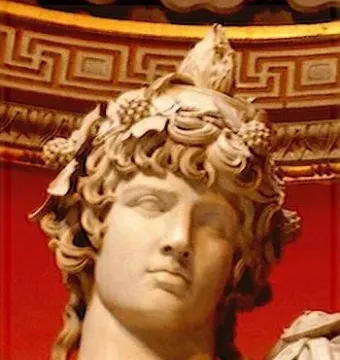
Antinous Braschi, also known as the Antinous Pio-Clementino, is a colossal ancient Roman statue of Antinous, the favorite and beloved of Emperor Hadrian. Found in 1792–1793, it was purchased for the Braschi family collection and is now displayed in the Rotunda Hall of the Pio-Clementino Museum. Carved from white, probably Carrara, marble, the sculpture stands 326 cm high. It shows Antinous as an idealized youth and syncretic deity, combining features of Dionysus and Osiris. The figure wears a draped cloak, a diadem with ivy and other restored elements, and is posed with a thyrsus.
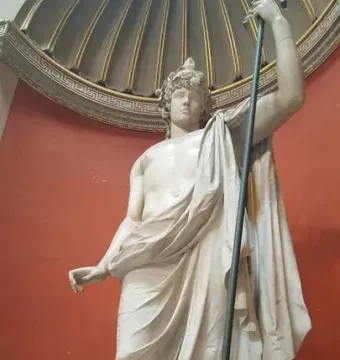
April 2017 © Jamie Heath · CC BY-SA 2.0
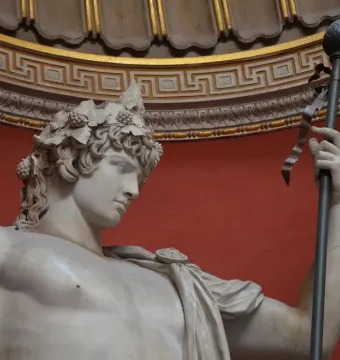
August 2015 © Carole Raddato · CC BY-SA 2.0
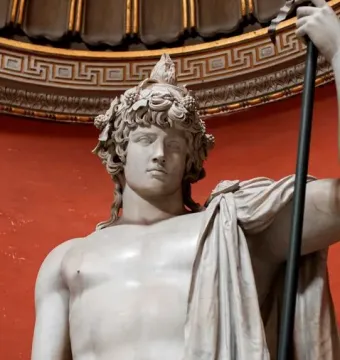
April 2016 © Sergey Sosnovskiy · CC BY-SA 2.0
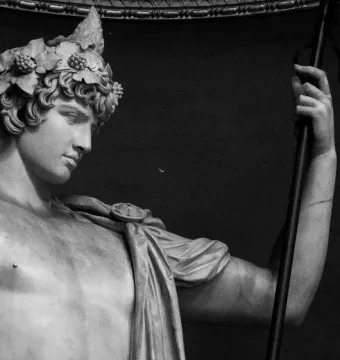
July 2018 © Ajwm8103 · CC BY-SA 4.0
2003 © Jastrow · Public domain
Identification | |
| Title | Antinous Braschi |
| Alternative name | Antinous Pio-Clementino |
| Type | Ancient Roman colossal portrait sculpture |
| Scale | Colossal |
| Subject | Antinous, the Greek youth and favorite/lover of Emperor Hadrian |
Historical context | |
| Date of creation | After the death of Antinous in 130 CE |
| Historical context | Created as part of the posthumous cult of Antinous after he drowned in the Nile during a journey with Hadrian in Egypt |
| Hadrian's reign | 117–138 AD |
Creator | |
| Restorer | Giovanni Pierantoni, under the direction of Gavin Hamilton |
Discovery and provenance | |
| Discovery date | 1792–1793 |
| Discovery location | Palestrina, Italy, in the area called "La Villa" |
| Discovery context | Discovered during excavations of the supposed Villa of Hadrian at Palestrina; numerous sculptures were found at the site |
| Excavators | Gavin Hamilton and Robert Fagan; another unnamed person is also mentioned |
| Acquisition | Bought for the Braschi family collection by Count Braschi; after restoration acquired by Pope Pius VI (Braschi) |
| Name origin | Named after Palazzo Braschi / the Braschi family collection |
Physical characteristics | |
| Base | Oval plinth-base with a profiled perimeter, protruding rings at top and bottom, and a groove between them; an ancient base fragment is present at the back of the modern pedestal |
| Ancient base fragment | 54.5 × 61 cm marble with green veins |
| Total height | 326 cm |
| Plinth height | 15.5 cm |
| Head height | 36 cm from crown to chin |
Materials | |
| Primary material | Marble, probably Carrara marble |
| Headgear material | Some researchers suggest bronze for lost headgear details |
Technique | |
| Surface treatment | Thoroughly cleaned, especially the face |
Appearance | |
| Lost headgear elements | Headdress probably once had an Osirian attribute such as a uraeus or a lotus flower |
| Headgear | Diadem-like headdress with a wreath of two ivy branches with leaves and berries crossing at the front, and a forehead ribbon with tied ends hanging at the back |
| Accessories | Thyrsus topped with a pine cone and ribbons; a woven basket or vessel near the left foot with its lid lifted and snake scales visible inside |
| Right arm and hand | Right arm lowered along the body with forearm slightly forward and outward; right hand relaxed, probably originally held a kantharos |
| Left arm and hand | Left arm extended parallel to the ground and slightly forward, forearm raised; left hand grips a large thyrsus resting near the left foot |
| Drapery | Cloak fastened on the left shoulder with a large round fibula; one edge falls forward over the right hip and legs, while the rest falls back in vertical folds |
| Body | Moderately modeled chest with visible pectoral and serratus anterior muscles; flat abdomen; strongly protruding left nipple |
| Posture | Contrapposto-like stance with weight on the left leg; right leg slightly withdrawn and bent, right foot flat and turned outward |
| Eyes | Pupils drilled, corneas modeled in relief, gaze directed to the left |
| Lips | Full and sensual |
| Cheeks | Full |
| Eyebrows | Straight, hair-drawn eyebrows |
| Hair | Large tousled semi-lunar curls; curly hair falls onto the forehead, temples, and over the ears, with long wavy strands down the neck onto the shoulders |
| Face shape | Rounded young face with expressive, severe features |
| Head position | Slightly inclined downward and to the left |
| Facial expression | Dreamy, languid, melancholic gaze |
| Portrait style | One of the classic portraits of a Greek youth |
| Nose | Large and straight |
Iconography and meaning | |
| Stylistic context | Combination of Greek and Egyptian traditions common in Hadrianic art |
| Aesthetic description | Combines classical restraint with mystically demonic beauty |
| Portrait type in Antinous iconography | First type, subtype A |
| Interpretation | Idealized depiction of Antinous as a syncretic deity with gods associated with rebirth; shown with the splendor of an Olympian god |
| Iconographic features | Combines features of Dionysus and Osiris |
| Depicted as | A youth in the form of a deity |
Location and ownership | |
| Current location | Sala Rotonda, Pio-Clementino Museum, Vatican Museums |
| Later display history | Displayed at Palazzo Braschi in Rome until 1844; transferred to the Lateran Museum and then to the Vatican Museums |
History and restoration | |
| Restoration history | 19th-century restoration replaced the missing crown part with an improvised cone of leaves; some leaves, berries, the pine cone, a row of hair locks, parts of the ears, the entire cloak, the thyrsus, the mystic casket, the right elbow, and parts of the fingers and feet were recreated; the thyrsus may have stood differently in antiquity |
| Modern restorations | The current diadem replaced the original uraeus with a lotus flower in successive restorations |
| Transfer date | 1844 to the Lateran Museum; transferred to the Vatican Museums in 1862 or 1863 |
| Ownership and display after discovery | After restoration it was acquired by Pope Pius VI, displayed in Palazzo Braschi, and later purchased from the Braschi family by Pope Gregory XVI for the Lateran Museum |
Significance | |
| Posthumous cult | One of many sculptural portraits of Antinous created throughout the empire until Hadrian's death in 138 CE |
| Reception | One of the three images of Antinous most frequently reproduced on gems |
| Medals | Featured centrally in 1853 medals engraved by Giuseppe Cerbara under Pope Pius IX |
| Related works | Paired busts of Antinous Braschi and Hadrian are known; another full-length Braschi Antinous in the guise of Hercules is now in the Louvre |
| Copies and reproductions | Copies and casts survive in Saint Petersburg, Cambridge, Oxford, Berlin, Castle Howard, Dresden, the Free University of Berlin, and Warsaw; a marble bust also appeared in front of the north façade of the Chinese Palace in Oranienbaum; Jeff Koons created a 2013 reinterpretation based on the work |