
World Clock
World Clock, also known as the Urania World Time Clock, is a large turret-shaped clock on Alexanderplatz in Berlin’s Mitte district, Germany. Since its construction in 1969, it has become both a tourist attraction and a popular meeting place. The metal rotunda displays the time in 148 major cities around the world. Its 24-sided column represents the Earth’s main time zones, with city names engraved on each side, and a painted compass rose marks the pavement below. The sculpture includes four small analog clocks and a solar-system artwork of steel rings and spheres that turns once a minute. In 1997, the clock was renovated and parts were replaced by Aurotec GmbH.
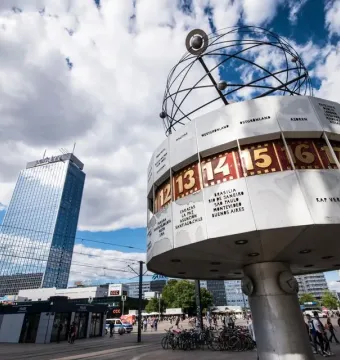
July 2018 © Ralf Steinberger · CC BY 2.0
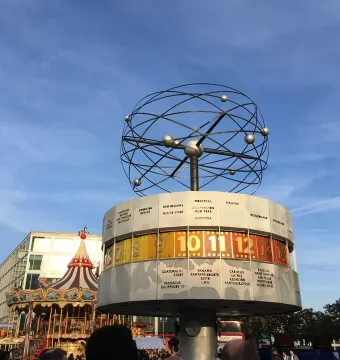
September 2017 © Sandra Becker 01 · CC BY-SA 4.0
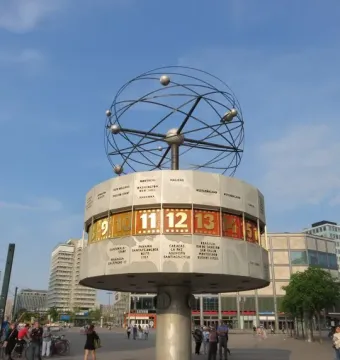
April 2018 © Paulo SP/ Wikimedia · CC BY-SA 4.0
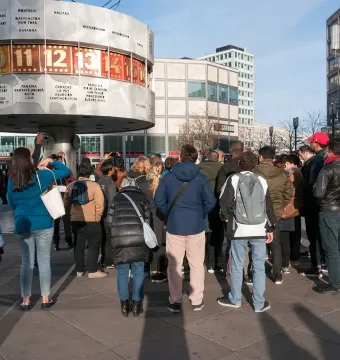
March 2019 © Matti Blume · CC BY-SA 4.0
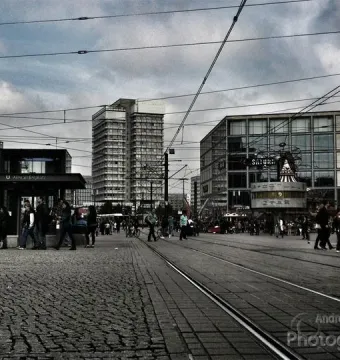
© André Beier · CC BY 3.0
Identification | |
| Title | World Clock |
| Original-language name | Urania-Weltzeituhr |
| German name | Weltzeituhr |
| Italian name | Orologio mondiale dell'Urania |
| Type | public clock sculpture / world clock |
| Alternative name | Urania World Clock |
Historical context | |
| Construction date | 1969 |
| Public unveiling date | 30 September 1969 |
| Occasion of unveiling | 20th anniversary of the German Democratic Republic |
| Associated event | opened alongside the Berlin TV Tower |
| Associated urban project | part of the redesign and expansion of Alexanderplatz in East Berlin under socialist modernism |
Creator | |
| Construction team | more than 120 engineers, specialists, and other tradespeople |
| Collaborating craftsman | Hans-Joachim Kunsch |
| Collaborating company | Getriebefabrik Coswig |
| Designer | Erich John |
| Construction supervision | Erich John |
| Supervisor | Walter Womacka |
| Designer's role | employee of the Alexanderplatz planning group under Walter Womacka; lecturer in product design at the University of Applied Arts in Berlin / Kunsthochschule Berlin-Weißensee |
Discovery and provenance | |
| Origin of idea | the idea arose in 1966 when remains of the Urania Column (also called the Wettersäule), a pre-World War II public clock, were found during the restoration of Alexanderplatz |
| Earlier object | Urania Column / Wettersäule |
| Name origin | named after Urania, the muse of astronomy in Greek mythology |
Physical characteristics | |
| Rotunda inscription | names of 146 places plus the International Date Line |
| Base height | 2.7 meters |
| Top feature | openwork model of the Solar System |
| Weight | 16 tonnes |
| Height | 10 meters |
| Form | clock installation in the form of a column or tower with a rotunda; described as a symbolic clock / world clock |
Materials | |
| Material | metal |
| Base material | metal |
| Rotunda material | metal |
Technique | |
| Time display method | time is read from the markings on the metal rotunda |
| Time zones displayed | 148 major cities around the world |
History and restoration | |
| Vandalism | on 17 October 2023, activists of Ultima Generazione vandalized the clock after damage to the Brandenburg Gate |
| Commemorative coin | a coin featuring the World Clock was issued in 1987 |
| Honor received by designer | Federal Cross of Merit on ribbon in 2021 for inventing the World Clock |
| Rights transfer | Erich John transferred advertising and marketing rights to a Berlin-based startup company in 2018 |
| Naming dispute | Bratislava was changed to Pressburg despite protests from Slovakia |
| Time zone update | Kyiv was moved from Moscow time to Eastern European Time |
| Cities added in 1997 | including Jerusalem, Tel Aviv, Cape Town, and Seoul |
| Examples of updated city names | Leningrad to Saint Petersburg; Alma Ata to Almaty |
| Restoration works | city names were updated, 20 new cities were added, and city-to-time-zone assignments were revised |
| Restoration cost | 350,000 marks |
| Restoration responsibility | Hans-Joachim Kunsch as metal restorer |
| Restoration period | October to December 1997 |
| Heritage status | protected monument status since July 2015; declared a monument of historical and cultural importance by the German government |
Location and ownership | |
| Location | Alexanderplatz, Mitte, Berlin, Germany |
| Original location context | East Berlin, Germany |
Significance | |
| Function | shows the current time in 148 major cities around the world |
| Social role | popular meeting place for Berliners and tourists |
| Touristic role | tourist attraction |
| Cultural status | considered Berlin's most famous meeting point |
| Cultural and political significance | icon of socialist modernity |
| Depicted on | postage stamps and coins of the German Democratic Republic |