
Hand of Irulegi
Hand of Irulegi is a bronze apotropaic amulet in the shape of a right hand, discovered in 2021 during archaeological excavations in an Iron Age village near Irulegi Castle in Aranguren, east of Pamplona in Navarre. Studied inscriptions on its palm revealed four lines of text in Iberian syllabary, likely in a Vasconic language such as Proto-Basque or Aquitanian, with the first word clearly linked to modern Basque. The find has been presented as possible evidence of an early written form of the language. Found at the entrance to a house amid charcoal, it is thought to have been used to bring luck or protect the home. It is now displayed at the Museum of Navarre in Pamplona.
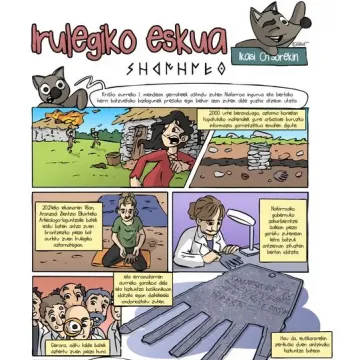
November 2022 © Eñaut Irribarrez · CC BY-SA 4.0
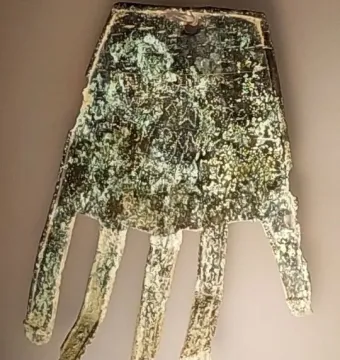
December 2022 © Asier Azpilikueta · CC BY-SA 4.0
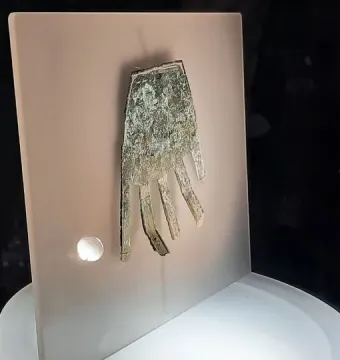
December 2022 © Asier Azpilikueta · CC BY-SA 4.0
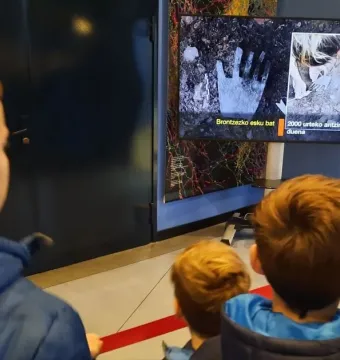
December 2022 © Asier Azpilikueta · CC BY-SA 4.0
December 2022 © Asier Azpilikueta · CC BY-SA 4.0
Identification | |
| Title | Hand of Irulegi |
| Object type | Archaeological artifact; bronze hand-shaped plaque / amulet |
| Original name | Irulegiko eskua / Irulegiko Eskua / la mano de Irulegui / La Mano de Irulegui |
Historical context | |
| Date | 1st century BC (late Iron Age) |
| Historical context | Sertorian War; the settlement was attacked, burned, and later abandoned |
| Associated population | Vascones / Vasconic population |
Creator | |
| Excavation director | Mattin Aiestaran / Matín Aistaran |
| Excavation organization | Aranzadi Scientific Society / Sociedad de Ciencias Aranzadi |
Discovery and provenance | |
| Discoverer | Leire Malkorra |
| Conservation and restoration | Cleaned and restored on 18 January 2022 in the Restoration Department of the Government of Navarre by Carmen Usua, with Berta Balduz |
| Transfer to authorities | Transferred to the Government of Navarre on 13 July 2021 |
| Discovery date | 18 June 2021 |
| Preservation context | Found among debris with charcoal after the roof of the dwelling collapsed |
| Discovery context | Found during archaeological excavations at an Iron Age settlement near Irulegi Castle; in house 6000, at the entrance of a dwelling |
| Discovery location | Near Irulegi Castle, in Aranguren, south/east of Pamplona, Navarre, Spain |
Physical characteristics | |
| Form | Stylized open right hand with extended fingers |
| Physical feature | Hole on the side |
Materials | |
| Material | Bronze |
Technique | |
| Inscription technique | Engraved / carved on the back (palm side) of the hand |
Appearance | |
| Inscription | Five lines / five words, 40 characters, in northeastern Iberian / Iberian script |
| Reading status | Not fully translated; language uncertain |
Iconography and meaning | |
| Language of inscription | Probably Basque (Proto-Basque / Vasconic) or Aquitanian; possibly the oldest known evidence of Basque |
| First word | sorioneku |
| Interpretation of first word | Likely corresponds to modern Basque zorioneko, meaning 'lucky' or 'of happiness' |
| Interpretation | Thought to have been an apotropaic object, perhaps hung from a door to protect the house or for greeting/luck-related purposes |
| Comparative example | Compared with eguzki-lore |
Location and ownership | |
| Current location | Museum of Navarre, Pamplona |
| Display status | On display; temporarily kept in the museum pending room renovations in 2024 |
| Museum room | Recently renovated prehistoric room; Room 1.1 was still under renovation |
History and restoration | |
| Official announcement date | 14 November 2022 |
| Announcing authority | Government of Navarre |
| Asset of Cultural Interest process | Process to declare it an Asset of Cultural Interest began on 4 September 2023 |
Significance | |
| Historical significance | May be the oldest known inscription in the Basque language; a unique example of Paleohispanic writing and artifact |
| Significance | Considered extremely important and of unique nature; provides important clues for pre-Roman languages and cultural practices |