
Danaid
Danaid is a sculpture by French artist Auguste Rodin, conceived for his major project The Gates of Hell, though it was not included in the final version. The figure draws on literary sources such as Dante’s Divine Comedy, Baudelaire’s Flowers of Evil, and Ovid’s Metamorphoses, particularly the myth of Hypermnestra and the daughters of Danaus. Rodin presents a nude woman stretched across a rock, her tense body, exposed back, and falling hair suggesting remorse, humiliation, and eternal punishment. The water below recalls the endlessly empty vessels of the Danaids. Some scholars have suggested Camille Claudel may have modeled for the work, but this remains unverified and is rejected by the Rodin Museum’s research.
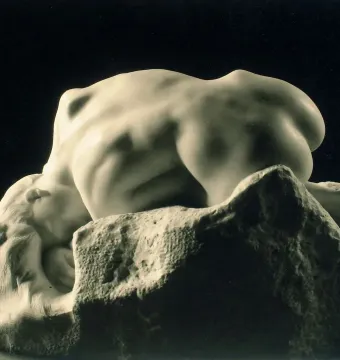
© Auguste Rodin · Public domain
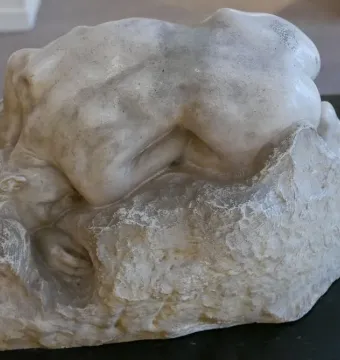
May 2024 © Finoskov · CC BY-SA 4.0
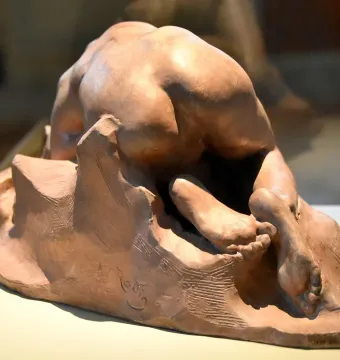
July 2019 © Osama Shukir Muhammed Amin FRCP(Glasg) · CC BY-SA 4.0
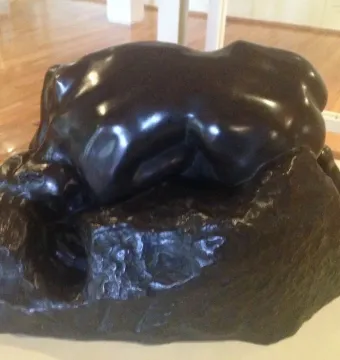
September 2015 © Fmontesdeoca93 · CC BY-SA 4.0
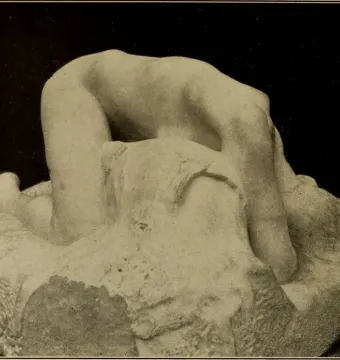
1904 © Internet Archive Book Images · No restrictions
Identification | |
| Title | Danaid |
| Alternative title | La Danaïde; La Danaide; The Spring |
| Type | Sculpture |
Historical context | |
| Date | 1889 |
| Original conception date | 1885 |
| Original conception context | Originally conceived for The Gates of Hell |
| Inclusion in The Gates of Hell | Not included in the final version of The Gates of Hell |
| Related work | The Gates of Hell |
| Literary inspiration | Dante Alighieri's The Divine Comedy; Baudelaire's The Flowers of Evil; Ovid's Metamorphoses |
Creator | |
| Artist | Auguste Rodin |
| Artist nationality | French |
| Artist lifespan | 1840–1917 |
Discovery and provenance | |
| Related figure | Andromeda |
| Relation to Camille Claudel | Rodin's student, collaborator, and romantic partner |
| Possible model | Camille Claudel may have served as the model, but this is unverified and rejected by the Rodin Museum's research |
Materials | |
| Material | Bronze |
| Material | Marble |
Technique | |
| Marble version production | Carved in Rodin's atelier under Rodin's supervision by Jean Escoula |
| Bronze versions | First cast in 1891 |
Physical characteristics | |
| Dimensions | 36 cm high, 71 cm wide, 53 cm deep |
| Current version type | Marble version |
Appearance | |
| Depicted subject | One of the Danaids, the fifty daughters of King Danaus of Argos |
| Mythological background | The Danaids were punished in the afterlife by endlessly filling leaking or bottomless vessels with water for killing their husbands on their wedding nights; Hypermnestra refused to kill her husband Lynceus |
Iconography and meaning | |
| Iconography | The sculpture does not follow the traditional iconography of the Danaid filling her jar |
| Body language and anatomy | Her tense posture emphasizes the back, neck, torso, strained back muscles, and exposed vertebrae |
| Water motif | The escaping water suggests endless, futile punishment |
| Associated object | A jar beside her, with water flowing from it |
| Hair | Her long hair falls softly over her face and onto the ground |
| Depicted figure | Hypermestra, the eldest of the Danaids |
| Pose and expression | She is shown collapsed from a kneeling position, fully nude on a rock, with her head resting on her arm as if in a great sob |
| Interpretation | A repentant, sensual martyr undergoing eternal punishment |
Style | |
| Style | Fantastic realism |
| Stylistic feature | Rodin emphasizes the line of the Danaid's back and nape |
| Facial treatment | The face is deemphasized because Rodin believed the body is more expressive than the face |
| Visual similarity | The sculpture resembles the silhouette of Andromeda |
Location and ownership | |
| Current location | Musée Rodin, Paris |
| Other marble locations | Musée Rodin, Paris; Rodin Museum, Philadelphia; Brooklyn Museum |
| Bronze locations | Collections in France; Museo Soumaya, Mexico City |
| Modern reproduction location | Permanent collection of the Peoria Riverfront Museum, Peoria, Illinois, United States |
| Modern reproduction donor | B. Gerald Cantor |
| Modern reproduction dedication | In honor of Carlotta and Gary Bielfeldt |
| Modern reproduction gift date | 1987 |
| Marble version presentation | Shown at the Salon in 1890 |
| Related figure in The Gates of Hell | Andromeda is located at the top of the right leaf; the Danaid appears on each leaf and on the left as part of the Winged Genie falling |
| Marble version current location | Musée d'Orsay |