
Storia
Storia refers to the marble sculpture by Horatio Greenough known as George Washington, commissioned by the U.S. Congress on 14 July 1832 to mark the centenary of George Washington’s birth. Completed in 1840, it was first displayed in the rotunda of the United States Capitol, then moved to the Capitol’s East Garden in 1843. Since 1964, it has been kept at the National Museum of American History. Greenough modeled the work on Phidias’ statue of Zeus at Olympia, one of the Seven Wonders of the Ancient World, which was destroyed in late antiquity.
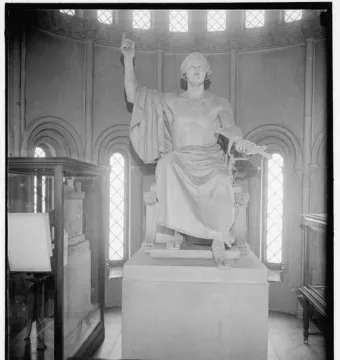
1939 © Harris & Ewing, photographer · Public domain
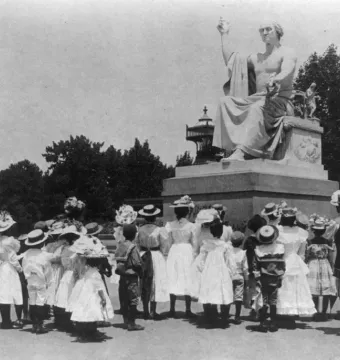
· Public domain
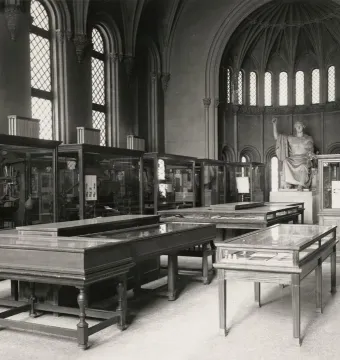
© Smithsonian Institution · Public domain
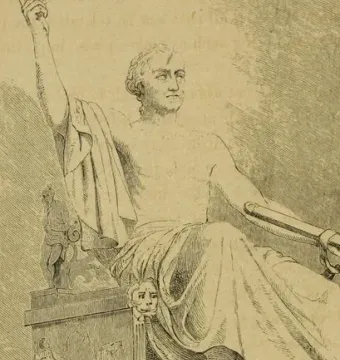
1854 © Internet Archive Book Images · No restrictions
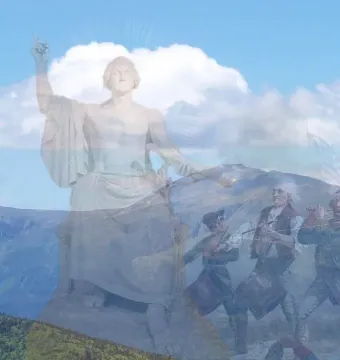
July 2018 © Kalki · CC BY-SA 3.0
Identification | |
| Title | George Washington |
| Subject | George Washington |
| Type | large marble statue |
| Alternative name | Enthroned Washington |
Creator | |
| Sculptor | Horatio Greenough |
| Artist nationality | American |
Historical context | |
| Style | Neoclassicism |
| Referenced model fate | destroyed in late antiquity |
| Referenced model significance | one of the Seven Wonders of the Ancient World |
| Inspiration | the Statue of Zeus at Olympia by Phidias |
| Completion date | 1840 |
| George Washington birth date | 22 February 1732 |
| Commission purpose | to commemorate the 100th anniversary of George Washington's birth |
| Commission date | 14 July 1832 |
| Commissioned by | United States Congress |
Discovery and provenance | |
| Transferred to | the Smithsonian Institution |
| Current display location | second floor of the museum |
| Current location | National Museum of American History |
| Transferred to | the Museum of History and Technology (now the National Museum of American History) |
| Displayed at | the Smithsonian Castle |
| Arrival in Washington, D.C. | 31 July 1841 |
| Transfer authorization | joint resolution of Congress dated 22 May 1908 |
| Relocated to | a pedestal in the East Garden of the Capitol |
| Relocation date | 1843 |
| Initial display location | rotunda of the United States Capitol |
| Initial installation date | December 1841 |
| Made in | Italy |
Physical characteristics | |
| Right hand gesture | raised with the index finger pointing upward |
| Cost | $44,000 at contemporary prices |
| Technique | carved from a huge block of marble |
| Material | Carrara marble |
| Left hand object | sheathed sword held hilt-first |
| Height | about 3.5 meters (11 feet 4 inches) |
| Footwear | ancient-style sandals |
| Depiction | bare-chested George Washington in a semi-nude, semi-divine pose |
| Pose | seated on an improvised throne |
| Weight | 12 tons |
| Clothing | Roman toga |
Appearance | |
| Christopher Columbus depiction | bearded, wrapped in ancient-style drapery, contemplating a globe |
| Right side relief | Apollo driving the chariot of the Sun |
| Left side relief | baby Heracles strangling serpents while his brother Iphicles covers his eyes |
| Seat back decoration | two small figures depicting Christopher Columbus and an Indigenous person |
| Seat decoration | decorated with acanthus leaves and lion heads |
| Expression | gazes sternly ahead |
Iconography and meaning | |
| Symbolism of sword | represents the transfer of power to the people of the United States after the American Revolutionary War |
| Symbolic meaning | represents freedom and peace |
| Relief interpretation | allegories of North America and South America |
| Inscriptions | Latin inscription on the reverse side of the base of the pedestal, naming Horatio Greenough and translating as: 'Horatio Greenough made this image as a great example of freedom, which will not survive without freedom itself.' |
History and restoration | |
| Initial reception | immediately controversial and criticized; many found the semi-nude Washington offensive or comical |
| Relocation reason | the sculpture's weight and the dim light inside the rotunda |
| Ongoing reaction | disapproval continued after relocation; some joked that Washington was trying to recover his clothes, then displayed at the Patent Office |
Significance | |
| Unconventionality | described as an unconventional sculpture |
| Literary reference | mentioned in Dan Brown's The Lost Symbol (2009) as part of a hypothesis about Masonic or occult symbols in the nation's capital |
| Video game appearance | appears at the beginning of BioShock Infinite (2013), set in an alternate 1912 where Washington is worshipped in the floating city of Columbia |