
Oviri
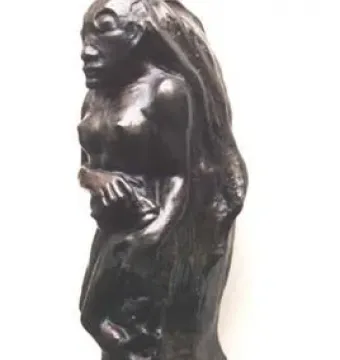
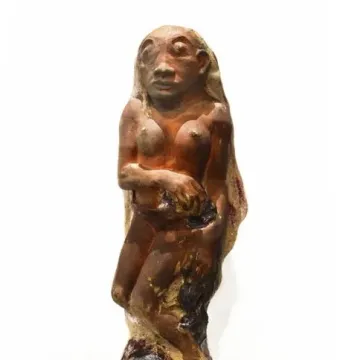
Oviri is a 1894 ceramic sculpture by the French artist Paul Gauguin. In Tahitian mythology, Oviri was the goddess of mourning, and the figure is shown with long light hair and wild eyes, suffocating a wolf with its feet while holding a cub in its arms. Art historians have proposed multiple interpretations, often linking it to Gauguin’s self-image as a “civilized savage.” Gauguin made three molds in partially glazed stoneware, and the original mold is now in the Musée d’Orsay. The sculpture later appeared at the Salon d’Automne in 1906 and influenced Pablo Picasso, who used it as a basis for one of the figures in Les Demoiselles d’Avignon.
© Frachet · CC BY-SA 3.0
1894 © Paul Gauguin, Oviri, photograph by Coldcreation · Public domain
© Christopher Brown · CC BY 2.0
© Paul Gauguin · Public domain
© Paul Gauguin · Public domain
Identification | |
| Title | Oviri |
| Type | Ceramic sculpture |
Historical context | |
| Possible influences | Assyrian reliefs of a 'master of animals' or Gilgamesh with a lion cub; Majapahit mummies and terracotta figures; preserved skulls from the Marquesas Islands; figures and fertility imagery from Borobudur; an 18th-dynasty Egyptian tomb fresco; Odilon Redon's La Mort; Gauguin's 'little world of friends' from his first Tahitian visit |
| Related earlier works | Gauguin's Tahitian paper mask portraits from 1891, his 1889 ceramic Black Venus, and his fox imagery in Soyez amoureuses vous serez heureuses (1889), Be in Love, You Will Be Happy (1889), and The Loss of Virginity (1891) |
| Tahitian context | By 1894, Tahitian goddesses of Gauguin's era had largely disappeared from popular memory, so the work is largely imaginative |
| Date | Winter 1894 |
Creator | |
| Workshop of creation | Ernest Chaplet's workshop at Rue de Vaugirard, Paris |
| Artist | Paul Gauguin |
| Artist nationality | French |
| Related ceramics background | Gauguin began working in ceramics around 1886 under Ernest Chaplet, collaborating on stoneware pots with applied figures, ornamental fragments, and multiple handles |
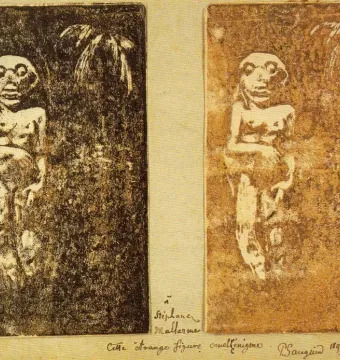
| Gauguin's descriptions | Gauguin called the figure an 'enigma strange and cruel' in 1895 and referred to it as La Tueuse ('The Murderess' / 'The Killer') in a 1897 letter to Ambroise Vollard; he also described it as his great ceramic statue and an exceptional piece such as no ceramist had made before |
Materials | |
| Material | Partially glazed stoneware |
Technique | |
| Number of casts | Three |
Discovery and provenance | |
| Original location | Musée d'Orsay |
| Current location | Musée d'Orsay, Paris |
| Sale history | Gauguin's sale of the casts was unsuccessful |
| Buyer | Gustave Fayet bought one version in 1905, two years after Gauguin's death |
History and restoration | |
| Exhibition history | Submitted to the Salon of the Société Nationale des Beaux-Arts in 1895 and exhibited at the 1906 Salon d'Automne as no. 57 |
| Exhibition controversy | Accounts differ: Charles Morice said Gauguin was literally expelled from the exhibition, while Ambroise Vollard said Oviri was accepted only after Ernest Chaplet threatened to withdraw his own works |
| Preserved versions | Three plaster versions are recorded: one donated to George-Daniel de Monfreid and now at the Musée départemental Maurice Denis in Saint-Germain-en-Laye; one kept by Gustave Fayet and later part of his son Léon's collection; and one retained by the artist who made the molds |
| Bronze proposal | In 1897, Ambroise Vollard suggested casting Gauguin's sculptures in bronze; Gauguin said Oviri would look very good cast in bronze, without retouching or patina, and that a buyer would get both the ceramic piece and a bronze edition |
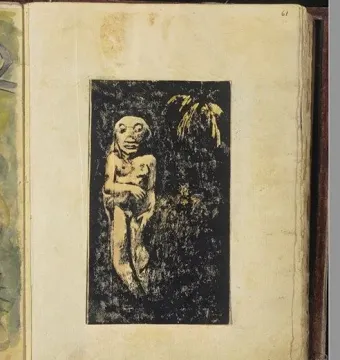
| Related depiction | Gauguin depicted Oviri in at least one drawing, two watercolor transfer monotypes, and two woodcuts; the woodcuts may have been made in Pont-Aven in summer 1894, and the latest related drawing probably appeared in the first issue of Le Sourire published between August 1899 and April 1900 |
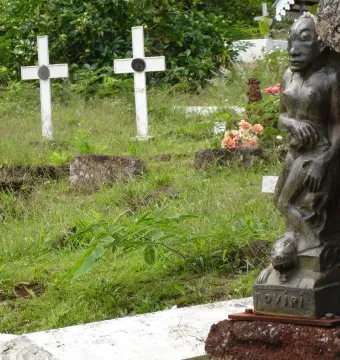
| Funerary bronze | A bronze version was placed on Gauguin's tomb in Atuona; the tomb monument was erected on 29 March 1973 |
| Other versions | Several plaster or bronze copies exist; several bronzes were produced |
Appearance | |
| Related drawing inscription | On the Le Sourire drawing, Gauguin wrote: 'Et le monstre, entraînant sa créature, féconde de sa semence des flancs généreux pour engendrer Séraphitus-Séraphita' |
| Pose | It is unclear whether she is smothering or embracing the cub |
| Composition | The figure is seated on the body of a dead she-wolf, crushing its cub |
| Animal identification | The animals are usually identified as wolves, though Nancy Mowll Mathews suggested they may be foxes |
| Animal motif | She holds a cub at her hip and has a second animal at her feet |
| Figure description | Shown with long blond or gray hair reaching to her knees and wild eyes; her head and eyes are disproportionately large, and the back of her head has an opening that resembles a vaginal orifice |
| Subject | A female figure named Oviri |
Iconography and meaning | |
| Interpretation | Art historians often interpret the work as Gauguin's epithet reinforcing his self-image as a 'civilized savage' |
| Themes | Death, the wild, the fierce, sacrifice, infanticide, indifference, wild power, and the archetype of the vengeful mother; life and death are evoked in the same image |
| Alternative title | Diane Chasseresse ('Diana the Huntress') was used by Charles Morice, alluding to Diana, goddess of the hunt, the moon, and childbirth |
| Literary reference | A drawing of the figure carried an inscription referencing Honoré de Balzac's Séraphîta and the androgynous figure Séraphitus-Séraphita |
| Mythological figure | Oviri, the goddess of mourning in Tahitian mythology |
| Interpretive notes | Barbara Landy read the life-and-death theme as Gauguin's need to abandon his civilized ego and return to the primitive savage; Nancy Mowll Mathews interpreted the animals as foxes, linking them to fox symbolism in Asian folklore |
Significance | |
| Reception | The exhibition controversy prompted Gauguin to write an indignant letter to Le Soir complaining about the state of modern ceramics and the treatment of ceramic artists |
| Influence on artists | The work influenced Pablo Picasso and informed one of the figures in Les Demoiselles d'Avignon |