
Four Seasons Altar
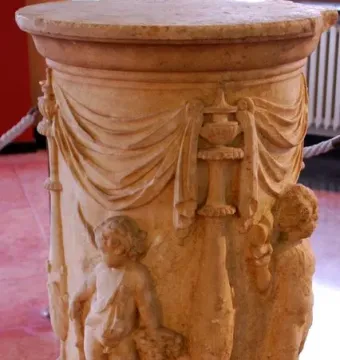
The Four Seasons Altar is a Roman decorative altar from around 40 AD, made of finely crystalline white marble. It was found in 1886 on the Pincio in Rome, on the grounds of the former Horti Sallustiani, and later reappeared after decades in a private collection and the antiquities trade. The round altar is decorated at regular intervals with four putti representing the seasons through their attributes. The sculpture is 73 cm high and 56.4 cm in diameter, and is largely preserved apart from minor damage. It is dated to the early Claudian period and is now in the collection of the Martin von Wagner Museum in Würzburg.
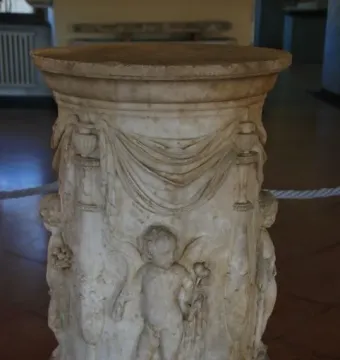
October 2012 © Marcus Cyron · CC BY-SA 3.0
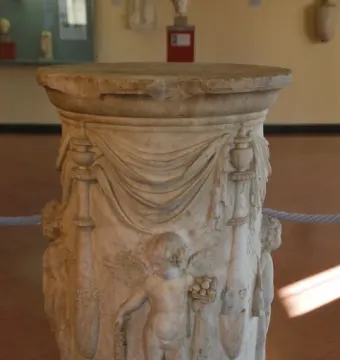
October 2012 © Marcus Cyron · CC BY-SA 3.0
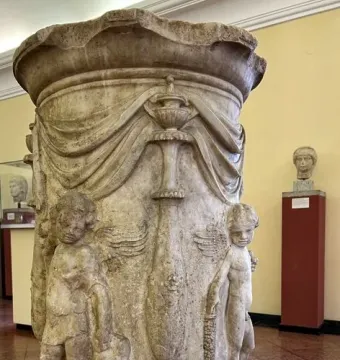
October 2024 © Burkhard Mücke · CC BY-SA 4.0
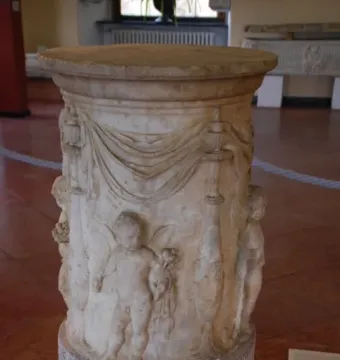
July 2010 © Marcus Cyron · CC BY-SA 3.0
July 2008 © Marcus Cyron · CC BY-SA 3.0
Identification | |
| Title | Four Seasons Altar |
| Original language names | Würzburger Vierjahreszeitenaltar; Ara delle quattro stagioni |
| Type | Roman decorative altar |
| Alternative names | Würzburger Vierjahreszeitenaltar; Ara delle Quattro Stagioni; Four Seasons Altar of Würzburg; Würzburg Four Seasons Altar |
Historical context | |
| Date | c. 40 AD, early Claudian period |
| Period | Roman |
Creator | |
| Creator | Unknown |
Discovery and provenance | |
| Competing buyer | Antikensammlung Berlin, through Friedrich Matz Jr. and Adolf Greifenhagen; the altar was sold to Würzburg instead |
| Dealer | Giorgio Fallani |
| Italian state claim | The Italian state could no longer claim the work after eighty years |
| Discovery location | Pincio, Rome, on the site of the former Horti Sallustiani (Sallustian Gardens), on property that had belonged to the Roman emperors |
| Acquisition | Purchased for the antiquities collection of the Martin von Wagner Museum in Würzburg by Erika Simon, who recognized it as the lost altar |
| Post-discovery history | Soon lost after publication; later in a private American collection for decades; reappeared in Rome in 1966 in the antiquities trade of Giorgio Fallani |
| First publication | Immediately after discovery |
| Discovery date | 1886 |
Physical characteristics | |
| Damage note | The winter putto was damaged during carving of the dead animal and was not further worked out; the damage was not repaired |
| Condition | Mostly complete; only minor chips and edge damage |
| Diameter | 56.4 cm |
| Height | 73 cm |
| Form | Round altar |
Materials | |
| Material | Fine-grained white marble |
Appearance | |
| Decoration | Four putti evenly spaced around the altar |
Iconography and meaning | |
| Main theme | The four seasons represented by four putti |
| Winter figure | A putto dressed as a farmworker, with a slaughtered animal and a wine amphora |
| Spring figure | Associated with Venus and Flora; marked by a floral garland |
| Summer figure | Associated with Ceres; marked by ears of grain and poppies |
| Autumn figure | Satyr-like putto with a basket of grapes, symbolizing Bacchus |
| Figure arrangement | Winter faces spring, and autumn faces summer |
| Literary references | The seasonal personifications are linked in literary tradition by authors such as Ovid and Lucretius |
Location and ownership | |
| Current location | Martin von Wagner Museum, Würzburg |
| Inventory number | H 5056 |
| Intended function | Probably intended less for cult use than as a decorative garden ornament |
Significance | |
| Possible political meaning | Possibly alludes to a positive development of the Julio-Claudian dynasty |
| Iconographic context | In the early Imperial period, imperial princes were also represented as putti |