
Berlin Green Head
Berlin Green Head is a male sculptural portrait made of grey-green grauwacke, about 21.5 cm high. Dating to around 350 BCE, it is an important work of ancient Egyptian art from the Late Period. The identity of the man depicted and the sculptor are unknown. The figure shows an adult man with a bald head, deep wrinkles around the eyes, fleshy slightly sagging cheeks, and a double chin. Its carefully polished surface and realistic features reflect the style of the period, while the near-symmetry of the face suggests a carefully constructed image rather than a portrait from life. The sculpture was donated by James Simon to the Egyptian Museum and Papyrus Collection and is displayed in the Neues Museum.
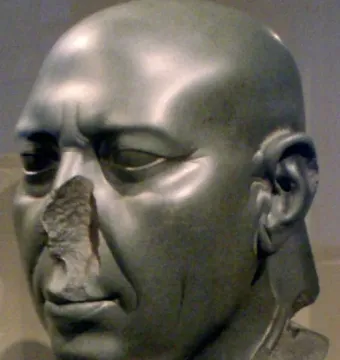
November 2006 © Keith Schengili-Roberts · CC BY-SA 3.0
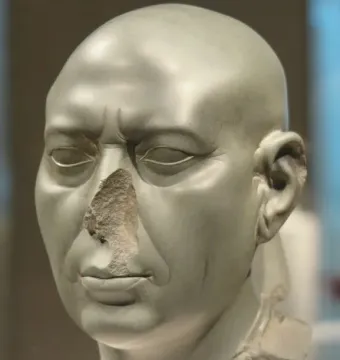
February 2015 © Rolf Dietrich Brecher · CC BY-SA 2.0
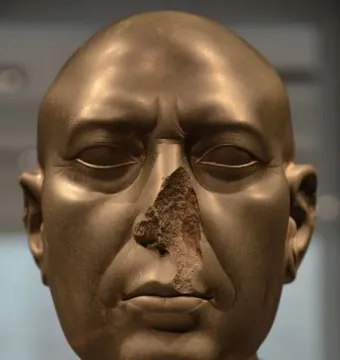
March 2014 © Following Hadrian · CC BY-SA 2.0
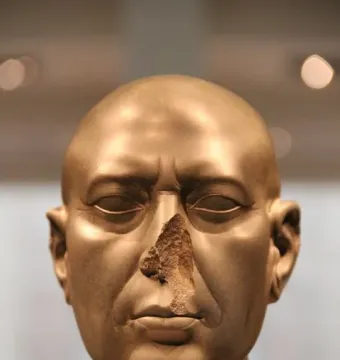
August 2016 © Gary Todd · CC0
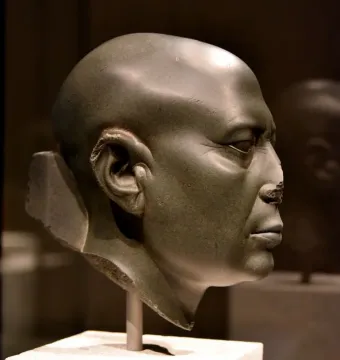
July 2019 © Osama Shukir Muhammed Amin FRCP(Glasg) · CC BY-SA 4.0
Identification | |
| Title | Berlin Green Head |
| Original-language name | Берлінська зелена голова |
| Original title | La Tête verte de Berlin |
| Original-language title | La cabeza verde de Berlín |
| Type | Male sculptural portrait; head sculpture |
| Inventory number | AeMP 12500 |
| Original language title | Berlinskaya zelyonaya golova |
Historical context | |
| Dating | Approximately 350 BC; later proposed more specifically as 100–50 BCE by Bernard von Bothmer (1960) |
| Earlier attribution | Once regarded as Saite period art; later attributed to the Ptolemaic period by Friedrich Wilhelm von Bissing |
| Dating method | Dated on stylistic grounds only, because the object is uninscribed |
| Historical context | The dynasty began by expelling the Persians from Egypt and conquering Judea during the decline of the Persian Empire |
| Dynasty origin | Sebennytos |
| Dynasty dates | 378–341 BC |
| Dynasty | Egyptian Dynasty XXX |
| Period | Late Period of Egypt |
| Culture | Ancient Egypt |
Creator | |
| Artist | Unknown |
| Attribution | Considered the work of a highly skilled ancient Egyptian sculptor, whose identity is unknown |
Discovery and provenance | |
| Provenance | Unknown before 1895 |
| Acquisition date | 1895 |
| Acquisition source | From the collections of Prince Ibrahim Hilmy and Henry Wallis |
| Donor | James Simon |
| Donation | Presented as a gift to the Egyptian Museum and Papyrus Collection |
Physical characteristics | |
| Shape | Oval head |
| Condition | Bald or shaved head |
| Support element | The upper part of a conventional back pillar is visible behind the head |
| Color | Grey-green |
| Height | 21.5 cm |
| Material | Grey-green grauwacke (also described as green schist, greenschist, slate, or green stone; possibly Bekhen stone) |
Appearance | |
| Subject | An adult, middle-aged man |
| Hair | Bald or shaved |
| Facial features | Distinctive skull structure, deep wrinkles around the eyes and bridge of the nose, fleshy slightly sagging cheeks, and a double chin |
| Expression | Calm, emotionless, gloomy, and stern |
| Symmetry | Almost perfectly symmetrical |
| Realism | Highly realistic |
| Surface treatment | Carefully polished surface |
| Style | Typical of Late Period sculpture |
Iconography and meaning | |
| Construction of face | The sculptor appears to have constructed the face rather than modeled it from a live subject |
| Wrinkle treatment | Wrinkles were systematically conceived and rendered with precision |
| Influence | Shows influence of ancient Greek art |
| Possible identification | May have been a priest |
| Interpretation | The facial features differ from ancient Egyptian beauty ideals, giving the portrait individuality |
Location and ownership | |
| Current location | Neues Museum, Berlin |
| Collection | Egyptian Museum and Papyrus Collection |
| Display location | Room 1.09, one floor below the Nefertiti Bust |
| Display status | On display |
| Owner's name and titles | Unknown |
History and restoration | |
| Verism | Reduced compared with the Boston Green Head |
| Asymmetry | Less prominent than in the Boston Green Head |
| Inscription | Uninscribed |
| Comparison with Boston Green Head | The Berlin Green Head has lost veristic features, including asymmetry, that are more prominent in the Boston Green Head, while still retaining characterization of the individual represented |
| Comparative object | Compared with the earlier Boston Green Head |
Significance | |
| Art historical significance | One of the most famous and important works of ancient Egyptian art, and one of the best-known works of the Late and Ptolemaic periods |
| Comparison with other famous works | Often mentioned together with the bust of Nefertiti and the funerary mask of Tutankhamun |
| Alternative interpretation of realism | Earlier viewers thought such anatomical realism would have required knowledge of Greek anatomy, but this was later rejected by comparison with earlier Egyptian works |
Other | |
| Image views listed | Front face; right profile; left profile; reconstructed image; same image without retouching |