
Boy with Thorn
Boy with Thorn, also called Fedele, Fedelino, or Spinario, is a Hellenistic Greco-Roman bronze sculpture of a boy removing a thorn from the sole of his foot. The original was found around 300 BCE and is now in the Palazzo dei Conservatori in Rome. A Roman marble version of the same subject, from the Medici collections, is in a corridor of the Uffizi Gallery in Florence. The work became admired in the early Renaissance as one of the first Roman sculptures to be copied, inspiring bronze reductions and later diplomatic gifts to rulers in France, Spain, and England. A bronze copy is also described in a still life by Pieter Claesz now in the Rijksmuseum.
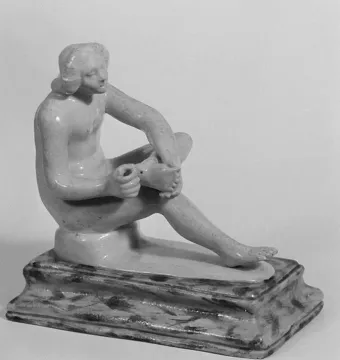
· CC0
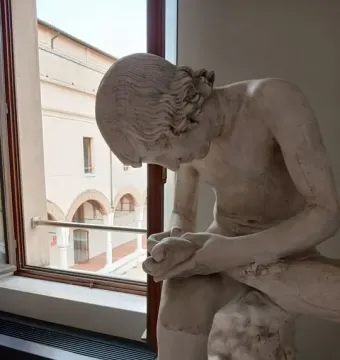
September 2025 © ERC ARCHIATER · CC BY 4.0
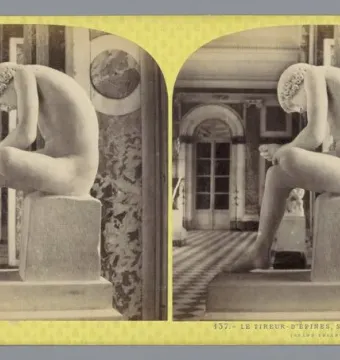
© Rijksmuseum · CC0
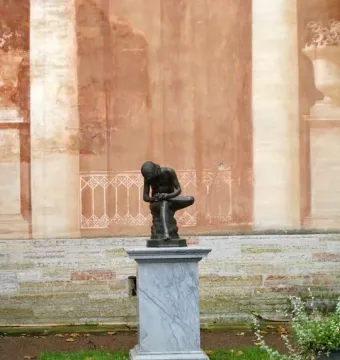
October 2016 © Екатерина Борисова · CC BY-SA 4.0
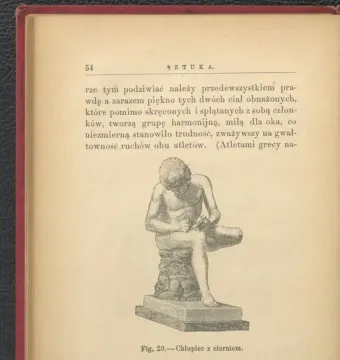
© Elie Jean Pécaut · Public domain
Identification | |
| Title | Spinario |
| Original title | Menino com Espinho |
| Alternative names | Fedele; Il Fedele; El Niño de la espina; Spinario capitolino (Capitoline Spinario); Fedele (Fedelino); Spinario capitolino; Capitoline Spinario |
| Type | Ancient bronze statue |
| English title | Boy with Thorn |
Historical context | |
| Date | Probably Roman bronze of the 1st century BC; some sources date it to the 1st century AD |
| Style/period | Hellenistic / Greco-Roman |
| Early Renaissance significance | One of the first Roman sculptures to be copied; one of the most admired and copied ancient statues during the Renaissance |
Creator | |
| Attribution | Considered a Roman pastiche inspired by a Greek sculpture |
Physical characteristics | |
| Body style | Hellenistic in style |
| Hair | Finely styled; in strands, with an archaizing arrangement that stays close to the head |
| Head style | Archaic in style; recalls 5th-century BC works and is adapted from an older prototype |
| Composition of version | Body: Hellenistic, 3rd century BC; head: 5th century BC |
| Head position | Bent over the foot |
| Height | 73 cm |
| Pose | Sits on a rock block with the left leg bent and resting over the right thigh |
| Depicted figure | A seated boy or youth on a rock |
| Action depicted | Removing a thorn from the sole of his left foot |
Materials | |
| Primary material | Bronze |
| Other versions | Also known through marble variants, plaster copies, and later bronze copies |
Technique | |
| Construction hypothesis | Thought to be assembled from two statues or from a Hellenistic body and a later head |
| Scale | Usually life-size |
Appearance | |
| Subject | A youth removing a thorn from his foot |
Iconography and meaning | |
| Symbolism | Youth |
| Iconographic theme | Related to depictions of Pan and satyrs; linked to the world of Dionysus |
| Medieval interpretation | The thorn was interpreted as a symbol of original sin, so the figure was seen as a sinner seeking salvation |
| Legendary identification | Associated in later legend with the shepherd boy Gnaeus Marius / Cnaeus Marius / Martius, who carried a message to the Roman Senate before removing the thorn |
| Additional legend | Another Renaissance legend identified the figure as the shepherd boy Cnaeus Marius, sent to warn of an enemy advance and delayed by the thorn until completing the mission |
Discovery and provenance | |
| Transfer to Palazzo dei Conservatori | Probably moved there by Pope Sixtus IV in 1471 or in the 1470s; first recorded there in 1499–1500 |
| Magister Gregorius identification | Priapus |
| Benjamin of Tudela identification | Absalom, described as being without defect from the sole of his foot to the top of his head |
| Known since | The Middle Ages |
| Early location | Outside the Lateran Palace, set on top of a marble column |
| Earliest recorded observers | Benjamin of Tudela in the 12th century; Magister Gregorius around 1200 |
Location and ownership | |
| Related version location | British Museum, London |
| Related version location | The Oliver Mansion, South Bend, Indiana |
| Related version location | Newcastle University School of Medical Science entrance lobby |
| Related version location | Rijksmuseum, Amsterdam |
| Related version location | Metropolitan Museum of Art, New York |
| Related version location | Pushkin Museum, Moscow |
| Related version location | Louvre Museum, Paris |
| Related version location | Galleria Estense, Modena |
| Related version location | Uffizi Gallery, Florence |
| Current location | Capitoline Museums, Rome |
| Earlier location after transfer | Palazzo dei Conservatori, Rome |
History and restoration | |
| Scholarly view | Recent scholarship generally credits the Capitoline Spinario as a Roman bronze of the 1st century BC / early Roman period, possibly a pastiche assembled from parts with an archaic head adapted from an older prototype |
| Influence on artists | Inspired Renaissance artists; the pose influenced Brunelleschi's Sacrifice of Isaac for the Florence Baptistery doors and Botticelli's The Trials of Moses; it also influenced Masaccio and Michelangelo through Medici-circle access to the sculpture |
| Copy for Philip II of Spain | A copy given by Cardinal Giovanni Ricci |
| Copy for Francis I of France | A version from Ippolito II d'Este, supervised by Giovanni Fancelli and Jacopo Sansovino and carried out by Benvenuto Cellini; now in the Louvre Museum |
| Specific copy for Isabella d'Este | Made by Jacopo Buonaccolsi around 1501; now in the Galleria Estense, Modena |
| Copies and variants | A bronze reduction by Severo da Ravenna; a bronze reduction by Jacopo Buonaccolsi ('L'Antico'); a full-size variant by Antonello Gagini for a fountain in Messina; a bronze Spinario by Hubert Le Sueur for Charles I of England; marble and bronze copies in later collections; Hellenistic marble variants discovered in later excavations |
| Renaissance copying | Frequently copied in marble and bronze in the early Renaissance; bronze copies also used as ambassadorial gifts in the 16th century |
| Looting and removal | Looted by the French in 1798 and taken to Paris as part of the Musée Napoléon / Louvre collections |
| Donation to the city | Donated by Pope Sixtus IV in 1471 |
| Return to Rome | Returned to the Capitoline authorities in 1815 and to Rome at the beginning of 1816 after Napoleon's defeat, with Canova's help |
Other | |
| Documentation of related version | The marble version from the Medici collections was found on the Esquiline and seems to have been among the antiquities assembled in the gardens at San Marco, Florence |
| Interpretive anecdote | The popular 18th-century name Il Fedele came from an invented story about a faithful messenger who delivered a message to the Roman Senate before removing the thorn; Paolo Alessandro Maffei rejected the story in 1704 |
| Still-life depiction | Depicted in Pieter Claesz's Still Life with 'Spinario' (1628), preserved in the Rijksmuseum, including a small plaster model of the statue |
Significance | |
| Reputation | Quickly gained international fame in cultivated European circles because of its exceptional preservation and the rarity of surviving ancient bronzes |
| Comparative fame | Considered comparable in fame to the Apollo Belvedere, Venus de' Medici, Laocoön, the Discobolus, and the Horses of San Marco |