
Dancers of Delphi
Dancers of Delphi are three classical Greek figures in the round, more accurately caryatids, that once topped an acanthus column and were meant to support a tripod containing an omphalos. Found near the sanctuary of Apollo Pythian at Delphi, they are now preserved in the Delphi Archaeological Museum. The sculpture inspired Claude Debussy’s first Prelude. Their dating has long been debated: while an early date was first proposed, later evidence and stylistic analysis place the monument in the second half of the 4th century BC, probably before 335 BC. The figures remain an important example of ancient Greek sculpture and Delphi’s monumental dedications.
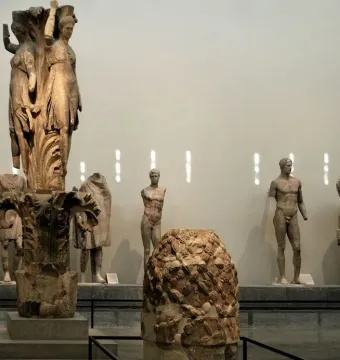
April 2013 © LBM1948 · CC BY-SA 4.0
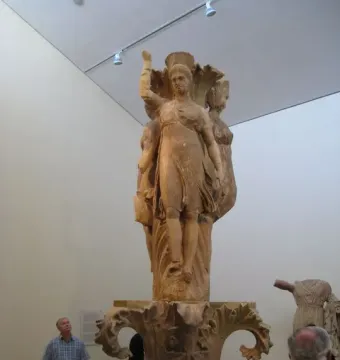
October 2008 © Yair Haklai · CC BY-SA 3.0
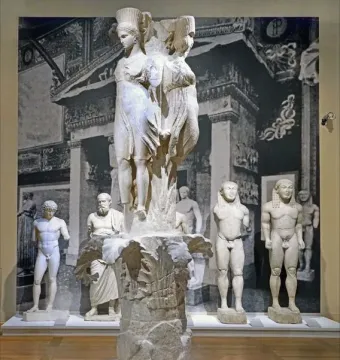
October 2021 © Jean-Pierre Dalbéra · CC BY 2.0
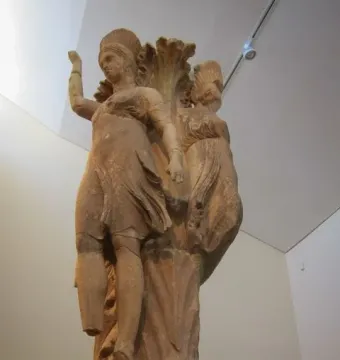
June 2013 © Sharon Mollerus · CC BY 2.0
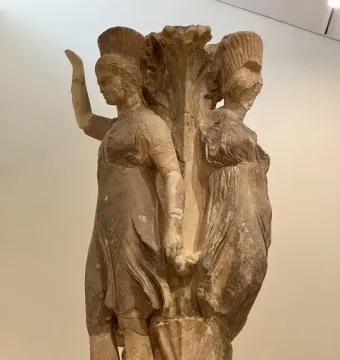
March 2022 © Chabe01 · CC BY-SA 4.0
Identification | |
| Title | Dancers of Delphi |
| Alternative names | Acanthus Column in Delphi; Acanthus Column; The Dancers of Delphi; Κίονας με τις χορεύτριες |
| Object type | Sculptural monument: a marble acanthus column with three sculptural figures at the top |
| Original French title | Les Danseuses de Delphes |
Historical context | |
| Art period | Classical Greek sculpture |
| Date | c. 330 BC; earlier proposals include before 373 BC and early Hellenistic period |
| Dedication | Votive offering by the Athenians; one later interpretation proposes a dedication by the Phocians as a fine for sacrilege against Delphi |
| Historical occasion | Traditionally linked to Athenian victory over Sparta, including Timotheos' naval victory at Alyzeia |
Creator | |
| Artist | Praxiteles (signature attributed, but disputed) |
| Possible commissioner | Timotheos |
| Associated workshop | Workshop of Cephisodotus the Elder |
Discovery and provenance | |
| Research milestone | 1963 research identified the findspot more precisely and rejected destruction in the 373 BC earthquake |
| Inscriptions found | Inscriptions discovered in 1983 on the surviving blocks and pedestal |
| Findspot | Near the sanctuary of Apollo Pythian at Delphi, on the terraces east and northeast of the Temple of Apollo; later research identified the remains at the northeast corner of the sanctuary |
| Original setting | North-eastern corner of the sanctuary, above the remains of the pediments of the earlier Temple of Apollo, between the Monument of Daochos and the so-called Corcyra base |
| Discovery date | Between May and July 1894 |
Physical characteristics | |
| Composition | Three sculptural figures |
| Reconstructed height | About 13 metres |
| Structure | Column of seven drums/cylindrical blocks with a capital and an upper extension |
| Base and support | Triple-stepped limestone base on a poros foundation |
| Surviving materials | Pentelic marble, limestone, and poros |
| Figure size | Each female figure is about 1.95 metres high |
| Column form | Acanthus-stem shape |
Materials | |
| Associated object material | Bronze tripod |
| Base material | Limestone blocks |
| Column material | Pentelic marble |
| Foundation material | Poros |
Technique | |
| Decoration | Capital decorated with acanthus leaves; each shaft block encircled by acanthus leaves, with three leaves turned downward at the bottom and three upward at the top |
| Construction details | The base consisted of six limestone blocks, with one block lost; the pedestal rested on a poros foundation |
Appearance | |
| Figure appearance | Three female figures in short tunics (chitoniskoi), barefoot, suspended in the air with raised arms and carrying kalathoi |
| Visual interpretation | The figures look like dancers, which is the origin of the monument’s name |
| Column top | The upper part of the column is surmounted by the three female figures |
Iconography and meaning | |
| Alternative reconstruction | A 2020 proposal by Didier Laroche and Anne Jacquemin interprets the figures as Brises (Aurai) placing Apollo’s tripod on its return to Delphi |
| Symbolism | The acanthus was considered by the ancient Greeks to be a sacred plant of Apollo |
| Mythological interpretation | One interpretation identifies the figures as the Aglaurides, linked with arable land and the growth of plants |
| Alternative identifications | Originally interpreted as dancing women; other proposed identifications are the Aglaurides, the three Thries, and Brises (Aurai) |
| Possible top element | A bronze tripod; one later reconstruction proposes a conical stone, vertical shaft, and horizontal disk instead |
| Associated object | Omphalos |
| Function | The figures were meant to support a bronze tripod whose basin contained or crowned an omphalos |
Location and ownership | |
| Current location | Delphi Archaeological Museum |
| Display context | The upper part of the column is displayed in Museum room XI |
History and restoration | |
| Restoration hypothesis | The monument may have been damaged, possibly by the 373 BC earthquake, and re-erected about fifty years later after repairs to the column and foundation |
| Inscription on base | A dedication by the Athenians and their allies, financed with war booty from the Lacedaemonians/Spartans, is preserved on the east side and plinth |
| Inscribed names | The inscription mentions the archons Hippodamas at Athens and Leochares at Delphi; 'PAN' on the base is interpreted as Pankrates of Argos |
| Signature | Praxiteles’ signature was reported below the dedication, but this reading is disputed |
| Dating evidence | Stylistic analysis, letter forms, and the monument’s relation to nearby structures have been used to date it to the late Classical or early Hellenistic period |
| Alternative dating proposals | Proposed dates include 375 BC, before 373 BC, after 334 BC, and around 330 BC |
Significance | |
| Influence | Inspired Claude Debussy’s first Prélude |
Other | |
| Findings about attribution and patronage | One proposal credits Timotheos with the dedication and suggests he may have commissioned the work through Cephisodotus the Elder, who entrusted it to Praxiteles |