
Warwick Vase
The Warwick Vase is a Roman marble krater with Bacchic ornament, discovered in fragments in 1771 in the mud of a pond at Tivoli, near Rome, on the grounds of Emperor Hadrian’s villa. Gavin Hamilton, a Scottish painter, antiquary, and art dealer in Rome, had the excavation rights there. The vase is estimated to date to between AD 118 and 133. It stands 170 cm high and measures 211 cm across including the handles. Richly decorated, it was not originally a flower container but a garden architectural ornament. The handles are formed by intertwined vine strands, and the body is decorated with acanthus leaves, satyr heads, and the head of Dionysus; the reverse side shows Ariadne instead of Dionysus.
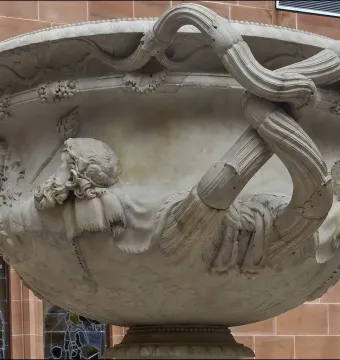
March 2012 © dun_deagh · CC BY-SA 2.0
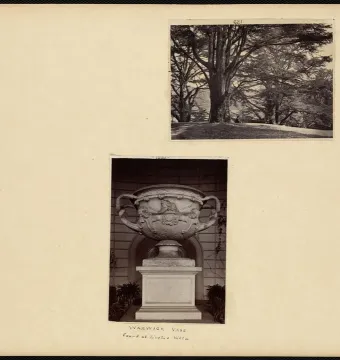
© Boston Public Library · Public domain
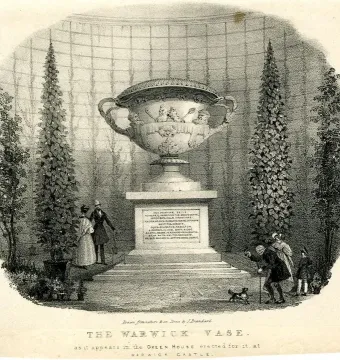
1845 · Public domain
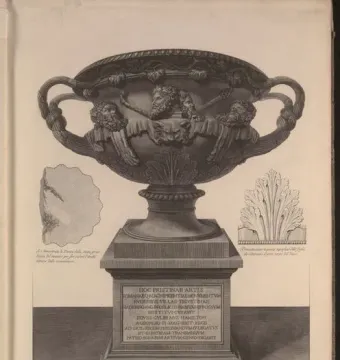
1800 © Unknown · Public domain
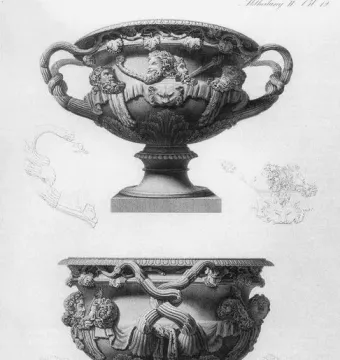
1821 © AnonymousUnknown author · Public domain
Identification | |
| Title | Warwick Vase |
| Type | Roman marble crater |
| Alternative names | El vaso Warwick; Vase of Hadrian |
Historical context | |
| Date | Early 2nd century CE, probably 118–133 |
| Origin | Ancient Rome |
Creator | |
| Discoverer | Gavin Hamilton |
| Discoverer occupation | Scottish painter, antiquarian, and art dealer in Rome |
Discovery and provenance | |
| Provenance note | The fragments were sold by Gavin Hamilton to Sir William Hamilton, then passed from Sir William Hamilton's collection to George Greville |
| Restoration specialists | James Byres and Giovanni Battista Piranesi |
| Purchase and restoration | Sir William Hamilton spent 300 pounds on purchase and restoration; the work took nearly two years and cost about 30,000 pounds in total |
| Discovery location | Hadrian's Villa, Tivoli, Italy |
| Subsequent owner | George Greville, 2nd Earl of Warwick |
| First owner after discovery | Sir William Hamilton |
| Discovery context | Found in several fragments in the mud or silt of a marshy pond at the lowest point of the villa's grounds; Hamilton had obtained excavation rights and drained the area |
| Discovery date | 1771 |
History and restoration | |
| Condition | Partially restored |
| Restoration note | Later restored and reassembled; the Ariadne head was apparently added in the 19th century by an Italian sculptor, though one account says the addition was made in the 18th century |
Physical characteristics | |
| Height | 170 cm |
| Width including handles | 211 cm |
Materials | |
| Material | White marble |
Technique | |
| Form | Monumental crater-like decorative vessel |
| Decoration style | Bacchic ornament |
Appearance | |
| Handle design | Two handles made of two intertwined strands of vine shoots, continuing below the rim with leaves and fruits |
| Lower body decoration | Acanthus leaves |
| Figural decoration | The wall is decorated with satyr heads, a silenus, and the head of Dionysus on one side, and a corresponding Ariadne head on the other; a feline head appears on the shield or pelt motif |
| Original function | Not a flower container at its original size, but a decorative element of garden architecture |
Iconography and meaning | |
| Style / inspiration | An imitation of ancient drinking vessels and classical antiquity in form and decoration |
| Historical precedent | Imitations of such vessels existed since the Late Hellenistic period and were especially placed in gardens and colonnades |
Location and ownership | |
| Current location | Burrell Collection, Glasgow, Scotland |
| Acquisition by current collection | 1979 |
| Former display location | Warwick Castle, Warwickshire, England |
| Former display context | Displayed in a specially built greenhouse or garden structure |
Significance | |
| Artistic significance | Considered one of the representative motifs of Roman decorative art |
| Popularity and reproductions | Became widely known in Europe, especially in the 19th century, and was reproduced in many sizes and materials; replicas and reinterpretations were made in iron, zinc, bronze, silver, cast iron, and other materials |
| Later uses | Used as a model for garden ornament vases, porcelain decoration, industrial design pattern books, and modern reproductions; the 2006 Australian Open winner's trophy is based on its form |